

Jews are obligated by their tradition to leave the Earth a better place than we found it. By most accounts, however, we are way behind schedule.
A new book of essays, stories and poems by prominent Jewish environmental activists attempts to show us the way forward. Edited by Rabbi Andrue J. Kahn, “The Sacred Earth: Jewish Perspectives on Our Planet” (CCAR Press) includes chapters by three Marylanders — Rabbi Nina Beth Cardin and her husband Rabbi Avram Israel Reisner of Pikesville, and Dr. Mirele B. Goldsmith, an environmental psychologist who lives in Bethesda.
Goldsmith, co-founder of the Jewish Earth Alliance, which mobilizes Jews to lobby Congress for climate solutions, says the book is emblematic of the “growth of the Jewish environmental movement and the Jewish community’s awareness of the climate crisis.
“I remember the days when all we had to draw … were some quotes that were pulled out of context,” she says. “I was so impressed with the depth of the articles [in ‘The Sacred Earth’]. It’s a book for the [general] public, but it’s rooted in deep scholarly work about Judaism and our Jewish texts and Jewish practices, and how we have to come together to confront the climate crisis.”
Rabbi Cardin, founder of the Maryland Campaign for Environmental Human Rights, also recalls when the work of the Jewish environmental movement seemed less urgent.

“In the 1990s, early 2000s, the Jewish environmental community was focusing on many issues which felt bad but maybe not catastrophic,” she says. “We were looking at localized pollution and some toxins, at changing our lightbulbs, recycling, maybe a little bit of composting, and it seemed like these were nice things to do and they were important things to do.
“But the sense that there is doom awaiting humanity wasn’t there,” Rabbi Cardin says. “And then you had [the 2006 documentary] ‘An Inconvenient Truth’ and people understanding what climate change was all about, and you understood there was species extinction, there was a potential for a runaway train in in global climate disruptions that we couldn’t control, and this jewel of a unique planet and all that depends on it is truly in peril if we don’t do something more and do something better.”
Goldsmith says the movement has matured in other ways.
“When we started with this, the environment was something separate that wasn’t seen as central to Jewish life,” she says. “One of the things that’s changed is an understanding that the climate crisis and the environmental crisis more broadly is related to social justice issues that have always — or for a long time at least — been at the center of Jewish concern. The awareness of environmental justice and social justice being at the center of the climate justice movement, and even the terminology changing from environmentalism to environmental justice and climate justice, that’s made a big difference in terms of Jewish communities being engaged and understanding these are Jewish issues. They’re not something peripheral to Jewish life.”
Both Rabbi Cardin and Goldsmith are impressed with the diverse perspectives, topics and lgenres reflected in “The Sacred Earth.” Some Jewish climate activists who contributed to the book include Rabbi Jill Hammer, director of spiritual education at the Academy for Jewish Religion and co-founder of the Kohenet Hebrew Priestess Institute; Rabbi Arthur Waskow, the Baltimore-born founder of the Shalom Center; Nigel S. Savage, founder of Hazon; and Rabbi Jennie Rosenn, founder of Dayenu.
“It’s not only the usual suspects who are in this book,” says Rabbi Cardin. “[It’s] a lot of people who evidently have been working in this field, either academically, theologically or just practically. It shows that sustainability is penetrating deeply into the sort of theological, cultural, practical DNA of the Jewish people.”

The chapter by Rabbis Cardin and Reisner, titled “Yishuv HaOlam: The Jewish Imperative of Sustainability,” explores the commandment to sustain a healthy, regenerative world.
“[Yishun haOlam] is the very first thing upon which everything else rests, starting with Genesis 1,” says Rabbi Cardin. “This is the foundation, the central organizing principle of Jewish law, values, ethics, structure, community. Make sure you have a livable environment … that your water is drinkable … your air is breathable … the soil is healthy so you can grow food. Make sure you can distribute food properly. Make sure you don’t benefit at somebody else’s expense or at the Earth’s expense. That should be the sort of a frame that guides our behavior and practices.”
While Rabbi Cardin and Goldsmith believe the climate crisis is the existential threat of our lifetimes, they are convinced there is hope. Goldsmith’s article uses the biblical story of Jonah to show how human behavior changes slowly but surely.
“What I was really trying to do in that chapter was bring social science research into the discussion and connect it with the story of Jonah and the Jewish tradition, because I think there’s so much that we can learn,” she says. “One of the things that I cite in that article is that there’s empirical research that shows that if 3.5% of the population get involved in a civic movement, that movement will be successful. The basic idea is that if everyone’s not involved doesn’t mean we’re not winning.”
Says Rabbi Cardin: “We’re still living with that sort of positive hopeful idea that everything will be OK. That mentality is going to destroy us and it’s going to destroy the world. We cannot be complacent any longer. We are a force of nature, the human collective as a whole, and we have to understand the power that we have and the impact that we have. Therefore, we have to take responsibility and do that intentionally. You don’t have to reinvent the wheel. … In your own communities, there are organizations you can get involved in, Jewish and non-Jewish. We need everyone to get involved.”
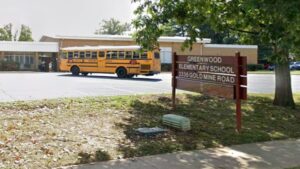
Schools in Montgomery County have recently experienced a wave of antisemitic incidents.
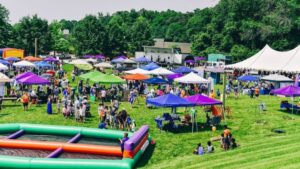
This year’s Community Block Party at the JCC of Greater Baltimore will feature classic cars, giant inflatables, games, a rock-climbing wall and roller skating rink, and strolling entertainers.

For 35 years, the late Deborah Brodie, aka Bubbie Cookie, amassed a collection of over 200 Jewish ritual objects, which she used to teach her Hebrew school students with special needs.
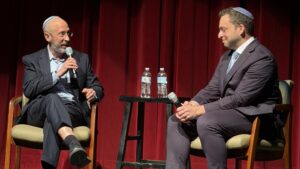
In a recent talk at Beth Tfiloh, Elisha Wiesel called on Jews to cultivate joyfulness in their faith and sense of community.