

When David Jacobs was growing up in Baltimore, there wasn’t much money around. Maybe that’s why he glamorized big bucks for all America when he created television’s “Dallas” and “Knots Landing.”
Jacobs, who died the other day at age 84, not only created those long-running shows, he invented the modern nighttime soap opera. And for better or worse, he taught America to look past the odious qualities of the shows’ characters and embrace their amoral, winner-take-all quest for money.
Growing up in Baltimore, where he graduated from Baltimore City College, Jacobs knew the working-class hunger for spare change, not the grabbing of big fortunes. His father was a part-time bookie. His mother, Ruth, a homemaker. When he wasn’t taking bets, the father, Melvin Jacobs, sold appliances, drove a cab, sold insurance.
David Jacobs had artistic dreams. He went to the Maryland Institute College of Art and graduated with a degree in fine arts. He moved to New York and tried making a living as a writer.
He married, divorced, moved to Los Angeles and found work in TV. He rewrote scripts that needed work. One was “Delvecchio,” with Judd Hirsch as a detective studying to be an attorney.
But it was “Dallas” that brought Jacobs the big bucks — and helped (again, for better or worse) change the culture of television and of Americans’ views about money. If you wanted a lot of it, you’d do just about anything to get it.
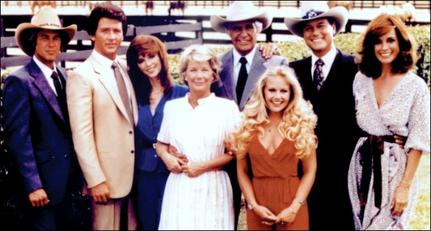
Before Jacobs’ creations, prime-time television in America was mostly about middle-class and working-class folks modestly working things out domestically. The accent was on family matters, not on their bank accounts.
When we watched “Father Knows Best” or “Ozzie and Harriet,” the scripts and the ideals (and the physical surroundings) were there to reflect sponsors’ goals. Love the Andersons, love the Nelsons, maybe you’d want the kind of products propping up their shows.
“Dallas” and “Knots Landing” brought in a world never imagined by the likes of Ralph and Alice Kramden.
Newspaper ads for “Dallas” boasted of “a family ruthless in its quest for power and passion.”
In a retrospective on the show, Texas Monthly magazine wrote, “’Dallas’ was trashy and campy. The Ewings … were single-mindedly devoted to ruining other people’s lives for money. The show upended our moral codes. … Nine years before Oliver Stone’s ‘Wall Street’ turned ‘greed is good’ into a mantra, the Ewings taught us ‘all that matters is money.’”
Did Americans agree with this kind of cutthroat capitalism? Maybe, maybe not. But “Dallas” and “Knots Landing” each ran for more than a decade, most of it at the top of the TV ratings.
They let viewers dream. Americans have always dreamed, but this time the dream was about obscene money and greed, and along with these came a vulgarity that was new to network television and American middle-class culture, and found its ultimate conclusion in someone named Donald Trump.
Michael Olesker’s latest book, “Boogie: Life on A Merry-Go-Round,” was recently published by Apprentice House. It’s the life story of Baltimore legend Leonard “Boogie” Weinglass, an original “Diner” guy who grew up to create the Merry-Go-Round clothing chain and contribute millions to char
As millions mourn the passing of Stephen Colbert from the airwaves, Michael Olesker looks back on the "institution" of late-night TV.

The BCO, founded in 1984, will perform the works of Frank Zappa, Beethoven, Mason Bates and Karena Ingram.

Led by local Israel-American cellist Amit Peled, the Mount Vernon Virtuosi aims to inspire people beyond musical enjoyment.

As he gets ready to leave for California, Rabbi Daniel Cotzin Burg looks back on his time in Baltimore and his 10 years writing for Jmore.