
Mount Washington-based writer Arthur J. Magida has developed somewhat of a niche writing about little-known World War II stories.
His last book, “Code Name Madeleine” (W. W. Norton & Co.), chronicled the life of a Sufi spy in occupied Paris, while 2011’s “The Nazi Séance” was about a Jewish psychic in Hitler’s inner circle.
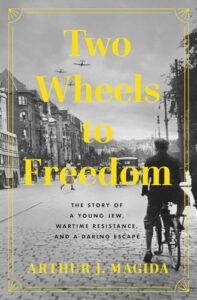
Magida’s latest book, “Two Wheels to Freedom” (Pegasus Books), tells the story of a German Jew named Samson “Cioma” Schönhaus who forged exit documents to help Jews and others escape the Nazis. When convinced his own safety was in jeopardy, he embarked on a dangerous escape, riding a bicycle from Berlin to neutral Switzerland.
Jmore recently spoke with Magida about the book, which Kirkus Reviews described as “an amazing story that would seem unlikely if it were not so well documented.”
Jmore: What led you to Cioma Schönhaus?
Magida: In 2010, while in Berlin doing research for my book ‘The Nazi Séance,’ I learned about a factory owner who hid deaf and blind Jews. That led me to Stella Kubler, who turned in Jews to save her own family. And that led me to her art school acquaintance, Cioma Schönhaus, who in 1943 offered to create a fake ID for her. The more I read about Cioma, the more excited I got about him as a book subject.
Cioma wrote a book about his experiences, and there was a feature film about him. Why did you feel it was necessary to write another book about him?
Cioma Schönhaus was a lot of things: a bon vivant, a romantic, an artist, a man of multiple aliases and a forger. What he wasn’t was a writer. His book told an interesting story, but not in a particularly interesting, compelling or even complete way. He didn’t give much detail, nothing about the ambience of the world at that time, nothing about his impressions, his fears, his own delights at pulling the wool over Nazis’ eyes. And I knew that I could tell that story much more effectively.
The book-worthy part of Cioma’s life happened during a three-year period in the 1940s. How did you decide how to write about his last 70 years until his death in 2015?
What I wanted to say in that last 12-page chapter was, ‘After you lose your parents, witness torture and almost get caught by the Nazis, here’s what you do: you go to college, raise a family, get a job and attempt to live your life as an ordinary citizen.’
You say that Cioma was the only person ever to escape the Nazis by biking to Switzerland. How can you make such a claim?
By now, I’ve researched Nazi Germany enough that I probably would’ve run across it either in interviews and people’s anecdotes or in archival material. The historians I told about Cioma’s bicycle journey were astonished. A translator at the Holocaust Museum in D.C. told me he’d heard of a few people who’d bicycled from Poland into Russia, but that wasn’t nearly as ambitious or hazardous as Cioma’s trip.
You’ve written books about religious etiquette and rituals, a rabbi who orchestrated his wife’s murder, and three books set in Nazi Germany. What’s the attraction to Jewish and religious themes?
I was born and raised Jewish. I’m not observant. I wish I knew more about the faith I was born into. I think Judaism has enriched me in many ways — religiously, historically, ethically, morally. In my teens, I got interested in eastern religions. And I was influenced by [spiritual leader] Ram Dass — another nice Jewish boy.
These books all speak to me in some way, whether about my own relationship to Judaism or more broadly about how religion affects people and cultures.

How has writing these books about Nazi Germany changed you?
Years ago, when my daughter wanted to visit Germany, I said, ‘Don’t you dare go to Germany! You know what those people are like.’ I’ve been scared of Germany since I was a small child. I’ve now spent over 12 years immersed in the country and its history, and I think it’s changed me for the better.
So many Germans were extraordinarily gracious. In various cities and towns, I’d see stones in the street inscribed with the names of the Jewish families that used to live there, the dates they were taken away. It was a constant reminder of where I was. But it was a constant reminder to the residents, too, of what their people had done.
Cioma came to terms with Nazi Germany because he remembered the Germans who had helped him. And I came to terms with Germany because of the current generation of Germans who are kind and generous. They haven’t ‘accepted’ but rather have tried to interpret their history and are trying to show that Germany is an entirely different land than it was in 1945. And I’m deeply indebted to them because they serve as an exemplar for the rest of us.
The Pikesville resident's latest offering "There's a Dragon in the Tree House and He Won't Come out!" was co-written with her grandsons.
A new biography captures the intensity and magic of the musical theater giant, writes Michael Olesker.
Emma Snyder, owner of The Ivy Bookshop, offers recommendations for must-read titles for adults and children.
Schwab currently serves as president of Cumberland's historic B'er Chayim Congregation.