

When people hear the word seder, they usually associate it with Passover, the reading of the Haggadah and the retelling of the Exodus story, the array of rituals and customs, the gathering of family and friends, the boisterous conversations and the big, festive meal.
But nu, five seders?
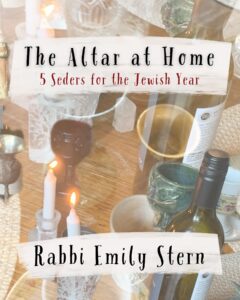
In her new book “The Altar at Home: Five Seders for the Jewish Year” (Blurb), Rabbi Emily Stern recommends adding more seders throughout the year to enhance one’s spiritual life.
Jmore recently spoke with Rabbi Stern, spiritual leader of Kol HaLev Congregation in Lutherville-Timonium, about the book.
Where did the idea of seders for multiple occasions come from?
Some of the ancient rabbis said when the Second Temple was destroyed around 70 C.E., the central altar was never lost but lives in each kitchen table, the place where families gather. And I thought about gathering for Passover seders, and that led me to the idea that a communal meal, especially a ritual meal, can provide space for a spiritual transformation.
A seder isn’t just a commemoration of the past; it also responds to the moment — the people at the table, the atmosphere and the issues of the time.
You describe multiple seders in your book. Did you make them up?
There’s a historical basis for all of them. The Tu B’Shevat seder grew out of Kabbalistic tradition originally, but now the holiday and the seder are also celebrated as a time for environmental awareness. The seder that I created moves you through the four worlds of action, formation, creation and endlessness.
The Passover seder, of course, we’re all familiar with, although I do some different things with it.
The Moshiach seder, on the eighth day of Passover, grows out of a Hasidic tradition that journeys into Messianic consciousness, a future of perfect harmony and peace. And you go on a metaphorical journey into a land flowing with milk and honey.
The Vach Nacht seder is the night before a baby’s bris. The idea of circumcision is difficult for some people, and this is a way to process it spiritually, emotionally and psychologically. It grows out of an Ashkenazi custom where the baby is believed to be particularly vulnerable and in need of protection, so the night is spent in prayer and study, and sometimes, in Hasidic communities, with a celebratory meal. This seder asks questions like, ‘With this ceremony, what are you giving to your child?’ and ‘How do you let go of stereotypes to be open to what the child presents to us?’
And the Rosh Hashanah seder has a long history in Sephardic — but not Ashkenazi — culture.
Rosh Hashanah’s coming up. Talk about that seder.
On Rosh Hashanah, the tradition teaches, there is a cosmic rewriting of your story for the coming year. Each moment of Rosh Hashanah is a mapping of our year, each of the 12 waking hours of the day aligned with the 12 months of the year.
This year at Kol Halev, instead of our usual second-day service, we’re going to have our first Rosh Hashanah seder.
As we gather for this meal, we have the opportunity to participate in this powerful, transformative time by bringing positive attention to the act of creation. We set intentions for each of the types of food that we eat, with blessings, with practices, with rituals. In doing so, we become more conscious of what our rewriting and hopes for the new year could be. We honor the food we eat as symbols of our prayerful hopes and intentions.
For example, the letters of the Hebrew word for honey, devache, add up to the same numerical value as the word mussar, which refers to ethical teachings. The Mussar tradition is about transforming oneself and strengthening our virtuous qualities. And like honey, the process of self-transformation can be slow, but it can also be sweet.
I get the sense from reading your book that you enjoy puns.
I do. One of the foods at our Rosh Hashanah seder is the carrot. The Hebrew word for carrot, gezer, sounds very much like gazar, the Hebrew word for decree. So the rabbis made a pun: Eating carrots on Rosh Hashanah eradicates any negative decrees against us.
So at the seder, we talk about ways that we assign negative judgments to our behaviors and personalities – ‘I’m not good enough,’ ‘I can’t,’ ‘People won’t like me’ — that sort of thing. And then as we prepare to eat our carrot, we say a prayer asking God to erase that negative judgment and replace it with a sense of merit.
Should we think of your book as a how-to manual?
No, not at all! I hope people will think of the structures and examples in my book as starting places. They’re not rigid services, but invitations to play, adding blessings and puns, interpreting food and ritual, and tying them back to their own lives.
“The Altar at Home” is available on Amazon and as a downloadable pdf from BLURB.com.
Jonathan Shorr is a local freelance writer.
For more than five decades, Dr. Rosenstein was known by local families as a trusted and caring physician for their children.
Jewish Community Services' upcoming "Future-Ready Workplace" event will feature a keynote address from workplace expert and bestselling author Liz Fosslien.
A Baltimore native, Sweren was a collector of artists' books whose own works were displayed in national galleries.

The BCO, founded in 1984, will perform the works of Frank Zappa, Beethoven, Mason Bates and Karena Ingram.