

By Asaf Elia-Shalev
Boris Z. Gorbis can talk for hours about what turned him into a tchotchkes collector.
At 74, he has amassed what’s most likely the world’s largest assemblage of Zionist souvenirs — mass-produced menorahs, napkin holders, seder plates, plaques and other mid-century souvenirs from Israel that once filled American Jewish homes but have since been discarded or forgotten.
To explain the roots of his obsession with “Israeliana,” Gorbis weaves together Jewish lore, philosophy and bursts of self-psychoanalysis. But then, interrupting his own pontificating with a flash of blunt candor, he lands on the truest and most immediate cause.
It was a singular moment in the 1980s when he was gathering old menorahs for a Chanukah program in Los Angeles and stumbled upon one particular candle holder.
The menorah’s brilliant emerald-green color dazzled him, as did its form: The candles rested atop a base shaped like a fist — the symbol of Lehi, the Zionist paramilitary group from Israel’s pre-state years.
“That was it,” said Gorbis. “That set up everything that would follow.”
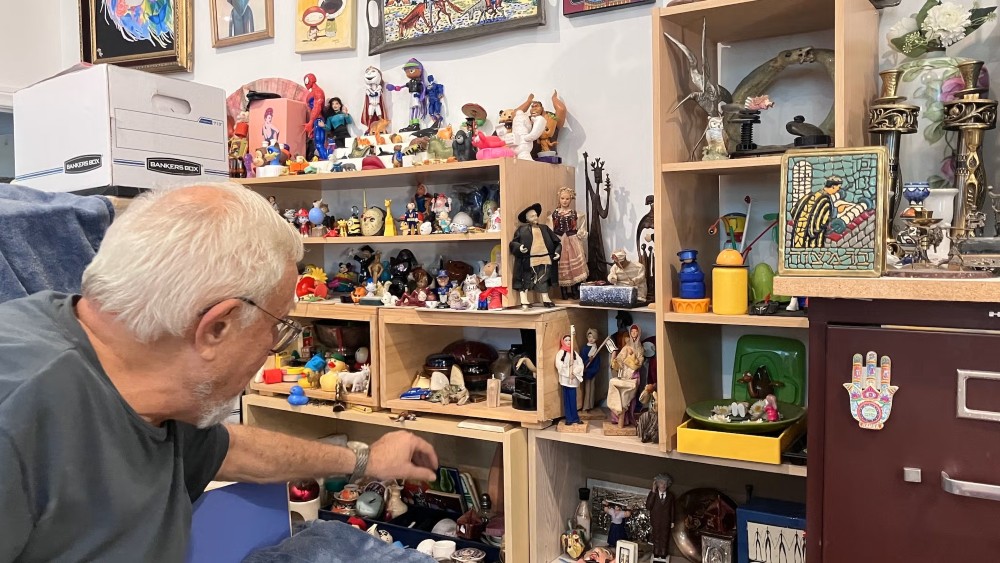
What would follow was an accumulation of hundreds of thousands of items that have overtaken Gorbis’ Hollywood Hills mansion (and a rented storage space) and set him on a now-urgent mission. He aims to find a home that can outlive him for a collection recalling a bygone era in Jewish history, a challenge made all the harder by a political climate shaped by the war in Gaza.
“A full-throttled exhibition about Zionist paraphernalia right now? I don’t see it happening,” said Dr. Jenna Weissman Joselit, a historian of American Jewish life and material culture at George Washington University. “And if it did, I could only dimly imagine the reception it would receive.”
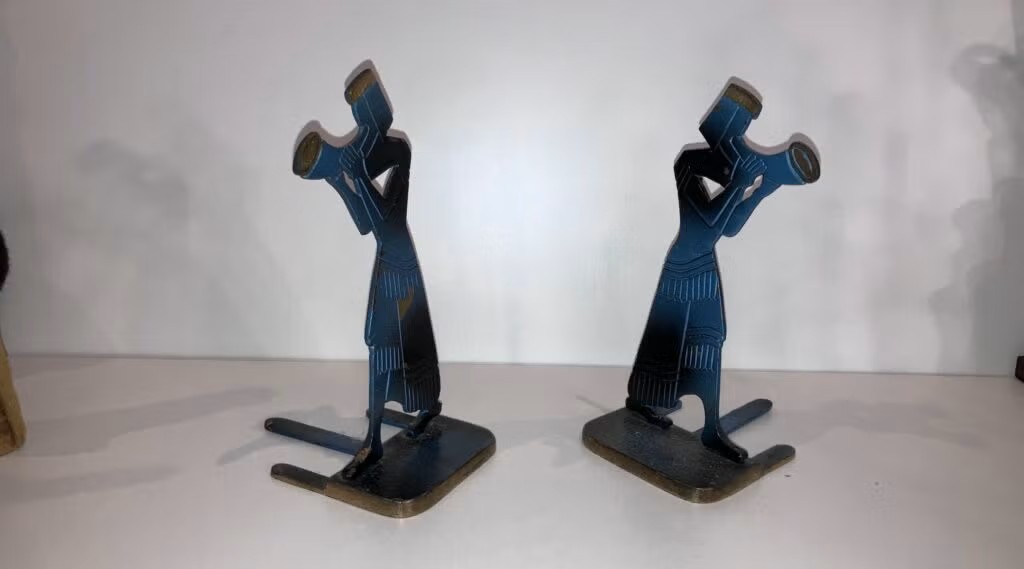
In the decades after Israel’s founding, souvenirs cast in alloy and painted in faux-patinated green to look like copper or bronze were widely collected by American Jews.
Joselit said these objects were intentionally designed to feel simultaneously ancient and contemporary.
“These objects harked back to King Solomon’s copper mines, but were constructed with a very modern geometry,” she said. “It’s a perfect symbol of this new construct of Israel that isn’t so new in many ways. Israel played on these currents, presenting itself as phoenix. And people wanted a little piece of that romance for themselves.”
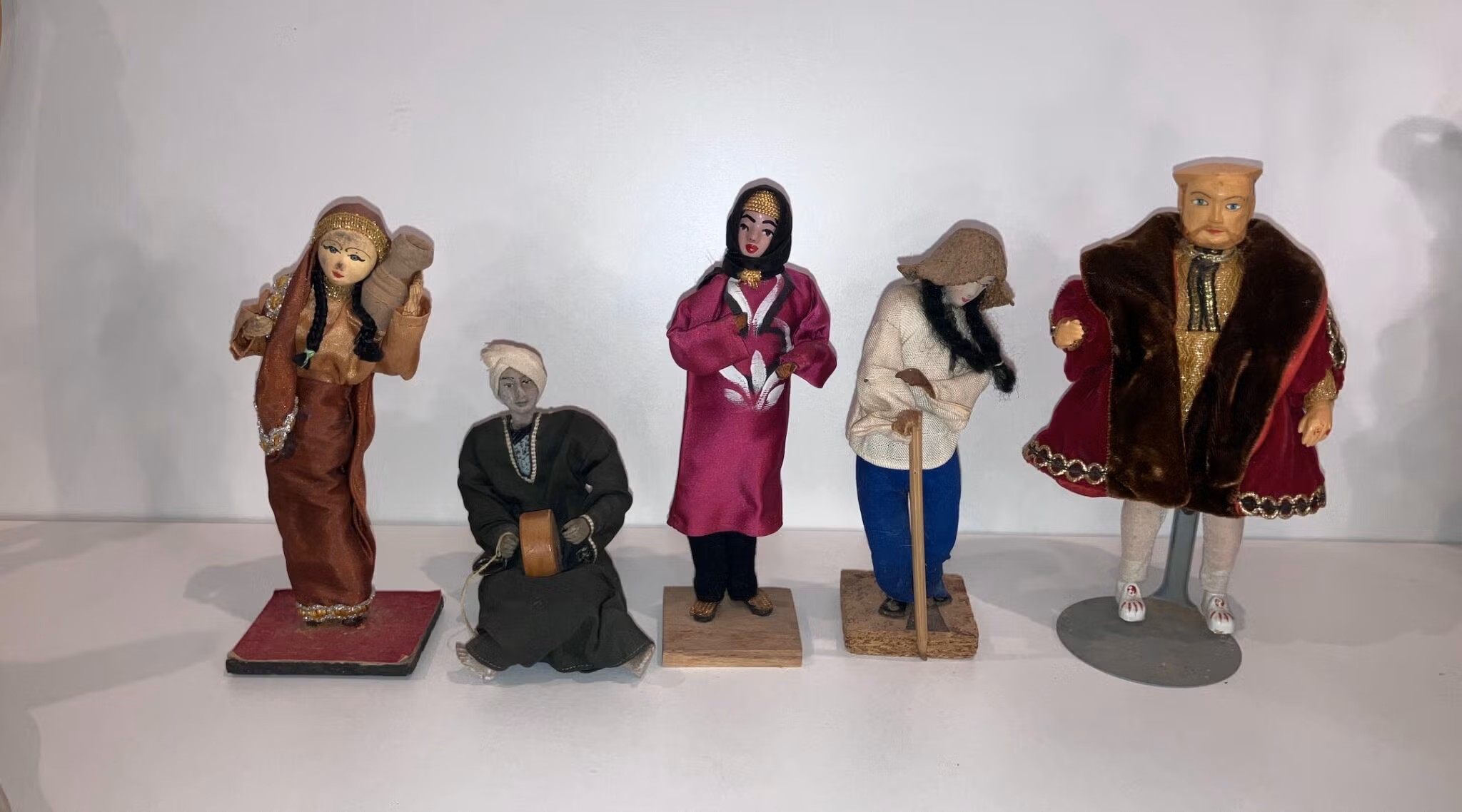
American Jewish tourists filled their suitcases with all manner of bric-a-brac: matchbooks from restaurants, postcards showing ancient landmarks, biblical figurines, ashtrays and coasters lavished with renderings of grapes, olives and lions.
Gorbis’s collection totals an estimated 200,000 items, including such ephemera as historical photographs, documents, books, trinkets, plates, statuettes and musical records.
(Photo by Asaf Elia-Shalev via JTA)
Few of the items are worth much on their own. Many of the relics were mass-produced in Israeli workshops and meant for sale as tourist paraphernalia. Gorbis scavenged the items one at a time from thrift stores, garage sales and, later, on eBay.
“It’s evidence of the love affair that existed between Americans and the entire idea of a Jewish home,” he said, lamenting what he views as today’s less enchanted relationship between Israel and the Diaspora.
But a small group of collectors and scholars have begun to take these objects seriously, not despite their kitsch value but because of it.
Rachael Goldman, a professional appraiser and historian, has spent years researching the origins and makers of these souvenirs. She has identified and cataloged more than 30 companies that once produced this material, such as Pal Bell, Dayagi-Hen Holon, Fantasia and Hakuli.
“It’s hands-down the best collection I’ve heard of,” she said of Gorbis’s treasure trove.
Consumed by Kitsch
With his advancing age, Gorbis’s desire to find a permanent home for his collection raises a universal challenge: What happens to all of our stuff after we die? Particularly when, as is so often the case, it is simultaneously invaluable but not very valuable at all?
Trying to answer that question can bring anguish and the deeper concern of wondering what one’s legacy is worth.
Gorbis’s house is located on a hillside sloping down from the road, which makes it look small from the street. Art is everywhere, and Gorbis sleeps surrounded by bookshelves, cabinets and tables packed with books and artifacts, with only a narrow access point for him to get in or out.
His poor health has limited his mobility, so the bedroom is where he receives visitors. It’s also where he smokes cigarettes, oversees his art projects (figurines assembled from miscellaneous plastic parts) and dines.
In a slight Old World accent, Gorbis shared the story of his collection and how he used to run something called the “America-Israel Museum” out of a law office housed in the onetime headquarters of Hustler publisher Larry Flynt. It’s a juxtaposition that Gorbis seemed to find amusing rather than incongruous. His lease ran out years ago, and most of the collection is now in storage.
“I felt passionately consumed by protecting these things and preserving them, bringing them in one space, believing against all evidence I’m doing the job that should have been done and that people will see how necessary it was,” he said. “In the 30 or so years that I’ve been doing this, for reasons I cannot comprehend, I could not create alliances. All the appeals, all the letters I wrote to Danny Danon [Israel’s ambassador to the United Natons] and [former Israeli President] Reuven Rivlin and others. The worst part of it, I didn’t get a single response, not even an acknowledgement.”
Passionate collectors with compelling personal visions are essential for cultural preservation, but that doesn’t always translate into institutional acquisition, said Dr. Josh Perelman, senior advisor and former chief curator at the Weitzman National Museum of American Jewish History in Philadelphia.
(Photo by Asaf Elia-Shalev via JTA)
Perelman said collections like Gorbis’ can hold deep emotional and cultural resonance, and reflect aspects of American Jewish identity and the relationship with Israel that are worth preserving.
But for museums, practical concerns often get in the way: limited storage, finite staffing and the need to align with curatorial priorities.
“Agreeing to take something into the museum’s collection is a commitment to preservation in perpetuity,” Perelman said.
Despite the perceived lack of interest from institutions and decision-makers, there’s intellectual validation for Gorbis in the corners of academia that take everyday Jewish material culture seriously.
“These aren’t rare objects,” said Dr. Laura Arnold Leibman, a historian of Jewish material culture and the president of the New York-based Association for Jewish Studies. “But that’s exactly what makes them powerful. They show us how ordinary Jews once expressed identity in daily life, not in a synagogue, but at the breakfast table or in a guest room. That’s what most archives leave out.”
As an example of such an item, one that wouldn’t normally be preserved or readily fit into a museum collection, Leibman mentioned a small silver teaspoon that her grandmother brought back from Israel in the 1950s.
“It was just a little piece of junk,” she said. “But for me, it’s more than that. It’s my grandmother saying, ‘This is part of who I am.’ It’s an object that signifies that she thought it was worth remembering.”
Paradoxes & Guilt
The next generation inherits not just the object but the dilemma of what is worth preserving.
“Many people like me, when they’re taking apart their parents’ or their grandparents’ houses and sorting through everything, face these questions,” Leibman said. “Of the countless objects in my grandparents’ house, how do I decide which to keep and pass on?”
Gorbis opted for maximalism, an outcome he regards as a “paradox,” given his life’s trajectory.
Born and raised in Odesa, Baltimore’s sister city in Ukraine, Gorbis left the former Soviet Union in the early 1970s. At a way station in Vienna, he was given a choice relocate in the United States or Israel.
“I really didn’t feel like being in another collectivist paradise and paying a price for belonging,” he said of Israel, so he chose the U.S.
In Odesa, Gorbis studied nuclear engineering and linguistics, specializing in the history and literature of Romance and Germanic languages. After immigrating to the U.S., he became a lawyer, beginning his practice in 1980, the same year he was naturalized as a U.S. citizen. He specialized in consumer rights and personal injury cases.
In Los Angeles, he met his wife, Eda, an immigrant from the Georgian capital of Tbilisi. She is a clinical psychologist known for treating anxiety disorders, particularly obsessive-compulsive disorder and body dysmorphic disorder. They have two sons.
In 1980, Gorbis joined an effort to launch a cable network dedicated to Jewish audiences. Later, he helped found the Chabad Russian Synagogue in West Hollywood. He also served on the boards of the Los Angeles Jewish Community Relations Council and the American Jewish Committee.
As he settled into life in the U.S., Gorbis noticed something: American Jews were dispensing, on a wholesale basis, with the old knickknacks acquired by their parents or grandparents in Israel’s early days.
(Photo by Asaf Elia-Shalev via JTA)
“From where I stood, it seemed that buying the items was a belated effort by American Jews to surround themselves with symbolic and tangible proof of the Jewish state’s existence in order to deal with the shame and guilt of having betrayed their European brethren [during the Holocaust],” he said.
The children inherited the relics but not the burden, according to Gorbis’s view. “These tchotchkes did their job extinguishing a generation’s guilt and shame,” he said. “Those who came after didn’t dwell on the issue and didn’t need these sort of symbolic communicative devices anymore.”
If the heirs to these items didn’t think they were worth preserving, what made Gorbis see things differently?
“Having rejected belonging to Israel, what made me expend an absolutely inordinate amount of effort, time, money [and] resources, and derive pleasure from doing this?” Gorbis asked.
His answer arrived belatedly after Hamas’ Oct. 7, 2023 attack on Israel and the ensuing war that has challenged both the perception of Israel and the very ideals enshrined in his collection.
“I only recently admitted it to myself,” he said. “I think I was prompted to collect all this stuff by the fear that Israel is about to be wiped off, going to disappear. But some memory of it, some tangible pieces should remain.”
Asaf Elia-Shalev is a senior reporter with the JTA global Jewish news source.

Container vegetable gardening is a terrific option for people with limited space and/or time. Rebecca Brown and Norman Cohen share some tips.

Filmmaker Justin Schein looks at wealth and inequality through the very real story of his late father.

For 35 years, the late Deborah Brodie, aka Bubbie Cookie, amassed a collection of over 200 Jewish ritual objects, which she used to teach her Hebrew school students with special needs.

Conceived by Columbia resident Benjamin Kintisch, "Life Review: The Hospice Musical" offers a thought-provoking and occasionally amusing perspective on mortality.