
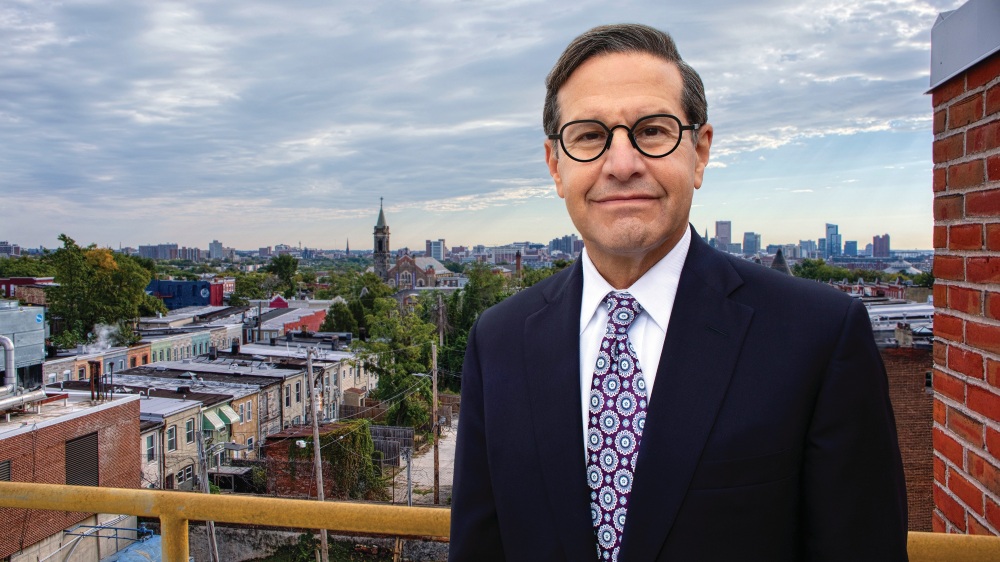
Anyone who knows Neil Meltzer knows he deeply values the precious and fleeting nature of time.
All around his spacious, tastefully decorated office at the Owings Mills headquarters of LifeBridge Health, you’ll find a number of clocks, large and small, placed pivotally around the room.
“The reason I have clocks everywhere is because my very first boss said to me, ‘You should never look at your watch during a meeting — ever,’” says Meltzer, LifeBridge Health’s president and CEO since March of 2013. “So you need to have clocks positioned around your office, because I know that when I’m looking out of the corner of my left eye, if you’re overstaying your welcome.”
He says this with a disarming smile and a twinkle in his eye. But after nearly four decades with the Baltimore-based health care organization, Meltzer, a Boston native who lives in the Lutherville-Timonium area, has decided the time is right to move on.
Last March, he announced plans to retire and has set his departure date for June 30, 2026. The LifeBridge board of directors is currently conducting a search for Meltzer’s successor.
LifeBridge is one of the state’s largest health care organizations, operating hospitals, outpatient centers and community-based programs throughout the region. The system includes Sinai Hospital, Northwest Hospital, Levindale Hebrew Geriatric Center and Hospital, Carroll Hospital and Grace Medical Center, as well as such subsidiaries and units as LifeBridge Health & Fitness.
For its annual “Innovations in Health Care’ issue, Jmore recently caught up with Meltzer, 69, to discuss his future plans, the evolution of LifeBridge Health over the years, and developments, innovations and challenges in the health care field.
Why did you decide now was the time to retire?
I actually decided two-and-a-half years ago. I had a three-year contract that was renewed, and I knew at the end of three years I would be at that point north of 70 and have been here for 38 years. I’ve seen too many colleagues and friends get sick and pass away. I didn’t want to go out on a stretcher.
I also was proud of the fact that we accomplished an awful lot. The most recent thing I’m really proud that we accomplished was the Regional Medical School for Sinai Hospital with George Washington University. Between that, the Center for Hope, The Family Tree, The Iron Pipeline — these are all things we’ve done recently that I felt were successes of LifeBridge Health. The Center for Hope is a national model, and I’m really proud of that.
Are you truly retiring?
[Laughs] I think I’m failing the word retire. I am involved in a number of startup boards and organizations and universities. I will be busy. In fact, I was recently asked to join the advisory board of a company out of Israel called Agado Live, and I’m still on the board of imadi and the Hippodrome Foundation. Plus, I’m on the advisory board of the GetWell Network in Bethesda.
So that’s my ‘retirement.’ But I’m not leaving Maryland. I hope to spend a little more time out of Maryland, but more time with my grandsons who are in Maryland.
I’d like to not be getting up at 4 o’clock in the morning and at my desk by 7, which I’ve been doing for about 45 years
Are you amazed when looking back on how much LifeBridge Health has transformed in recent decades?
I started here the day after Thanksgiving in 1988 and it was Sinai Hospital. Then, Levindale merged into Sinai and then at some point Northwest Hospital merged into the Sinai Health system, and we became LifeBridge Health. After that, I was named president of Sinai Hospital when Warren Green left, and I became CEO of LifeBridge Health.
We now have 135 sites across the state, southern Pennsylvania and northern Delaware, with about 14,000 employees. We’re about $2.3 billion [in] revenue. And unlike the other major health systems, we subordinate the LifeBridge name to the individual hospitals because we believe people relate to their local provider and hospital. So rather than say ‘LifeBridge Sinai’ or ‘LifeBridge Carroll’ or ‘LifeBridge Grace,’ we are individual hospitals but part of the LifeBridge Health system.
How has LifeBridge evolved during your tenure?
When I assumed the position 13 years ago, it was less than half the size it is today. During my tenure, it’s more than doubled in size.
We’ve expanded with Grace Medical Center, with Carroll Hospital, with The Family Tree, the Baltimore Child Abuse Center, with Springwell [Senior Living Community].
We really have the full continuum of care, from wellness with LifeBridge Health and Fitness — which was my very first project — all the way through hospice, BridgingLife Hospice, which is at Carroll, Northwest and Sinai.
So the search is on for your successor?
Yes. We’re looking for someone to step in the shoes sometime before my official retirement date, hopefully by the beginning of the year. There are many connections I’ve made here on the federal and state levels, local donors, people I really need to personally introduce my successor to.
This place is a part of my life. I’m not going to leave it in a lurch. I would never leave this place until it’s in the right hands.
Will you be serving as a consultant to the system?
Not formally. But I will be available to my successor, to our chief philanthropy officer, to anyone who needs me.
When arriving at Sinai, you planned to only stay for five years. What changed?
I fell in love with the community. One of the things I realized was it is a very warm and welcoming community. I drove down here with a 2-year-old in the back of my Plymouth station wagon, listening to ‘Baby Beluga’ by Raffi. Originally, we planned to return to the Boston area and raise our family in the shadows of our extended family. But what I liked about Baltimore was it was a very tight community. Both my wife and I grew up in very Jewish households, and I think Baltimore — certainly Pikesville and Owings Mills — felt like home.
But I also saw a lot of potential in Baltimore. To be honest, I’m a little disappointed that the renaissance here didn’t play out, but I’m still hopeful it will. I think Baltimore is moving in the right direction. With the reduction of violence, I think there’s a chance, there’s hope. I got involved with the Baltimore County Economic Development Council because it’s an opportunity for me to continue my focus on improving the communities around us.
You started working at a young age at your father’s drug stores in the Boston area. How did that shape your career?
Besides learning a little bit about health care by working at his drug stores, he had one particular store where not everyone could afford the pharmaceuticals or things he sold. So he would barter and trade, and people would bring him lasagna or food in return for medication. He saw that as his obligation to make sure the community stayed healthy.
Did that help inform your work regarding health disparities in the community?
Yes, I think it has. I worked in hospitals in and around Boston, from very wealthy communities to communities that are very inner-city, and I realized there’s a health equity gap in this country. We’ve been trying to develop a lot of community programs. We have around 45 community programs we provide in and around all of our hospitals, and they’re all focused on keeping people healthy and at home.
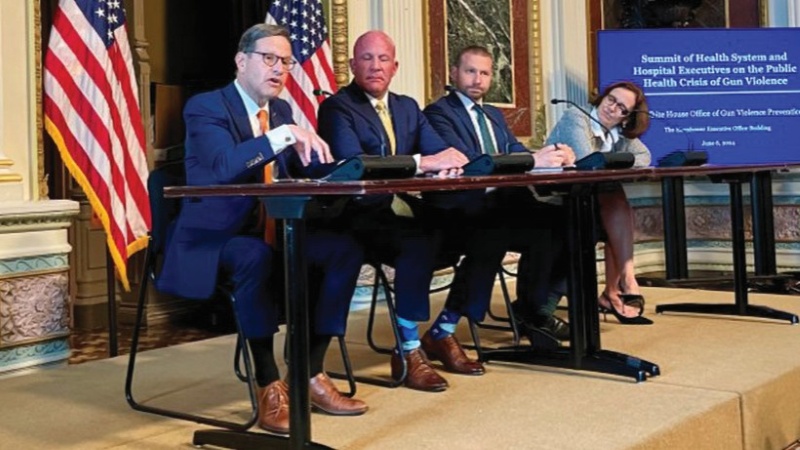
Every organization has its own personality and reputation. I’ve been told we’re the organization with a community conscience. We really try to support the communities around us, and part of the reason Center for Hope came about was we recognize that violence is a community health issue. With The Iron Pipeline, we saw violence is an issue that everyone was studying but nobody was doing anything about. The vast majority of gun violence in Maryland was being promulgated through guns trafficked up I-95 from Georgia, South and North Carolina, and we’re going to do something about it.
How did you get involved with health care?
I have a public health degree, but I never set out to run a health system. My background is really health and nuclear physics, studying the impact of nuclear power on the environment.
Back in the ‘70s when the [Yankee] Rowe Power Plant [in western Massachusetts] was the second one coming up, I was at Amherst and a tree-hugger, but there were no jobs for world-savers back then and I realized I could have a positive impact on a community besides hugging trees. I came to Baltimore and felt this was my calling. I feel good about what we’ve done.
Where do you feel LifeBridge fits into the regional health care scene?
We’re hyper-focused on our local communities, and it shows. The loyalty is there and the longevity of our staff — we have many employees who have been here 35, 45, more than 50 years. It’s a testament to the culture we’ve created, and it predates me.
I’m proud we’ve been able to continue that. I get to accept the accolades of the organization for the role I play, but this is a team sport. Everything good that happens is because of the team.
Do you ever worry about organizational overgrowth?
No. I think if you don’t grow, you fall behind. Every organization is growing. What we do better is we don’t necessarily follow the pack. When we’re told we can’t do something, we find a way to do it.
For years, people here wanted to build a medical school and tried and were told it couldn’t be done. And we did it, and I’m proud of that. People underestimate us because of our size. I think we punch above our weight.
Do you envision LifeBridge continuing to grow?
I certainly hope so. We’re expanding all of our emergency departments because demand is insatiable right now. And with our ExpressCare Urgent Care Centers, they’re busy and we continue to expand those as well.
What did you learn from your predecessor, Warren Green?
I learned a couple of things from him and my very first boss. They were very similar. They were both very humble individuals and taught me that to be a successful leader, people have to be able to relate to you. You’ve got to be vulnerable, someone that people can understand and recognize and relate to.
What are some of the innovations going on at LifeBridge these days?
I think where we’re going, at LifeBridge and with health care in general, is predictive analytics, using Artificial Intelligence to leverage what we’re doing using generative AI. One of the problems health care is facing is a shortage of staff generally. What AI is allowing us to do is leverage the staff for the populations we serve.
AI is very conversational now and it’s working in many organizations, including ours. We’re using it for ambient listening, to take notes. It is reviewing information behind the scenes to alert providers when a patient is souring. We’re using it for scheduling, and I think you’re going to see the technology generally moving organizations forward. That kind of information is helping clinicians identify situations that may occur in advance of anyone getting sick.
There’s a lot of in-home monitoring going on right now and being fed to our internal tracking system. We have nurses sitting behind a camera and giving patients discharge instructions. Every room will be a ‘smart room,’ we’ll be doing that systemwide.
The world is changing. It will be barbaric for waiting for someone to get sick before you start treating them. All of that information creates a profile for you and your siblings and children, in the likelihood of getting certain illnesses.
Do you feel there is still a lot of fear about AI?
I think less so. It’s everywhere and it’s been used for a long time, in radiology and cardiology for probably decades. It’s embedded in some of the equipment we have now.
Do you worry it will replace the human dimension of medicine?
I don’t think there’s a replacement for the human touch. But I think some of the technology is so incredible that it’s almost difficult to discern if you’re talking to a human or not. We’re just at the early stages.
How about robotics?
Generationally, the new surgeons are learning in robots. For certain things, I think it makes sense. I’m not sure it’s ever going to replace humans because humans still need to manipulate the levers to make the robots work.
But besides surgical robots, we have robots delivering medications all around the organization. I recently spoke with a company out of Sweden that is developing a robot that will live with an elderly person who’s living alone, to assure that the person is safe. You can give it verbal commands in plain English and it will react. It will follow you around, and it looks almost like a basketball.
Another Swedish company I recently spoke with has developed a ‘smart shoe’ that will determine if you’re likely to fall and can produce a certain vibration which does something to prevent the fall.
What do you view as the major challenges faced by health care today?
The shortage of primary care physicians nationally is a major concern. And I think, unfortunately, the reimbursement system in the country right now doesn’t encourage the development of primary care. Individuals are coming out of medical schools with huge loans and they need to work in a field that will allow them to pay back their loans.
There is a nursing shortage, but we’re seeing some stabilization right now. Our turnover is way down as an organization. At the start of the shortage in the early ’90s, we recruited 500-plus nurses from the Philippines and they’re wonderful nurses. We jumped early and it’s been successful for us.
Will virtual medicine ever supplant in-person visits?
I don’t think so, but there’s a lot you can do virtually. We now have a virtual hospital, with physicians seeing patients from in front of a computer. It seems to work, and people are comfortable with it.
At some point, I think there will be some kind of combination of virtual care and wearables that are much more elaborate than they are today to feed information to a physician on the other side of a camera, to perhaps be more exact in terms of following the patients.
Shifting gears, do you consider LifeBridge a faith-based organization?
LifeBridge is non-denominational, but both Sinai and Levindale are Jewish heritage organizations. Sinai was the founding member of LifeBridge and is the most comprehensive of all the hospitals that are part of LifeBridge Health.
Sinai really came about because Jews and Blacks were being discriminated against from residencies locally. People say there’s a certain comfort and spirituality when you enter Sinai and Levindale, a certain feeling of being at home, whether it’s the mezuzahs on the doors or the rabbi walking through the hallways.
I think that’s all part of the ethos of LifeBridge. We’re there for the community and to help all members of the community. That’s important to us. We’ve taken a look demographically and found that on any given day, half the Jews that live in our region are hospitalized at Sinai. I think it’s because of location but also heritage and comfort.
What do you view as LifeBridge’s specialties?
I think for our communities at least, it’s orthopedics, the neurosciences, physical medicine & rehabilitation, women’s services and pediatrics. We also have a very strong oncology department, and we have, unfortunately, one of the fastest growing pediatric cancer programs in the region.
We do research but it’s more based on patient-care research and focused. We do clinical trials and things of that nature.
Where do you see LifeBridge in 10 or 15 years?
I really hope we’re a thriving organization that maintains its community focus. I worry about this country today and the impact it’s having on health in general and us as an organization. I think all of the health care institutions in the area have been impacted negatively by what’s happening in Washington, D.C.
My hope and desire is we continue to grow and thrive, and flesh out our community-based services and continue to be seen as a shining example of what a community health system truly is.
I’d love to see the students going through our medical school come back as residents and serve our communities. We wanted to create a feeder system for our community.
Are you concerned about the national climate right now?
It’s a very scary time. Like other organizations in the city, we’ve lost federal funding for certain community programs. Unfortunately, the federal government doesn’t necessarily understand the impact of some of the decisions that have been undertaken. It’s very sad.
How do you stay inspired?
I think everyone has to have hope. Without hope, you fail. My role in this organization is not only to be a visionary and keep it moving forward, but to be a cheerleader and give people hope around the organization. In this very scary time, I try to stay focused on what we’re about.
Our purpose, the reason we exist, is to create healthier communities. If we keep people focused on our mission, we can achieve our goals
What was the best advice you ever received in the field?
To be relatable, to be vulnerable, not to be afraid to be human. Otherwise, you can’t lead. People are shocked when I say this, but I tell people, ‘Loosen the tie and become relatable.’
I want people to feel comfortable talking to me. My predecessors always went by ‘Mr.,’ but I’m just ‘Neil’ to everyone. That’s all I’ve wanted to be.
Fast Facts about Neil Meltzer
| • Joined Sinai Hospital in 1988 as vice president of operations, and was appointed the position of president in October of 1998. |
| • Appointed president and CEO of LifeBridge Health in July of 2013. |
| • Received a bachelor of science degree in public health from the University of Massachusetts Amherst in 1978. |
| • Received a master’s degree in public health and health administration from Tulane University in 1981. Also received an American Public Health Fellowship in 1979 and 1980. |
| • Following his administrative residency at the Lahey Clinic in Boston, was employed as assistant director of the Boston University Medical Center and Health Policy Institute, and vice president of operations at both Nashoba and Emerson hospitals. |
| • In May of 2009, received an honorary doctoral degree from the University of Maryland. |
| • Lives in Lutherville with his wife, Ellen, and has two adult children and two grandchildren. |
| • Named one of the state’s “Most Admired CEOs” and an “Influential Marylander” by The Maryland Daily Record. Also inducted into the Baltimore Sun’s Civic Hall of Fame in 2020 and the Baltimore Jewish Hall of Fame the following year. |

Schools in Montgomery County have recently experienced a wave of antisemitic incidents.
CCBC Honors scholars are discovering a level of academic rigor and opportunity typically associated with elite four-year institutions.
Filmmaker Justin Schein looks at wealth and inequality through the very real story of his late father.

This year’s Community Block Party at the JCC of Greater Baltimore will feature classic cars, giant inflatables, games, a rock-climbing wall and roller skating rink, and strolling entertainers.