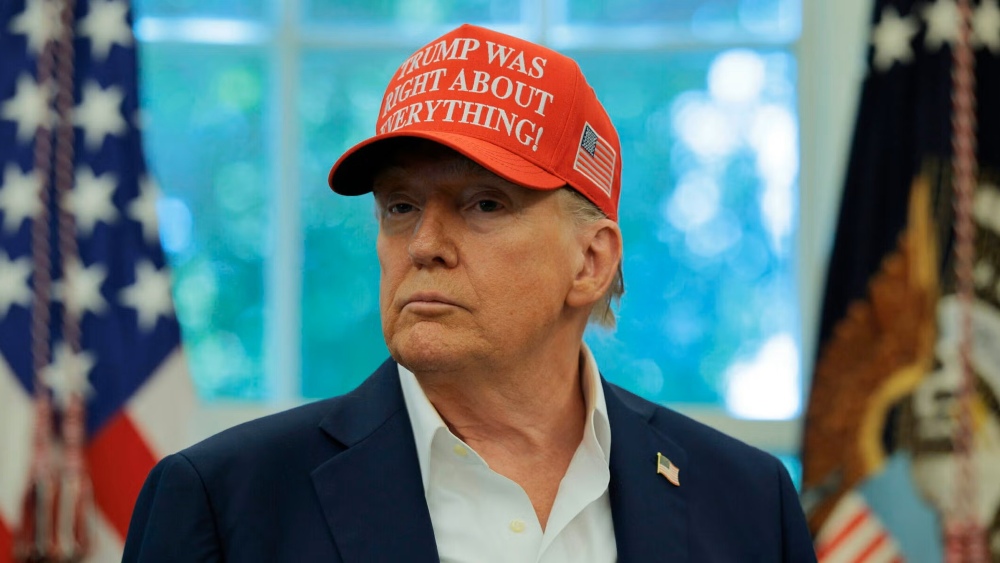
Now that the president of the United States has snatched away the arguable glory of a second-hand Nobel Prize, I can tell him from past experience that everything that glitters is not necessarily gold.
He can take that information straight from me or from local TV legend Richard Sher, whomever Donald Trump wishes to consult.
This president, the only one on the planet who has ever openly lobbied for a Nobel Peace Prize, recently applied so much pressure on the true winner of the award, Venezuela’s Maria Corina Machado, that she caved in and handed it over to him.
That other great Machado, first name Manny, never made such an error when he played for the Baltimore Orioles, I can tell you that.
Trump lobbies for the “peace” prize at the same time he’s spent the past year ordering military strikes on several continents and threatens now to invade our longtime NATO ally Greenland.
But enough about Trump. I was talking about the true value of distinguished prizes, such as a couple of honors received back in the distant era when I was truly a big shot in this town.
Such as the time the old Light Street Deli asked for a photograph of me they could put up on a wall.
Or the time the old dance club, Girard’s, asked me to judge a highly prestigious contest involving wet T-shirts.
And then the big honor: Baltimore magazine put me on a list of “Power Lunching,” one of 11 people “whose very presence at your lunch table will lend celebrity status and prestige to your image.”
And the magazine had a second list, which said, “Some people have it, some don’t: 10 local non-celebrities who can do little to advance your reputation as a Power Luncher by appearing at your table.”
And on that list was Richard Sher.
Yeah, Richard was some loser. At that time, he was co-hosting WJZ-TV’s “People Are Talking” with a young woman named Oprah Winfrey. The show dominated the local TV market and was the highest-rated local TV talk show in the country.
He also anchored the station’s No. 1 rated weekend news and hosted “Square-Off,” the public affairs show that’s still being streamed 40 years later.
And so, looking at the two Power Lunch lists, I naturally decided to take Richard to lunch.
Me, the Powerful Guy, and him, the Pipsqueak Luncher. (At least, according to Baltimore magazine.)
We went to Sabatino’s in Little Italy. Right away, a couple of cooks came out of the kitchen to say hello. To Richard, that is. Then a car salesman, a bookmaker, a guy in construction work, and a couple of women who just hovered over Richard batting their eyelashes.
“Uh, the Light Street Deli wants my autograph,” I explained to one of the women, who appeared not to hear me over the flutter of her eyelashes.
After lunch, we went to Harborplace, where a woman ran up to Richard and said, “I love your show.”
“Thank you,” he said. “This is Mike Olesker.”
“You look so much better in person,” she said. To Richard, that is.
We went to the Cookie Connection, where several people asked for autographs — from Richard.
“The Light Street Deli asked for my autograph,” I told them.
At the Caribbean Cuisine, people embraced Richard.
“I was asked to judge wet T-shirts at Girard’s,” I told them.
“You buying something, mister?” a cashier said to me.
“I’m a power luncher,” I explained. “Don’t you read Baltimore magazine?”
I mention all of this not to reach for anyone’s pity. Yes, everybody loved Richard Sher and, no, nobody asked for my autograph.
The point I wish to make is a much larger one, and I make it to the president of the United States.
You think you can impress people by pressuring poor Ms. Machado to fork over her Nobel Prize? Listen, I’ve won prizes. Does the name Girard’s mean anything to you? The Light Street Deli?
A lot of good those honors did me. A lot of good some phony Nobel Prize will do for Donald Trump, as the whole world laughs at him. 

A former Baltimore Sun columnist and WJZ-TV commentator, Michael Olesker is the author of six books, including “Journeys to the Heart of Baltimore” (Johns Hopkins University Press) and “Michael Olesker’s Baltimore: If You Live Here, You’re Home” (Johns Hopkins University).
What does it mean to be fully present with each other and the sacred, asks Maryland-born cultural anthropologist Alanna E. Cooper.
As millions mourn the passing of Stephen Colbert from the airwaves, Michael Olesker looks back on the "institution" of late-night TV.

As he gets ready to leave for California, Rabbi Daniel Cotzin Burg looks back on his time in Baltimore and his 10 years writing for Jmore.