
If you gazed across the hundreds of thousands of children marching last weekend for sane gun laws and felt them moving the whole country with their courage and passion, imagine the strength it took nearly 65 years ago for a little girl named Linda Brown.
She moved America — practically all by herself – in ways that resonate even today.
Brown died last weekend at 75, but her name lives on in legal annals and in the public school systems of Baltimore and Topeka, Kan., where her journey started, and every other community.
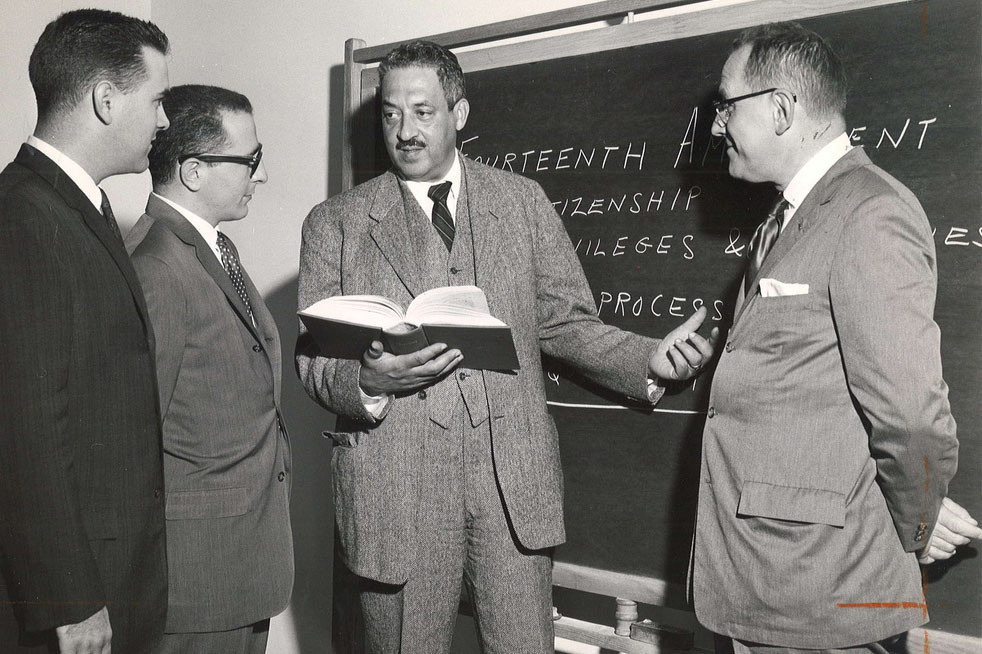
Her surname was the plaintiff’s in Brown v. Board of Education, the landmark 1954 school desegregation case that transformed not only American public schools but thousands of their surrounding neighborhoods.
It was Brown’s father, Oliver, who tried to enroll Linda in an all-white Topeka elementary school in 1950. The school principal turned them away. The Browns enlisted the lead attorney for the NAACP, a young fellow out of Baltimore named Thurgood Marshall, and in 1954 the U.S. Supreme Court unanimously ruled that segregated schools were inherently unequal and needed to be integrated speedily.
In a 1985 New York Times interview, Linda Brown recalled the long trek she had to make out of her integrated neighborhood in Topeka. She had to walk past a nearby white public school to the closest all-black school – through a rail yard, across a busy road, and then a bus ride.
“It was very frightening to me,” she said, “and then when wintertime came, it was a very cold walk. … I remember tears freezing up on my face because I began to cry.”
The court’s ruling ushered in a decade of genuine integration in many of America’s public schools, including Baltimore’s. But many jurisdictions resisted integration, including counties surrounding the city of Baltimore.
Their reluctance helped propel a suburban migration that had already begun in the post-World War II era. Baltimore city families fearful of integration saw the counties’ intransigence as a signal – “Come here,” they seemed to declare, “where we’re still all white.”
School integration was relatively peaceful in Baltimore city, but a quiet exodus commenced over the next decade, from schools and from communities.
A city whose population was nearly 1 million after the war barely tops 600,000 today. Those are numbers that reflect America’s ongoing struggle – to match the clear morality of equal school opportunity for all children with the real-world challenge of families sticking around to try to make the process work.
As Linda Brown goes to her grave, the country continues to grapple with that contradiction.
 A former Baltimore Sun columnist and WJZ-TV commentator, Michael Olesker is the author of six books. His most recent, “Front Stoops in the Fifties: Baltimore Legends Come of Age,” has just been re-issued in paperback by the Johns Hopkins University Press.

A new biography captures the intensity and magic of the musical theater giant, writes Michael Olesker.
Melinda Michel pays tribute to the longtime Jewish community leader and volunteer who passed away on June 8 at age 68.

Jmore Editor-in-Chief Alan Feiler remembers Temple Emanuel's longtime spiritual leader, who passed away earlier this week at age 91.

Camp and youth group experiences have the ingredients for true, deep, lifelong transformation, writes Rabbi Jessy Dressin.