

Little Richard. Aretha. Count Basie. Zappa.
Motown and Billie Holiday. Or for more modern tastes, Doug E. Fresh and Public Enemy.
The biggest names in show business have appeared on the iconic fluorescent, bold-type posters produced by the Globe Poster Printing Corporation, which was based in East Baltimore and operated for more than eight decades.
The origins of the company date back to 1914 when Norman I. Shapiro, an entrepreneurial-minded 15-year-old son of Jewish immigrants in Philadelphia, set up a used cast-iron letterpress and began printing what were called “calling cards” in the basement of his family’s rowhouse.
Soon, he was printing stationery items, envelopes and tags for his neighborhood business called the Triangle Printing Co. Eventually, Shapiro’s six brothers joined the business and set up poster companies in Baltimore, Philadelphia, Chicago, St. Louis, Dallas, Pittsburgh and Atlanta. (Interestingly, Martin Luther King Jr. worked at the family’s Southern Printing Poster Co. plant in Atlanta while attending Morehouse College.)
Starting in 1928, Norman Shapiro and his cousin, Norman. D. Goldstein, ran the Globe Poster company in Baltimore, until 1954 when Shapiro became the sole owner.
Shapiro’s grandson and great-granddaughter, Duke Zimmerman and Lori Gale, recently came out with a full-color coffee table book about their family’s poster business titled “People Get Ready: Pride, Prejudice, Protest, Promise.”
In addition, an exhibition of posters from all the Globe-affiliated poster companies, “People Get Ready: A Visual legacy of Black American Joy and Struggle for Civil Rights,” will be featured at Towson University’s Asian Arts Gallery & Cultural Center through Saturday, July 11.
Zimmerman and Gale will speak at the gallery and center about the history and artistry of Globe posters on Friday, June 19, from 5:30-8 p.m. The free talk is part of the university’s Summer at the Center’s Juneteenth Celebration.

Jmore recently spoke with Gale, a Northwest Baltimore native who lives in Washington, D.C., about the legacy of Globe posters.
What was the genesis of “People Get Ready”?
My dad and I have worked together throughout my entire career, and we are a fantastic team. We started working on this book five years ago, and the vision morphed a bit over time.
The book takes its title from Curtis Mayfield, who wrote the song “People Get Ready” for The Impressions in 1965, after the March on Washington and the Birmingham church bombing.
How would you characterize the role that Globe posters played in the civil rights movement?
This is a book about Black America, made by two people who are not Black. That is the elephant in the room, so let’s get that out of the way: we are a white father and daughter.
The lives recorded on these posters are not ours. The segregation they document, and the movement that rose to meet it, are not our story to claim.

What is ours is the printing trade our family has worked for four generations, and the businesses that the two of us enjoyed personally building and expanding together over our careers. That successful partnership continues as we write this book. Unless otherwise noted, every poster in this book came off the family’s presses or those of its successors.
How did Globe posters evolve over the years? After all, besides concerts and R&B, the posters publicized sporting events, burlesque, political and community gatherings, vaudeville and other happenings.
Well, as we continued to learn about the posters, that civil rights chapter grew and grew until it was obvious it deserved its own book. The circuses and carnivals are now on the back burner, a story for another day. Nobody is threatening to erase the clowns.
Attempts to rewrite African American history, however, are all too pervasive. The posters are tangible evidence of Black life in America over the past century — its pride, prejudice, protest and promise.
You will view posters for benefit concerts for civil rights groups, freedom rallies billed as concerts or dances, and Black sports leagues. Together, these pieces record how African Americans gathered, celebrated, organized and pushed the country forward.
Why do these posters touch such a nostalgic chord?
For those who lived through these years, the posters are instantly familiar. For everyone after, they are a way into history that textbooks tend to flatten or skip entirely.
It is unlikely that a young person looking at one of these posters will appreciate the story behind it — that the headliner couldn’t rent a hotel room in the same town that lined up to see him or her, or what it took for that crowd to gather at all: the miles they traveled to reach a room that would let them in, and the long work week already behind them.
Those things must be explained, and this book is our attempt to do exactly that.
How did Globe become so involved in the Black community?

Many people and companies simply would not do business with Jewish firms, and that exclusion is a part of why the Shapiros initially became so deeply tied to the Black community. Both groups were shut out of mainstream American commerce, and the work and camaraderie flowed naturally between them.
The alliance continued over the years, and the Shapiros’ commitment to the civil rights movement was evident in the causes they proudly supported and the customers they served.
Over the century, the family’s plants printed many hundreds of thousands of posters documenting aspects of the Black American experience and progress in the fight for civil rights.
What is it about Globe posters that are so visually alluring and appealing?
Behind the posters that emerged out of Globe Poster in Baltimore was Harry Knorr. He was a game-changing designer who worked at Globe for nearly 50 years. There is no doubt that he developed the look and feel of a Globe poster more than any other single designer.
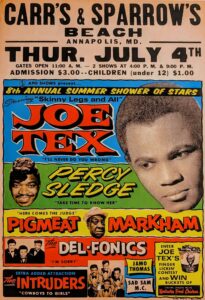
Norman Shapiro introduced brilliant Day-Glo inks to Globe’s color palette. With Knorr’s design skills, Globe started printing jump-off-the-poster ink colors behind bold type to highlight and promote the key parts of a poster. Concertgoers could tell after three seconds of seeing a poster that the event would be exciting and full of energy.
In addition to the brilliant use of color, Harry created unique fonts and design elements that became Globe signatures. The style of these posters is revered and mimicked to this day.
The posters needed to immediately catch your eye, convey the basic facts in a few seconds, and be dirt cheap. They also learned that there is no substitute for excellent customer service.
How did the Towson University exhibition come about?
The TU exhibition came to be after Dean Regina Carlow of the TU College of Fine Arts and Communication learned of our project and decided it would be a great fit for their Summer Arts Festival.
We are also talking to other universities and museums around the country — mostly those focused on civil rights, art, music and African American history. We think there is something in here for everyone.
What do you hope audience members take away from your talk at Towson on June 19th?

We hope audience members will walk away with a better understanding of history. So many people today don’t take the time to read; the wiring in our brains has changed. People now absorb the visuals, and if they are interested enough in what they see, they will take the time to read the details.
These iconic posters are snapshots in time, containing important historical nuggets about African American civil rights. What better way to learn history?
School books have been banned, African American institutions are losing funding, and those with a memory of the past won’t always be with us. If people don’t know about Jim Crow, segregation, the Chitlin’ Circuit, or the sports figures, activists, and performers who broke barriers with their talent and persistence, then you are missing a lot of history.
These posters convey snapshots of African American pride, prejudice, protest and promise.
For information, visit tickets.tuboxoffice.com/eventperformances.asp?evt=291 or globeposterbook.com/.
Baltimore Heritage’s Johns Hopkins recently highlighted the history of Globe Poster Corporation in its “Five Minute Histories” series:

The new exhibition revisits and updates a previous show about ritual hair covering in the observant community.

One of the most competitive local races for public office this political season is for Baltimore County Executive. Jmore recently spoke with four of the candidates about their views on how they hope to enhance life in the county.

The Pikesville resident's latest offering "There's a Dragon in the Tree House and He Won't Come out!" was co-written with her grandsons.

A new biography captures the intensity and magic of the musical theater giant, writes Michael Olesker.