
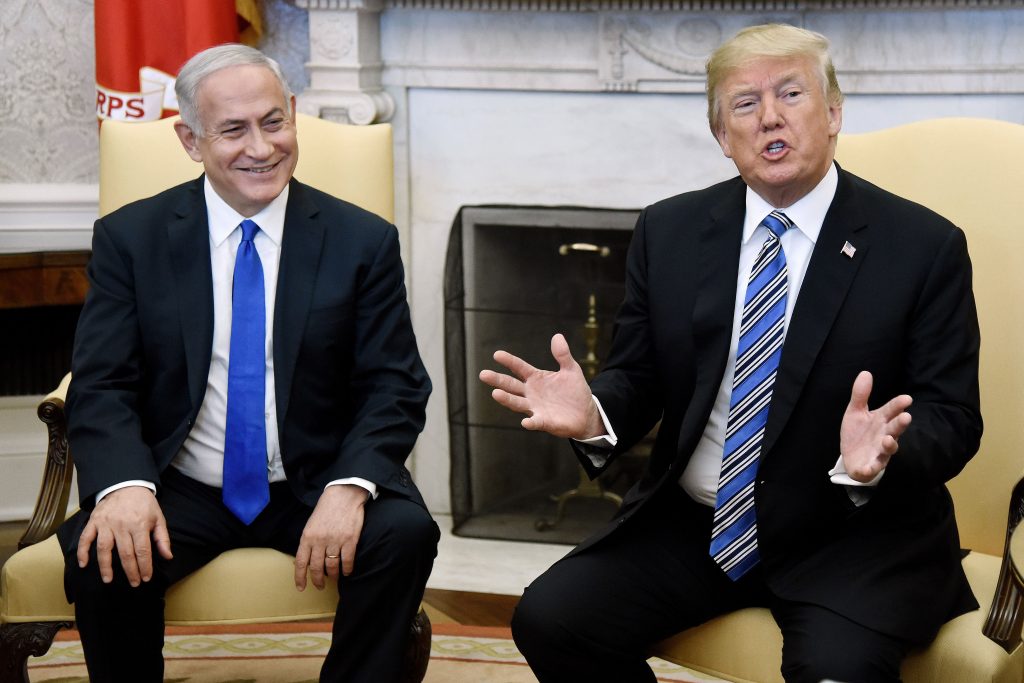
Israel turns 70 this year. And no relationship has been more important than its on-again, off-again friendship with the United States and its presidents.
In this series, JTA’s veteran Washington reporter Ron Kampeas describes the U.S.-Israel friendship through portraits of 13 of those presidents, from Harry Truman to Donald Trump.
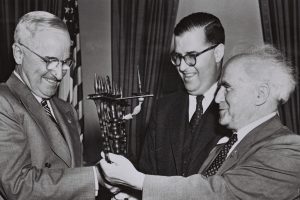
Harry Truman: Recognizing the new State of Israel
On May 12, 1948, two days before David Ben-Gurion declared Israel’s independence, things were tense at the White House. President Harry Truman was torn between his secretary of state, George Marshall, who counseled against recognizing the new Jewish state, and Clark Clifford, his White House counsel, who said Truman should recognize Israel.
What tipped the balance? Truman’s deeply held Christian faith, coupled with his old Army buddy and former partner in a haberdashery, Eddie Jacobson, who traveled to the White House to make the case for the Jewish state. Truman sent his telegram recognizing Israel 11 minutes after Ben-Gurion proclaimed the country’s existence on May 14, 1948.
Truman also may have recalled a letter he had received a few weeks earlier from Chaim Weizmann, in which the future president of Israel wrote:
“The choice for our people, Mr. President, is between statehood and extermination. History and providence have placed this issue in your hands, and I am confident that you will yet decide it in the spirit of the moral law.”
Truman would not be the last president to harbor a passion for Israel, to sustain a close friendship with a Jew … and to explode into anti-Semitic vituperation. (See under: Richard Nixon.) Truman resented pressures after the war from Jewish groups to help resettle millions of Jewish refugees.
“If Jesus Christ couldn’t satisfy the Jews while on earth, how the hell am I supposed to?” he told his Cabinet in 1946.
His tendency to explode under pressure manifested itself in his relationship with the Jewish state he helped midwife. In 1949, he threatened to break with Israel unless it allowed the return of some Palestinian refugees displaced in Israel’s 1948 War of Independence (Israel agreed, but Arab states rejected the offer). And he pressured Israel, without success, to withdraw from lands captured during that war.
Dwight Eisenhower: A war hero seeks a “balanced” approach
Dwight David Eisenhower sailed into office in the 1952 election because he was the general who ended World War II.
There was a specifically Jewish reason to buy into the hero worship: Eisenhower insisted that the world learn of the barbarism he witnessed when he liberated the Nazi death and concentration camps because he correctly anticipated there would be efforts to deny it.
Speaking to a group of journalists and congressmen he had led through Buchenwald in 1945, he said: “You saw only one camp yesterday. There are many others. Your responsibilities, I believe, extend into a great field, and informing the people at home of things like these atrocities is one of them.”
His comprehension of the horror included the realization that Jews were its principal victims.
“The Jews were in the most deplorable condition. For years they had been beaten, starved, and tortured,” he wrote in his 1948 account of the war, “Crusade in Europe.”
Nevertheless, Eisenhower believed Truman tilted U.S. policy toward Israel and sought a more “balanced” approach, which led to years of frustrations with Israel and to the establishment of two important Jewish institutions: the American Israel Public Affairs Committee, which cultivated support for Israel in Congress, as a means of tempering Eisenhower’s coolness toward the state, and the Conference of Presidents of Major American Jewish Organizations, established to show Eisenhower that the U.S. Jewish community was unanimous in its support for Israel. (Eisenhower aides had played up support for Israel-critical policies by marginal Jewish anti-Israel groups to explain his coolness to the country.)
The relationship reached a crisis in 1956 after Israel joined Britain and France in capturing the Sinai peninsula as a means of keeping Egypt from nationalizing the Suez Canal. Eisenhower was furious, and his pressure on Israel forced a pullout. He contemplated cutting off not only U.S. assistance to Israel but private money going to the Jewish state, he later wrote.
Who stood in the Republican president’s way? The Senate majority leader, a Democrat from Texas named Lyndon Baines Johnson, who said that “cracking down” on Israel would show a double standard, considering how soft Eisenhower had been on the repression of democratic protesters in Hungary the same year.
John Kennedy: A martyr who worried about the spread of nukes
The assassination of President John F. Kennedy on Nov. 22, 1963, devastated Americans, and American Jews were no exception.
On Nov. 25, a Monday, synagogues opened for the national day of mourning — and Jews flocked to services in large numbers. (The night of assassination, nightclub owner Jack Ruby attended a memorial service for the president at Temple Shearith Israel in Dallas. Two days later, he would shoot and kill the assassin, Lee Harvey Oswald, fueling a half-century of conspiracy theories. A key piece of evidence was a film of the motorcade as Kennedy was shot; it was made by a Jewish Kennedy supporter from Dallas named Abraham Zapruder.)
Within weeks of Kennedy’s death, the Jewish National Fund announced plans to build a memorial to the slain president in a Kennedy forest near Jerusalem.
Kennedy was the first non-Protestant, and Irish Catholic to boot, to be elected president. Stories imagining the once unimaginable proliferated in the Jewish press after he secured the nomination: Could a Jew one day be elected president? More Cabinet-level Jews worked for Kennedy than any predecessor.
Kennedy overrode Eisenhower-era State Department policies and increased arms sales to Israel. Kennedy unabashedly dove into pro-Israel politicking: On the Dec. 5 after his death, he was to have been the guest of honor at the annual dinner of the American Committee for the Weizmann Institute of Science. In 1961, Kennedy pardoned Herman Greenspun, the Las Vegas Sun publisher who had been convicted in 1950 on charges related to gun running to the nascent Zionist state.
The one phenomenon Kennedy feared above all was the proliferation of nuclear weapons on his watch. He demanded an accounting of the purpose of the nuclear reactor Israel was building near Dimona. At a 1961meeting in New York with Ben-Gurion, the prime minister noticeably mumbled a lot and used terms like “for the time being” in promising that the reactor would not produce weapons-grade fissile material.
Kennedy wanted Americans to inspect the plant; Israel kept dodging the requests. In May 1963, Kennedy threatened to isolate Israel unless it let in the inspectors. Neither he nor Johnson ever made good on the threat, and today, Israel’s nuclear capabilities are its worst-kept secret.
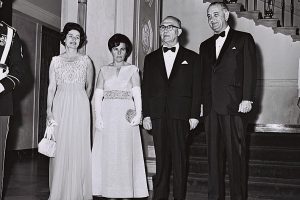
Lyndon Johnson: No better friend
After John F. Kennedy was killed and Lyndon Johnson became the 36th president, LBJ told an Israeli diplomat, “You have lost a very great friend. But you have found a better one.”
Indeed, it was Johnson, as Senate majority leader, who stood in the way years earlier of Dwight Eisenhower’s plans to cut off assistance to Israel. He knew few Jews growing up in Texas, but cultivated lifelong friendships as he rose through the ranks of the Democratic Party, which had become the natural political home for most Jews.
Historians generally regard Johnson as the president most uniformly friendly to Israel.
“Johnson was the most emotionally committed to Israel of any American president — a fact that is not popularly known but is clear from his background,” Dennis Ross, a veteran Middle East negotiator in Republican and Democratic administrations, said last year at a symposium of the Washington Institute for Near East Policy, where he is counselor.
Johnson was the first president to invite an Israeli prime minister, Levi Eshkol, on a state visit. They got along so well — both men were farmers — that Johnson paid Eshkol the rare compliment of inviting him to hisranch.
LBJ soon abandoned pressure on Israel to come clean about the Dimona reactor. He increased arms sales to Israel and in 1968, after Israel’s primary supplier, France, imposed an embargo as a means of cultivating ties in the Arab world, the United States became Israel’s main supplier of weapons, notably launching the talks that would lead to the sale of Phantom fighter jets to Israel.
Johnson wanted to commit more forcefully to Israel’s cause in the lead-up to the 1967 Six-Day War, but he felt constrained from a dramatic show of military might because of the failures of the war in Vietnam then dogging his presidency. Nonetheless, during the war, he ordered warships to within 50 miles of Syria’s coast as a warning to the Soviets not to interfere.
In a speech in the war’s immediate aftermath, Johnson effectively nipped in the bud any speculation that the United States would pressure Israel to unilaterally give up the lands it had captured. He laid down not only the “land for peace” formula that would inform subsequent U.N. Security Council resolutions, but made it clear that any formula had to ensure Jewish access to Jerusalem’s Old City.
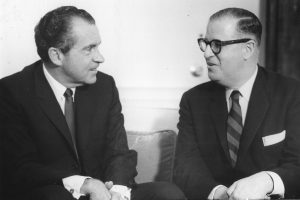
Richard Nixon: The anti-Semite who saved Israel
Nixon liked Israelis — a lot. He was close to Golda Meir, the prime minister; Moshe Dayan, the defense minister; and Yitzhak Rabin, the ambassador to the United States. Rabin would break diplomatic protocol and campaign for Nixon in 1972. Nixon saw his resolute, paranoid Cold Warrior reflected in Israelis. Like him, they were hard-edged realists who were forced to play for the highest stake of all, their existence.
Nixon stands out among presidents for taking the boldest risk for Israel: a much-needed arms airlift during the 1973 Yom Kippur War. An astonishing 567 missions by American aircraft (not to mention deliveries by sea and El Al flights) kept Israel fighting. Nixon ignored the counsel of his closest adviser, Henry Kissinger, who wanted to allow the war to play out for a while longer to give Egyptian President Anwar Sadat the political cover he needed to make peace in its aftermath. The stakes were too high for Israel to play with timing, Nixon told Kissinger.
Nixon had little to gain and much to lose. He was in his second term and, in any case, the Republican was never going to win over the largely liberal Jewish vote. The airlift helped spur an Arab oil embargo, driving gasoline prices sky high. Preoccupied by Watergate and mired in Vietnam, and against the advice of his Jewish adviser, Nixon risked a new war with the Soviets to save Israel.
Nixon “made it possible for Israel to win, at some risk to his own reputation and at great risk to the American economy,” historian Stephen Ambrose said.
Israel’s leadership knew it.
“President Nixon has done many things that nobody would have thought of doing,” Meir said, toasting Nixon during his 1974 visit. “All I can say, Mr. President, as friends and as an Israeli citizen to a great American president, thank you.”
The man who saved Israel, however, seemed unhealthily obsessed with Jews — as the White House tapes released subsequent to Nixon’s removal from office revealed. He shared with underlings a host of complaints: “The Jews are all over the government.” “Most Jews are disloyal.” “You can’t trust the bastards. They turn on you.” “The Jews are born spies.”
He wasn’t just blowing steam. Jews were prevalent on Nixon’s infamous “enemies list,” drawn up, according to a 1971 memo by White House counsel John Dean, to assess “how we can use the available federal machinery to screw our political enemies.” The same year, Nixon asked Fred Malek, the White House personnel chief, to count and name the Jews employed by the Bureau of Labor Statistics. Nixon was convinced Jews in the bureau were skewing jobs numbers to make him look bad.
Yet in June 1974, mired in the darkness of Watergate, just weeks before he would be the first president to resign, Nixon became the first president to visit Israel on the job. Speaking on the Ben Gurion Airport tarmac, he sounded relieved, like he had come home.
“We have been through, over these years, some difficult times,” he said. “During the period that I have served as president of the United States, we have been through some difficult times together, and I can only say that the friendship that we have for this nation, the respect and the admiration we have for the people of this nation, their courage, their tenacity, their firmness in the face of very great odds, is one that makes us proud to stand with Israel, as we have in the past in times of trouble, and now to work with Israel in a better time, a time that we trust will be a time of peace.”
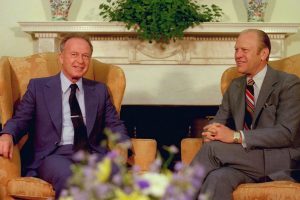
Gerald Ford: Backing Soviet Jews, and pressuring Israel to give back the Sinai
Gerald Ford, who succeeded Richard Nixon as president after his resignation in 1974, was an anomaly: a president for less than a thousand days who was not elected as president nor vice president. In 1973, he had replaced Vice President Spiro Agnew, who resigned in the face of bribery charges.
Yet Ford was president at a pivotal time. The movement to free Soviet Jewry in 1975 scored two critical political and diplomatic victories: the passage of the Jackson-Vanik Amendment, which denied most favored nation trading status to countries with restrictive emigration policies, and the signing of the Helsinki Declaration, requiring the Soviet Union to respect human rights, including fundamental freedoms of religion, thought and conscience.
Ford was the right executive at the right time to ensure both advances. An early backer of the movement to free Soviet Jews, he was Republican minority leader in the U.S. House of Representatives in 1971 when he spoke at a Madison Square Garden rally for Soviet Jewry.
“His administration’s signing of the Helsinki accords, which established a clear link between international relations and human rights, was the most important step in the struggle to win the Cold War,” Natan Sharansky, the former prisoner of Zion, told JTA when Ford died in 2006.
Ford inherited Henry Kissinger as secretary of state, and went along when Kissinger grew frustrated with what he perceived as Israeli intransigence in talks with Egypt. Kissinger wanted Yitzhak Rabin, who had become Israel’s prime minister, to pull back from a portion of the Sinai peninsula captured from Egypt in the Six-Day War. In March 1975, Kissinger said that the Ford administration was “reassessing” U.S. Middle East policy, including assistance to Israel.
Ford said he was “profoundly disappointed” in Israel’s reluctance to cooperate. He put a hold on critical arms sales for six months, but could not face down congressional pressure to relent. The pro-Israel lobbygarnered 76 signatures on a Senate letter to Ford “to be responsive to Israel’s urgent military and economic needs.”
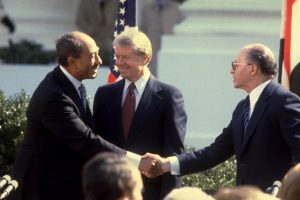
Jimmy Carter: The unpopular force behind the Camp David Accords
Jimmy Carter, the Democratic governor of Georgia, defeated Ford to become president in 1976. The devoutly Christian peanut farmer was the only figure at the 1978 Camp David peace talks between Israel and Egypt who was unflaggingly committed to the outcome.
Anwar Sadat, the Egyptian president, was unsure how much he could sacrifice to peace and maintain his position of leadership in the Arab world. Israeli Prime Minister Menachem Begin emerged from a political strain that did not give up land for anything. Aides to all three leaders advised them at various junctures to save face, cut losses and give up.
Carter was the perpetual engine of the talks that brought about a peace on Israel’s southern flank that has lasted until now, including a period when Egypt was ruled by the Muslim Brotherhood. For nearly two weeks, he managed to keep the Israeli and Egyptian leaders in place at the Camp David retreat in the Maryland hills, shuttling between their cabins to work out each nuance.
“Here is President Carter working day and night with those yellow legal pads with his sense of mission,” Elyakim Rubinstein, a member of the Israeli delegation who went into the talks believing they would be a bust,said at a symposium in 2003 on the 15th anniversary of the accords.
His was also the human rights presidency: He made the implementation of the Helsinki Declaration, requiring the Soviet Union to respect human rights, a hallmark of his presidency; spoke out on behalf of refusenik Natan Sharansky; and launched the process that would establish the U.S. Holocaust Memorial Museum in Washington, D.C.
For Israelis and the pro-Israel lobby, the flip side of Carter’s doggedness was a perceived stubborn arrogance. Carter came across to them as someone who believed he knew best. He was the first president to unequivocally declare Israel’s settlements in captured lands to be illegal. He launched secret contacts with the Palestine Liberation Organization. And he forged ahead with plans to sell Saudi Arabia F-15 combat aircraft.
In 1980, Carter became the first Democratic presidential nominee since 1924 not to garner a majority of Jewish voters. (He won a plurality of the Jewish vote in a three-way race with 45 percent, but lost the election.)
Carter remains among the most popular former presidents, but with American Jews, if anything, his relationship has become more fraught. In 2006, in a book he predicted that Israel was on a path to apartheid if it did not advance toward peace with the Palestinians. He met with leaders of the Hamas terrorist group.
“He is flawed, he’s got an obsession with Israel, a biased obsession that borders on anti-Semitism,” Abraham Foxman, then the director of the Anti-Defamation League, said in 2012.
Those present at Camp David say Carter, who as governor of Georgia visited Israel and was outspoken on behalf of Soviet Jews, should above all be remembered for making peace.
“You could argue with positions that President Carter took over the years on this or that aspect,” Rubinstein said, “but what he did then was the combination of his being an engineer and a religious man, believing religiously in peace and in the bettering of human life.”
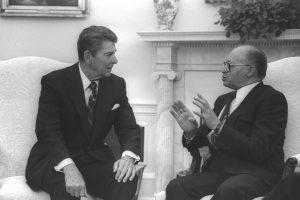
Ronald Reagan: A cold warrior who cared — and sold spy planes to the Saudis
When Ronald Reagan cowed the Soviet Union into winding down the Cold War — his successor, George H.W. Bush, formally ended it — a key component of his animus toward Moscow was the treatment of its Jews.
“He was someone who was truly committed to overturning the Communist system and gaining freedom for all people, but he had a particularly soft spot in his heart for Soviet Jewry,” Mark Levin, a longtime advocate for Soviet and Eurasian Jewry, told JTA in 2004 when Reagan died.
When Theodore Mann, the chairman of the National Conference on Soviet Jewry, returned from a visit to the Soviet Union in 1981, the first call he received in his law office was from Reagan.
“He wanted to know all about the trip,” Mann said in 2004.
On Reagan’s watch, in 1986, the Soviets released Natan Sharansky, the prisoner of conscience who spent nine years in Soviet prisons. Reagan’s ties to the pro-Israel community extended back to his Hollywood days as an actor and union leader. As California governor in 1967, he headlined a pro-Israel rally at the Hollywood Bowl.
Reagan won over the wary with his avuncular affect.
“This man cared,” Shoshana Cardin, who led a number of Jewish organizations, once said of Reagan, but his persuasive powers could also be a sharp-edged weapon.
In 1981, the American Israel Public Affairs Committee lobbied hard against a proposed sale of AWACS spy plans to Saudi Arabia. Reagan met with Jewish senators one on one and threatened to unleash dual-loyalty charges if they voted against him.
“It is not the business of other nations to make American foreign policy,” the president said. The Reagan administration in 1981 joined a U.N. Security Council resolution condemning Israel’s bombing of Iraq’s nuclear reactor.
After Israel’s Christian allies in Lebanon massacred Palestinians in 1982, Reagan sent U.S. troops into Lebanon — against advice from Israel.
He and Israeli Prime Minister Menachem Begin exchanged barbs, and Begin famously chided Reagan for treating Israel like a “banana republic.” Reagan secretly planned to surprise Begin with a peace plan that would have pulled Israel out of the West Bank and Gaza Strip. Under pressure from Reagan, Israel allowed PLO leader Yasser Arafat to safely leave Lebanon.
On Reagan’s watch, authorities arrested Jonathan Pollard, a civilian Navy analyst who was a spy for Israel, and Israeli figures were caught up in his administration’s efforts to trade arms to Iran for the release of U.S. hostages in Beirut, and then funnel the proceeds to right-wing militias in Central America. In his final months in office, a lame duck beyond political pressures, Reagan established ties with the Palestine Liberation Organization.
To the chagrin of even his closest allies, Reagan went ahead with plans in 1985 to visit Germany’s Bitburg cemetery, where 40 members of the Nazi Waffen SS were buried.
“It is precisely because you have so impressed us in the past with your deep understanding of the need to keep the meaning and memory of the Holocaust alive that we have been so keenly disturbed by your plans,” Elie Wiesel, the Holocaust memoirist, said in a telegram to Reagan.
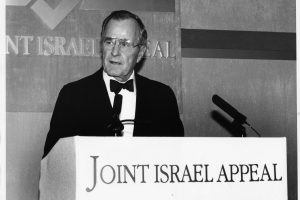
George H. W. Bush: The patrician advocate for Jews in distress and the Madrid peace talks
George H.W. Bush was involved in Soviet Jewry advocacy since his days as ambassador to the United Nations under President Richard Nixon. As vice president to Ronald Reagan, his responsibilities included efforts to free Jews in distress — not only in the former Soviet Union but in Ethiopia and in Syria.
Bush quarterbacked Secretary of State George Schultz’s confrontation with the Soviets over Russia’s captive Jews and was instrumental in persuading the Syrian dictator, Hafez Assad, to allow young Jewish women to immigrate to the U.S. so they could marry within the faith. As president, he gave the nod to the Marxist Mengistu regime in Ethiopia that led to Operation Solomon, the mass airlift to Israel in 1991.
Following his success in the 1991 Gulf War, Bush convened the multilateral Arab-Israeli peace conference in Madrid. It was marked by his tensions with Israeli Prime Minister Yitzhak Shamir. But in retrospect, Bush was as tough on the Arab interlocutors, and just the fact that Saudi Arabia, Gulf states and North African countries sat at the table with Israel led to Israeli diplomatic inroads in those countries.
Pro-Israel activists will never forget — or forgive — when Bush said he was “one lonely guy” facing off against “thousands of lobbyists on the Hill.” He was referring to lobbyists from the American Israel Public Affairs Committee, who in 1991 were pushing back against his pledge to suspend loan guarantees to Israel unless it froze settlement building.
But lacking Reagan’s easy charm, the patrician Bush couldn’t get away with the tough guy talk and instead sounded self-pitying and mildly anti-Semitic. His chief of staff, James Baker, didn’t help things when he reportedly dismissed the prospect of Jewish protestations by saying, essentially but much more crassly, “To hell with them — they don’t vote for us anyway.”
After Saddam Hussein invaded Kuwait in 1990, the Iraqi strongman pelted Israel with missiles. Israel itched to respond, but Bush insisted that Israel take it on the chin so he could assemble as broad a coalition as possible to oust Iraqi forces from Kuwait. Israel complied, and its leaders were stunned when in the war’s aftermath, Bush used American actions to protect Israel during the war as leverage to get Israel to Madrid. It seemed galling because Israel had been reluctant to accept the assistance in the first place.
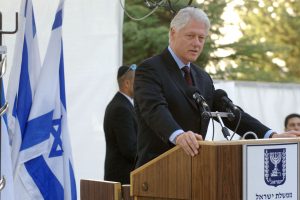
Bill Clinton: The ‘chaver’ who brought Israelis and Palestinians together — up to a point
“Shalom, chaver,” Bill Clinton said at the funeral of assassinated Israeli Prime Minister Yitzhak Rabin, and those two words encapsulated the intimate passion Clinton felt toward Israel: He was a friend, one close enough that he wanted to bid goodbye to a man he saw as a mentor in his language.
Clinton’s relationship with the American Jewish community was similarly intimate. Unlike George H.W. Bush, he was an adept retail politician and made it a point to win folks over. The pro-Israel community, likewise, understood that this was a president who responded best to friendly overtures. The American Israel Public Affairs Committee named as its president Steve Grossman, a Massachusetts businessman and early Clinton backer. In 1995, over cigars on the White House balcony, Grossman talked Clinton into imposing the first sanctions on Iran related to its nuclear program.
Clinton in his first term had the luck of working with an Israeli administration whose peacemaking agenda matched his own. In what one reporter called “a triumph of hope over history,” Clinton brought Rabin and Yasser Arafat, the PLO chairman, to the White House to shake hands on their first agreement on ending their conflict.
Yet to the consternation of the Palestinians, Clinton would never get ahead of Israel. Although the Oslo track clearly was destined toward statehood for the Palestinians, Clinton did not articulate that outcome until his last weeks in office. In 2000, after the Camp David talks ended without a deal, Clinton broke with protocol and blamed Yasser Arafat, the PLO leader, for the failure.
After Rabin’s assassination in 1995, Clinton thought it important enough to preserve his friend’s legacy that he blatantly electioneered on behalf of Rabin’s successor, Shimon Peres. Rattled by a series of deadly terrorist bus bombings, Clinton pushed Middle East leaders into convening a summit against terrorism starring Peres. It didn’t work. Benjamin Netanyahu was narrowly elected to his first term in office, and the U.S.-Israel relationship turned rocky.
Clinton grew frustrated at what he said was Netanyahu’s predilection for introducing out-of-left-field demands after talks on an issue had wrapped up for the day. In one instance during the 1998 Wye River negotiations to advance the Oslo process, Netanyahu asked Arafat to assassinate a Gaza Strip police chief. In another, during the same talks, he asked Clinton to release Jonathan Pollard, the civilian Navy analyst who was caught spying for Israel. (Clinton was ready to do it, but his intelligence chiefs were outraged and threatened to quit.)
Clinton learned his lesson by the 1999 elections and kept out — kind of. His two campaign advisers, Stanley Greenberg and James Carville, traveled to Israel to advise Netanyahu’s challenger, Ehud Barak, and Barak won.
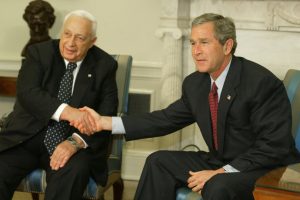
George W. Bush: Launching a war on terror, and making the case for democracy
The 9/11 terrorist attacks in 2001 seemed for Israelis to be a turning point in U.S. foreign policy, burying once and for all the American realist strain that posited engagement with bad actors as a dirty but necessary statecraft. George W. Bush’s “with us or against us” approach to the war on terrorism, his very coinage of the term “war on terrorism,” was music to the ears of Israelis who for years had said that partners in peace must renounce absolutist demands and absolutist means to achieve them.
Bush extended his outlook to the Israeli-Palestinian conflict. Relaunching the peace process with his “road map” in 2002, one explicit condition was that he would no longer deal with Yasser Arafat, who had steered his PLO factions into participating in the bloody second intifada.
“The Jewish community started to see a resolve for promoting peace by motivating the Palestinians to take good actions rather than starting with Israeli concessions,” Jay Lefkowitz, a former Bush White House policy adviser, told JTA in 2004.
The same year, Bush made history when he recognized some Israeli claims to the West Bank. His vision of a new Middle East borrowed much from Natan Sharansky’s 2005 book, “A Case for Democracy.”
Bush also never demanded that Israel hew to standards he would not: Once the United States launched targeted killings against suspected terrorists, the Bush administration put an end to State Department statements condemning Israel for doing the same.
In his second term, during Israel’s 2006 war with Hezbollah, Bush overrode his secretary of state, Condoleezza Rice, who was pressuring Israel to end the war before it was ready to do so.
“It is important to remember this crisis began with Hezbollah’s unprovoked terrorist attacks against Israel,” Bush said at the time.
Fred Zeidman, a Jewish Texas businessman and a longtime Bush backer, told JTA in 2004: “If there has ever been a thing that was not politically expedient, it was the way he handled Israel.”
Ariel Sharon was elected Israeli prime minister just about the same time Bush became president, and the two already were close: Two years earlier, Sharon had taken Bush on a helicopter tour of Israel to make tangible how small and vulnerable the country was. There was talk that Sharon would be to Bush what Yitzhak Rabin was to Bill Clinton: a wizened, war-tested father figure and mentor.
That didn’t quite work out, perhaps because Bush already had two competing father figures — his actual father, who unlike Clinton’s was alive, and his vice president, Dick Cheney. In any case, by 2005, the honeymoon was over. Bush had agreed not to press Israel on settlements as long as the growth remained “natural,” but Bush administration officials had concluded that the growth was anything but natural. A Texassummit in April of that year between the two leaders turned sour: Sharon, unlike most other leaders, was not invited to spend the night at Bush’s ranch, and instead was ensconced in a Waco hotel. About all the leaders could agree on was that Israel would withdraw its settlements and troops from the Gaza Strip that summer. By the time of the 2009 transition to the Obama administration, Bush administration officials were so frustrated with Israel they treated the “natural growth” agreement as null and void.
Also irritating the relationship was the raid in 2004 by federal agents on the offices of the American Israel Public Affairs Committee in pursuit of evidence of espionage charges that years later proved groundless.
A tireless democracy promoter, Bush insisted on Palestinian elections in 2006, which Israel correctly feared would bring about a Hamas victory. (It didn’t help that Condoleezza Rice, his secretary of state, on multiple occasions likened what she witnessed in the West Bank to her upbringing in the Jim Crow South.)
Bush also rejected Sharon’s advice to topple Saddam Hussein in Iraq and get out, again pinning his hopes on Iraq to set an example as an Arab democracy. Instead, a long U.S.-led occupation went south and set the stage for the rise of Iran in the region — and ultimately dampened American enthusiasm for involvement in the Middle East. Israelis complained privately that Bush’s focus on Iraq was giving Iran a free hand. Adding salt to the wound, Bush denied an Israeli request in 2008 for permission to fly through Iraqi airspace to hit Iran’s suspected nuclear weapons facilities.
He remained beloved nonetheless and delivered a speech at the Knesset in May of 2008 marking Israel’s 60th anniversary.
“You have raised a modern society in the Promised Land, a light unto the nations that preserves the legacy of Abraham and Isaac and Jacob,” Bush said to applause. “And you have built a mighty democracy that will endure forever and can always count on the United States of America to be at your side.”
“Such statements about the State of Israel have never been spoken before by a U.S. president in the Knesset,” marveled Israeli Prime Minister Ehud Olmert.
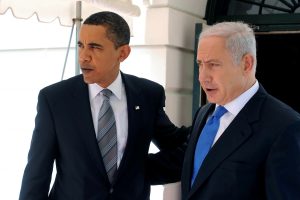
Barack Obama: Acts of friendship and diplomatic pratfalls
Barack Obama, a Democratic presidential hopeful, did something few before or since have accomplished as a speaker at AIPAC’s annual conference: In 2008, the then-U.S. senator from Illinois received a standing ovation for talking about something that had nothing to do with: Israel.
“In the great social movements in our country’s history, Jewish- and African-Americans have stood shoulder to shoulder,” he said.
Obama seemed to herald a return to an alliance long troubled, in part because of differences over Israel and increasing African-American sympathies for the Palestinians. Candidate Obama sought out the council of Israel’s then-opposition leader Benjamin Netanyahu and a range of pro-Israel figures in the United States on the threat posed by Iran and on the means to achieve peace. As president, he expressed affection for the state — and for the Jewish community — in ways that suggested his belief in the U.S.-Israel alliance stemmed from his perspective as a black man.
“To a young man like me, grappling with his own identity, recognizing the scars of race here in this nation, inspired by the civil rights struggle, the idea that you could be grounded in your history, as Israel was, but not be trapped by it, to be able to repair the world — that idea was liberating,” he told the Adas Israel congregation in Washington in May 2015, the first address by a president to a Jewish congregation. “The example of Israel and its values was inspiring.”
Obama put an end to the linking of loan guarantees to Israel’s spending on settlement construction and increased defense assistance to Israel to the unprecedented level of $38 billion over 10 years, making permanent hundreds of millions of dollars in assistance to Israel’s anti-missile programs. He authorized assistance to Iron Dome, the short-range anti-missile system that has proven critical in Israel’s three wars since 2009 with Hamas on its border with the Gaza Strip. In 2011, when Israeli diplomats were trapped inside the Cairo embassy by rioters, Obama made their extraction a priority. “This was a decisive and fateful moment,” Netanyahu said. “He said ‘I will do everything I can,” he said, referring to Obama. “And so he did.”
There was a hard edge to Obama’s embrace of the alliance: Israel’s military might and intelligence savvy provided the pressure that Obama sought to leverage Iranian compliance with his demands that it roll back its nuclear weapons program. Under Obama, Israel and the United States are believed to have worked together to create the computer virus that crippled Iran’s uranium enrichment capability in 2010. Israelis unhesitatingly said military and intelligence cooperation was closer under Obama than any of his predecessors.
Beyond the secret relationships, there were plenty of firsts: Obama was the first president to conduct formal Passover seders in the White House; the first to mark Jewish Heritage Month in May with a party; the first to deliver a speech at the Israeli Embassy, marking Holocaust remembrance; the first, in 2016, to hold multiple Hanukkah parties to accommodate demand. (Multiple Christmas parties have long been a thing.) He may have been the first, in 2011, to structure a speech to a Jewish audience, the Union for Reform Judaism, around a dvar Torah.
But Obama’s relationship with Israel suffered from the flaw of every good friend who is certain he “gets” you: He doesn’t truly get you.
Before Obama was elected, he told a group of Jews, “I think there is a strain within the pro-Israel community that says unless you adopt an unwavering pro-Likud approach to Israel that you’re anti-Israel, and that can’t be the measure of our friendship with Israel.” The implication was that Netanyahu’s party was a nuisance — especially awkward after Netanyahu would return to office just weeks after Obama was inaugurated.
The conversation between Obama and Israelis — Netanyahu, in particular — seemed susceptible to pratfalls however good the intentions on both sides.
Obama addressed the Muslim world in a 2009 speech in Cairo, and said Holocaust denial was corrosive and counseled acceptance of Israel; he was lacerated because it seemed to some that he predicated Israel’s existence on the Holocaust. The next year, Vice President Joe Biden landed in Israel for a let’s-be-friends trip; within hours the mood was soured when a midlevel Israeli bureaucrat announced, apparently to Netanyahu’s surprise, that there would be new building in eastern Jerusalem.
And the next year, in 2011, Obama outlined a Middle East policy that for the first time included a formal American endorsement of a longstanding Israeli demand that a Palestinian state be demilitarized. Whatever goodwill that may have garnered was squashed by Obama’s inclusion of the 1967 lines as the basis for a Palestinian-Israeli border. Netanyahu subsequently lectured Obama on Middle East history in the Oval Office.
Nothing frustrated Netanyahu and his advisers more than repeated assurances from Obama and his cohort that they knew what was good for Israel, particularly heading into the Iran nuclear deal in 2015.
“To friends of Israel, and to the Israeli people, I say this: A nuclear-armed Iran is far more dangerous to Israel, to America, and to the world than an Iran that benefits from sanctions relief,” he said in a 2015 speechon the deal, which swapped sanctions relief for a rollback in Iran’s nuclear program.
Netanyahu decried the deal as a deadly one, saying its “sunset clauses” removing some restrictions simply delayed for a few years Iran’s nuclear weapon. He arranged with the Republican leadership in Congress to speak out against the deal in a joint meeting, infuriating Obama and prompting a rift between Israel and Democrats that persists until this day. AIPAC threw itself into trying to stop the deal, intensely lobbying lawmakers to kill it and other Jewish organizations to speak up against it.
The pattern — an act of friendship followed by a diplomatic slapdown — persisted until the end of the Obama presidency. His administration’s two final Israel-related acts were signing the deal with Israel that guaranteed unprecedented levels of assistance — and then letting the U.N. Security Council adopt a resolution condemning Israel’s settlements. Notably, it was the first time that Obama failed to stop a Security Council resolution that Israel opposed — his predecessors allowed through multiple such resolutions.
Obama was adamant to the end that he had Israel’s best interests at heart. Four days before he left office, he told Israel’s Channel 2, “I believe it would be a moral betrayal for the world not to protect and secure a homeland for the Jewish people.”
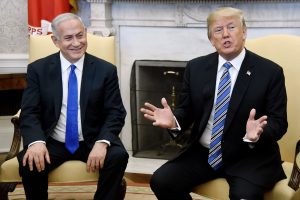
Donald Trump: Following through on his Israel promises
Donald Trump, the unlikeliest of Republican presidents, has gotten a reputation for unpredictability. But if he is consistent on one thing, it is his campaign promises. He tends to keep them.
On Dec. 6, 2017, he made good on his promise to recognize Jerusalem as Israel’s capital and move the U.S. Embassy to Jerusalem from Tel Aviv.
“While previous presidents have made this a major campaign promise, they failed to deliver,” Trump said. “Today, I am delivering.”
Trump not only delivers, he delivers with a vengeance. Recognizing Jerusalem and setting a schedule to move the embassy would have been enough for his Jewish base, but Trump accelerated the process and the embassy opened in May, albeit in temporary quarters.
The same goes for his other Israel-related pledges. Trump promised to block Israel-hostile actions at the United Nations; his ambassador to the body, Nikki Haley, has been perhaps the most proactively pro-Israel envoy since Daniel Patrick Moynihan under Gerald Ford. Haley has forced the United Nations to withdraw reports critical of Israel and stopped a Palestinian from assuming a senior position in the body because the same courtesy has yet to be afforded to an Israeli.
Similarly, Trump said he would reconsider the Iran nuclear deal; he has scrapped it.
“With President Trump, I have fewer disagreements,” Israeli Prime Minister Netanyahu said last month when he was asked to compare his interactions with Obama and Clinton. “It’s fair to say I don’t have any disagreements.”
Trump wants to revive Israeli-Palestinian talks, and has entrusted the task to a team of three, all with solid pro-Israel ties, led by his son-in-law, Jared Kushner.
In the second year of his presidency, Trump is bolder and more confident in his role, and is distancing himself from the foreign policy mavens who insist the United States must ensure stability worldwide. For example, he plans to pull out from Syria the 2,000 or so troops there training and advising U.S.-friendly rebel forces.
“It is very costly for our country, and it helps other countries more than it helps us,” Trump said earlier in April of the U.S. presence in Syria. “I want to get out, I want to bring our troops back home.”
That’s not a prospect Israel relishes. Russia has joined with Iran and Hezbollah — both deadly enemies to Israel — in propping up the Assad regime in Syria. Israel is adamantly opposed to a long-term Iranian presence in Syria, and to an emboldened Hezbollah, the Lebanese militia that launched a war against Israel in 2006.
Now that Syria’s civil war is winding down, the absence of a U.S. presence would give Russia, Iran and Hezbollah more room to consolidate their presence there. Already the prospect of an Israeli conflict with not just Iran but possibly with Russia is looming in Syria.
Trump’s base on the isolationist right has made it eminently clear it wants out of Syria, and Trump is being responsive. The same loyalty to his base could explain the horror he has stirred among American Jews with his failure to condemn — and at times his seeming encouragement — of white supremacists.
The most searing moment was last August, when it took Trump days to unequivocally condemn the neo-Nazis who marched in Charlottesville, Va., an event that culminated in a car-ramming attack on counterprotesters that killed one. Trump said there were “very fine” people on both sides, drawing rebukes from across the Jewish spectrum — including, unprecedentedly, from AIPAC and even the Republican Jewish Coalition.

Opposition leader Yair Lapid spoke at Thursday's Jerusalem rally, which drew 10,000 participants and 2,000 police officers.

Stewart, a business attorney, believes trust and affordability are the county's biggest obstacles.
The County Councilman from the 2nd District feels that transit-oriented developments can help meet pressing priorities.

The former Colt, who passed away on May 25 at age 93, achieved immortality during a cold December day in 1958, writes Michael Olesker.