
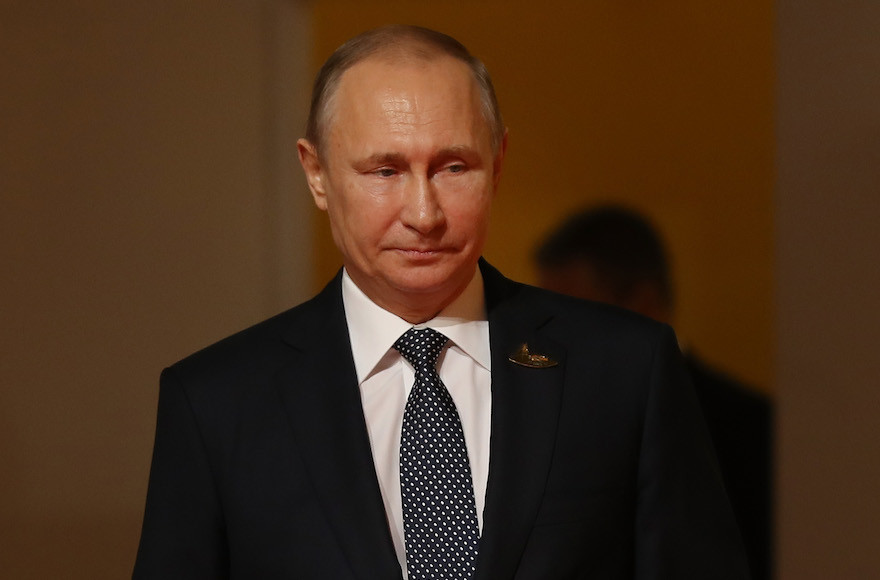
In June, when we last voted in Maryland’s primary elections, the great thinkers in government gave us paper ballots. Intentional or not, this felt like a poke in Russian President Vladimir Putin’s eye. You want to hack American computers and poison our elections? Try meddling with x marks on a piece of paper.
“This will show Putin,” someone was laughing in the place where I vote, in the city of Baltimore. “Because, as everyone knows, nothing is more important to him than the vote for Baltimore City Council.”
In our era of Russian meddling, this is known as dark humor, as whistling past the graveyard of American elections, as imagining Putin’s reach extends so far that he’s influencing the most piddling of our municipal votes.
President Donald Trump meets in Helsinki, Finland, with the Russian leader, and everyone wonders how he’ll confront him – if at all – on his attack on the 2016 presidential election. Every U.S. intelligence agency confirms the abuse.
Only Trump withholds validation. He continues to call the investigation by Special Counsel Robert Mueller “a witch hunt.” This, despite last week’s indictment of a dozen Russian agents, an action that should allow Trump to tell Putin, “We not only know you invaded our election – we know the names of the guys who did it.”
Yet Trump equivocates at every step. He issues empty words about asking Putin if he authorized the attack, but says there’s no way he’ll know if the Russian’s telling him the truth.
But he’s offering the wrong approach: That they attacked is now a given. We want a public confession of the attack, nothing less.
And those dozen Russians indicted last week? This is the moment where Trump should tell Putin, “As part of your penance for your crimes, you must allow the United States to extradite those perpetrators to the U.S. to stand trial.”
Gee, Trump says, extradition hadn’t even occurred to him.
Well, of course not. Not when you’re the last person on the planet who’s still in denial over the original Russian crimes – and, not when you’re still trying to brand the whole investigation into it “a witch hunt.”
On television last week, we witnessed a kind of congressional show trial of this FBI official, Peter Strzok, who was indiscreet enough – yes, and stupid enough – to express his personal misgivings about Trump during the last campaign, in a place where others could find it.
Republicans found this deeply troubling. Imagine, any human being having human feelings about another human being! Surely, this had all the markings of a conspiracy!
This is troubling not only because it defies all insight into human behavior, and because it ignores the entire checks-and-balances mechanism of the FBI to nullify personal feelings in the midst of investigations, and because it ignores the actual outcome of the election.
It’s also troubling because it shows Capitol Hill is still fighting the last war, instead of the next one. A year-and-a-half after the election, they’re still wondering aloud about Hillary Clinton’s emails instead of wondering about the future.
And that future is the arrival of this autumn’s mid-term elections – when we’ll wonder, all over again, if the Russians have attacked us.
And if, all over America, we need to go to something even more primitive than paper ballots.
 A former Baltimore Sun columnist and WJZ-TV commentator, Michael Olesker is the author of six books. His most recent, “Front Stoops in the Fifties: Baltimore Legends Come of Age,” published by the Johns Hopkins University Press, is now in paperback.

At its annual meeting this year, the Baltimore Jewish Council will honor the late Harford County educator and longtime Holocaust education champion.

The former Colt, who passed away on May 25 at age 93, achieved immortality during a cold December day in 1958, writes Michael Olesker.

A new biography on the creator of "Doonesbury" misses the mark, writes Michael Olesker.

What does it mean to be fully present with each other and the sacred, asks Maryland-born cultural anthropologist Alanna E. Cooper.