
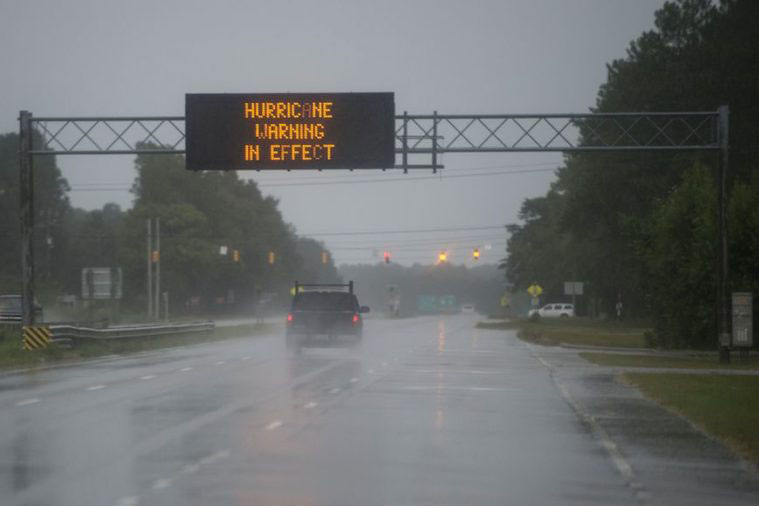
Here’s one man’s reaction to Hurricane Florence: In my head, I’m still recuperating from Hurricane Agnes — which was 46 years ago.
Does anybody else still remember Agnes? Back then, it was the costliest hurricane in recorded history to hit the United States. It did $110 million (in 1972 dollars) worth of damage in Maryland. It caused 19 deaths here. It left more than 700 people homeless in Howard County.
It was a forerunner of the awful damage inflicted now on the Carolinas by Hurricane Florence, where they’re still counting the dead, still assessing the property damage, and still hoping the terrible flooding will begin receding sooner rather than later.
And, as I watch the TV coverage of Florence, and see all those people whose lives are forever changed, I remember my own tiny trauma in the midst of Hurricane Agnes and realize how lucky I was.
I was leaving work, driving through rainy downtown Baltimore maybe a block from City Hall, when I foolishly tried to drive through a slightly flooded area. My car stopped halfway through the water. A block north of me, I could see a metro bus stalled in its own watery area, with passengers remaining inside.
Rolling down my window, peering downward through the steady downpour, I could see the water rising as it encircled my car. I wondered if I should abandon ship and try to get to dry ground – but I’d heard a report on the radio, minutes earlier, about a man trying to swim through some flooded area. He was sucked down a sewer. So I abandoned that plan.
Looking north now, I saw some of the people on the bus waving my way. I waved back. But nobody was going anywhere.
So I sat there. And, in minutes, I saw this strange, almost surrealistic thing happen: the inside of my car began to fill up with water. First it covered the floor, and then it began to work its way up my body: my legs, my midsection, my stomach.
Where to go? Should I open the window, while I still could, and try to climb onto the roof? Should I ignore whatever had happened to that poor soul sucked down a sewer and attempt to swim to dry land?
The folks on that bus, a block away, were waving to me, and I waved back. Gestures of support, that’s all. And then, as I watched the water reach my chest level and wondered if my time on earth had reached its date of expiration, a slight miracle occurred.
The rain stopped.
And slowly, slowly, I watched the flood water recede down my body and drain itself from the belly of my car.
A tiny little trauma in the midst of a hurricane. A reminder of how lucky I was that day, and how awful it must be, right now, for all those people in the Carolinas whose lives have been altered far more than mine.
Also see:
Jewish coalition helping Houston hurricane recovery lists groups aiding Florence victims
‘Who by water’: For Carolina Jews coping with Hurricane Florence, High Holiday themes resonate
 A former Baltimore Sun columnist and WJZ-TV commentator, Michael Olesker is the author of six books. His most recent, “Front Stoops in the Fifties: Baltimore Legends Come of Age,” has just been reissued in paperback by the Johns Hopkins University Press.

At its annual meeting this year, the Baltimore Jewish Council will honor the late Harford County educator and longtime Holocaust education champion.

The former Colt, who passed away on May 25 at age 93, achieved immortality during a cold December day in 1958, writes Michael Olesker.

A new biography on the creator of "Doonesbury" misses the mark, writes Michael Olesker.
What does it mean to be fully present with each other and the sacred, asks Maryland-born cultural anthropologist Alanna E. Cooper.