
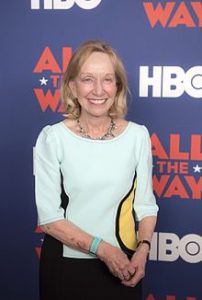
The acclaimed historian Doris Kearns Goodwin came to town Sept. 23 to talk about “Leadership in Turbulent Times” (Simon & Schuster), her new book about four of America’s presidential legends: Abraham Lincoln, both Roosevelts and Lyndon B. Johnson.
Also, she mentioned James Buchanan. Yes, James Buchanan.
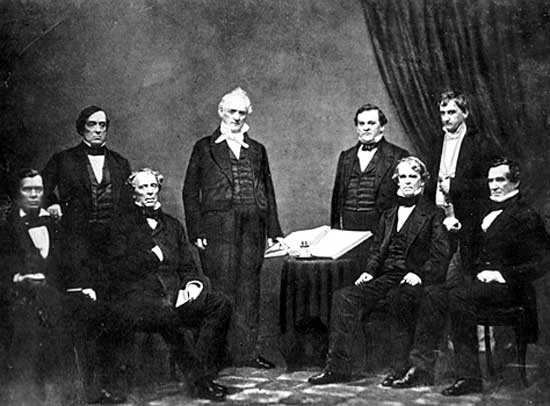
Buchanan, she noted, has mostly been legendary for finishing last in every poll of the best and worst presidents of all time – until now. With the Civil War looming, and slavery and southern secession tearing the country apart, Buchanan did virtually nothing. He finishes last based on merit.
But there is new polling, Goodwin told the overflow crowd at midtown Baltimore’s Church of the Holy Redeemer, which has caused much “celebrating” among all of Buchanan’s descendants. Their man is no longer rated the worst American president.
Donald Trump is.
A Pulitzer Prize winner, Goodwin said precious little about President Trump – at least directly – but by relating the qualities of presidential greatness these men had in common (humility, an ability to grow, a history of overcoming obstacles, etc.), no one needed reminders about how little Trump’s privileged history or his record in office coincide with these great leaders.
Lincoln had virtually no formal education and fought terrible depression. Teddy Roosevelt lost both his wife and mother on the same day. Franklin Delano Roosevelt was crippled by polio. Johnson came from abysmal poverty.
Lincoln and FDR got us through the worst wars in our history. Teddy Roosevelt gave us a laundry list of progressive triumphs. Johnson got lost in Vietnam, but he also gave us civil rights legislation and expanded Medicare and Medicaid.
Trump hopes to finish four years without getting kicked out of office.
As the Pulitzer Prize-winning historian Garry Wills writes in The New York Review of Books in a piece headlined, “Resistance Means More Than Voting,” “The signs of a creeping dictatorship are clear and daily displayed” by this president.
He cites Trump’s denigration of judges and journalists, the “branding of Muslims as ‘animals,’ as Hitler did the Jews,” the calling of neo-Nazis “good people,” the “personal rescinding, achieved or attempted, of major pacts reached by national diplomacy – from the Paris accords, to NATO, to NAFTA, to TPPA [Trans-Pacific Partnership Agreement],” and on and on.
He says it is “not premature” to call Trump “a tyrant.”
In her talk at the church, Goodwin said she will not be writing any biographies of Trump. In her presidential works, she said, “I have to want to wake up with them in the morning and go to sleep with them at night.”
She did not expand on that point.
Or need to.
 A former Baltimore Sun columnist and WJZ-TV commentator, Michael Olesker is the author of six books. His most recent, “Front Stoops in the Fifties: Baltimore Legends Come of Age,” published by the Johns Hopkins University Press, is now in paperback.
At its annual meeting this year, the Baltimore Jewish Council will honor the late Harford County educator and longtime Holocaust education champion.
The former Colt, who passed away on May 25 at age 93, achieved immortality during a cold December day in 1958, writes Michael Olesker.
A new biography on the creator of "Doonesbury" misses the mark, writes Michael Olesker.
What does it mean to be fully present with each other and the sacred, asks Maryland-born cultural anthropologist Alanna E. Cooper.