
Everybody knows we’re 17 years into Americans fighting a war in Afghanistan, but how about that other war of ours, which has gone on three times as long?
That’s the war on drugs, which we’ve been fighting (and losing) through a string of presidents and governors and mayors who have promised us we’re going to win this thing — even if everybody knows they’re lying.
The latest evidence comes from a Sunday Sun story by the veteran reporter Doug Donovan, who uses raw statistics not only to show that the losing goes on, but so does the political hypocrisy.
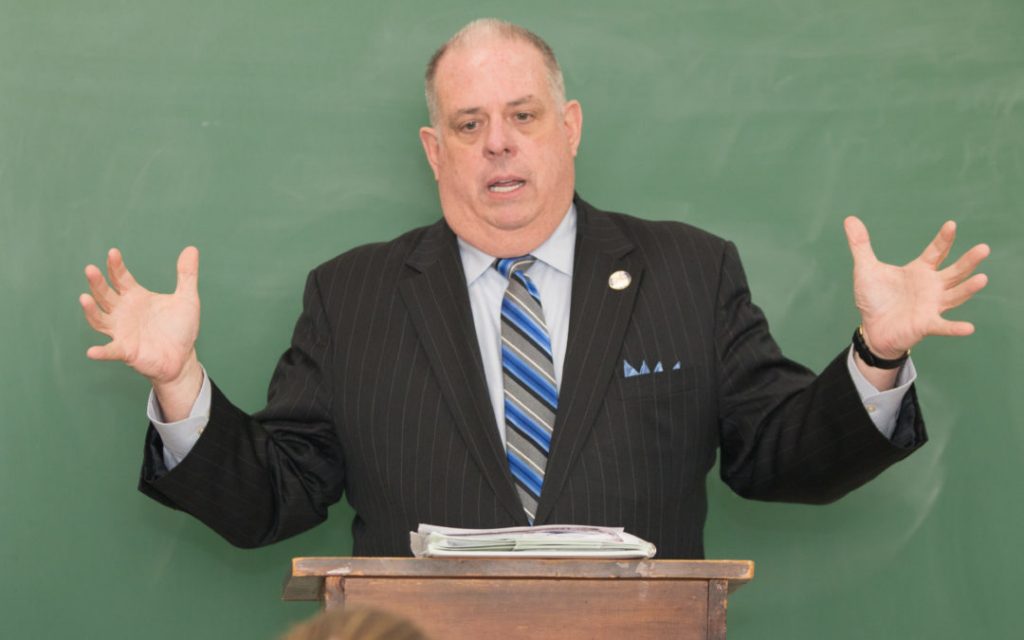
Four years ago, running for governor of Maryland, Larry Hogan berated the outgoing governor, Martin O’Malley, for failing to conquer the state’s “heroin epidemic … a major disaster.”
If elected, Hogan vowed he would immediately declare a state emergency. The state was approaching 900 opioid overdose deaths for that year, 2014. This would be a new, regrettable record.
As Donovan reported, Hogan never declared that formal emergency. Instead, he set up a statewide task force that issued a bunch of recommendations for fighting drug abuse – as though nobody had ever issued such a report in the half-century since various political and law enforcement figures declared “war” on drugs.
The result was that Maryland did not suffer another nearly 900 drug deaths in Hogan’s first year in office. Instead, there were 1,856 drug deaths.
And, while there were 5,019 opioid-related deaths during O’Malley’s tenure as governor, there have been 6,139 during Hogan’s.
And O’Malley’s happened over eight years. Hogan’s, in less than four years.
Do we blame Hogan for such wholesale dying? Not really. In fact, no more than he should have blamed O’Malley for the deaths during his years.
But the abuse, and the wasted lives, have become political footballs over the half-century in which narcotics abuse has spread across all aspects of American life.
For much of that time, America tried to imprison its way out of the problem. The theory was, lock up these abusers, that’ll teach ‘em. That’s the big reason Maryland’s prison population has quintupled since the post-war years.
More recently, as drug abuse has seeped into increasing numbers of middle-class families, there’s been a shift in some quarters, a cry for more treatment facilities. That was, in fact, one of the Hogan task force’s recommendations.
It was former Mayor Kurt Schmoke who first advocated the great shift in drug policy. Treatment, not punishment, Schmoke said. But many misinterpreted his words, falsely arguing he was calling for legalization of drugs.
So here we are, more than a quarter-century since Schmoke called for treatment, and more than half a century since politicians and police started calling for more imprisonment – and, for all the brain power that’s been extended, and all the money spent, we’re losing more lives than ever before and still wondering how to end the endless war.
 A former Baltimore Sun columnist and WJZ-TV commentator, Michael Olesker is the author of six books. His most recent book, “Front Stoops in the Fifties: Baltimore Legends Come of Age,” published by the Johns Hopkins University Press, is now in paperback.
At its annual meeting this year, the Baltimore Jewish Council will honor the late Harford County educator and longtime Holocaust education champion.
The former Colt, who passed away on May 25 at age 93, achieved immortality during a cold December day in 1958, writes Michael Olesker.
A new biography on the creator of "Doonesbury" misses the mark, writes Michael Olesker.
What does it mean to be fully present with each other and the sacred, asks Maryland-born cultural anthropologist Alanna E. Cooper.