
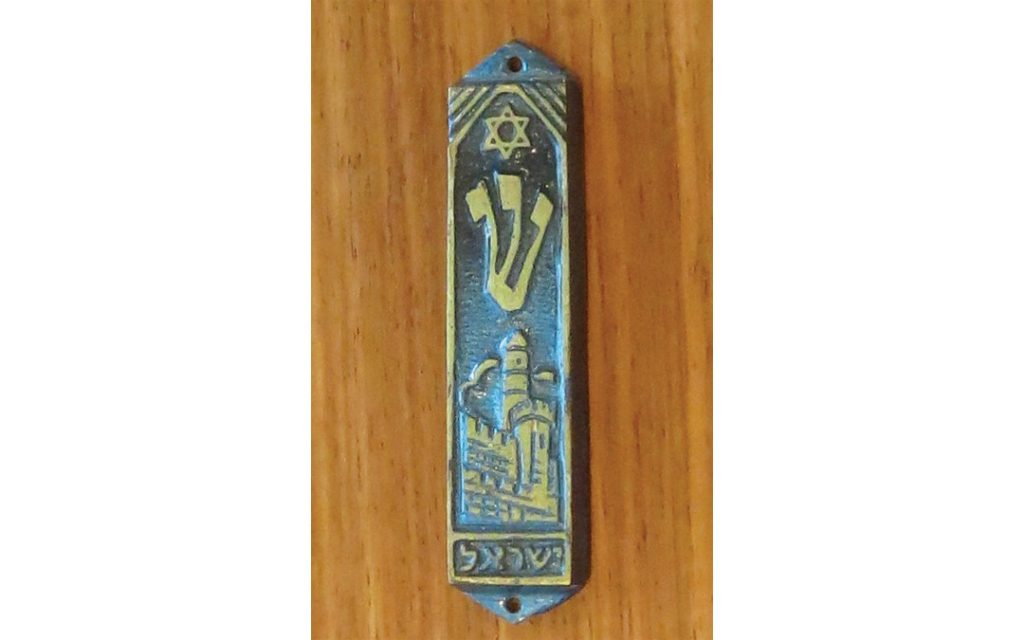
Sometime when you get a chance, take a walk around city neighborhoods like Forest Park, Lower Park Heights and Pimlico, and you’ll see mezuzahs still lining the doorframes of many residences and apartment dwellings there. They are remnants of a bygone era.
Most date back to the 1920s when Jews lived and worked in these communities. Some are covered with ancient slabs of extinct leaded paint, cracked like portraits from the Middle Ages that hang on museum walls.
And for the most part, they are abandoned and long forgotten.
These mezuzahs tend to be much smaller and simpler than their modern counterparts, those that are purchased in tony gift shops with embellished artistic flourishes of glass and metal. Some of them might resemble an oblong pill capsule, but they most definitely are still mezuzahs and mezuzah cases.
Some places have thresholds and doorways bearing the faded outlines of a mezuzah, revealing that at one point in time these were Jewish homes.
For several years of my life, I delivered mail throughout city neighborhoods for the U.S. Postal Service. I would venture that I was likely the only Jewish letter carrier in town — maybe in any town — searching for mezuzahs or the outlines of mezuzahs on doorways when I delivered mail in those neighborhoods.
It used to simply floor me that I found them on probably 90 percent of the homes to which I carried the mail. For me, it was sometimes tough to fathom that I was standing where a thriving Jewish neighborhood once existed, where Jewish kids wearing yarmulkes would play and mothers would make their way to the nearest butcher, beauty salon or corner grocery (many of which were located beneath a rowhouse).
Park Heights and its upscale Jewish cousin, Forest Park, both rose from empty plots, circa 1920. Not all of the inhabitants at first were Jewish, but by the 1930s — when East Baltimore’s Jewish population began to dwindle —these two areas gained sizable Jewish communities. More so in Park Heights, where its rowhouse population gave birth to numerous synagogues, kosher eateries and Judaica shops.
Forest Park, with its singular clapboard cottages of multiple stories, was a more homogenized mixture of Jews and non-Jews, interspersed with churches and synagogues. But it was not “the Jewish ghetto” of Park Heights. There was more greenery along with Spanish- influenced apartment buildings, and a golf course to boot.
This halcyon world was mostly gone by the early 1970s when I was a youngster, a victim of blockbusting, integration, and an increase in crime and poverty. It only lasted for about a half-century.
As the communities fled, Jewish supermarkets, houses of worship and businesses moved to Pikesville or Randallstown, only a few miles or so up the road in the great suburban northwest.
But still, after all of the turmoil, racial turnover and exodus of an ethnic group whose lives were embedded in their communities, the mezuzahs remain. In ways, they remind me of the large monumental statues on Easter Island, the final, enigmatic remains of a long-ago tribe that left its mark years after they were gone.
Yes, there are also buildings still with Stars of David and inscribed Hebrew writing on their cornerstones to prove that these were once communities with a Jewish population. But there are also thousands of rowhouses and cottages, now inhabited by non-Jews, that are still being blessed by these mezuzah cases and ancient Hebrew — albeit no longer kosher — scrolls.
May they bless these homes for a long, long time to come.
Steve Liebowitz is a Baltimore-based freelance writer and author of “Steel Pier, Atlantic City: Showplace of the Nation” (Down the Shore Publishing) and “Steel Pier” (Arcadia Publishing).
At its annual meeting this year, the Baltimore Jewish Council will honor the late Harford County educator and longtime Holocaust education champion.
The former Colt, who passed away on May 25 at age 93, achieved immortality during a cold December day in 1958, writes Michael Olesker.

A new biography on the creator of "Doonesbury" misses the mark, writes Michael Olesker.
What does it mean to be fully present with each other and the sacred, asks Maryland-born cultural anthropologist Alanna E. Cooper.