
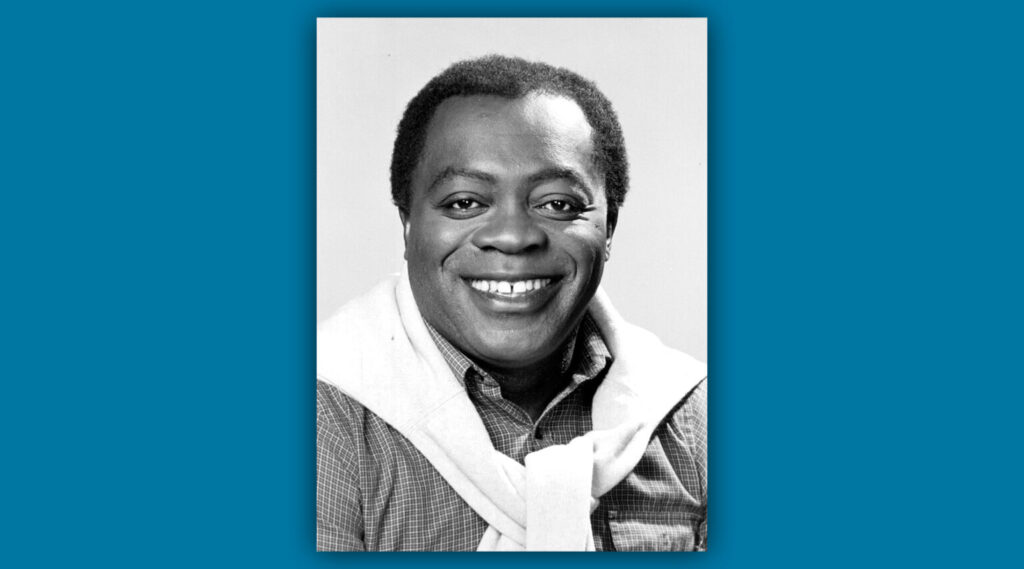
Yaphet Kotto, the versatile and commanding actor who starred in the acclaimed Baltimore TV crime drama “Homicide: Life on the Street,” died Mar. 15 at age 81. No cause of death was given. Kotto’s agent, Ryan Goldhar, said his death was “quite sudden.”
Besides “Homicide,” Kotto was known for many other memorable roles, including his Emmy Award-nominated performance as Ugandan dictator Idi Amin in the 1977 TV film “Raid On Entebbe,” which chronicled the daring rescue of Jewish airline passengers by Israeli commandos during a hijacking by Palestinian terrorists on July 4, 1976.
It was a role with a direct connection to the unusual lineage claimed by Kotto. Like Amin, Kotto had roots in Africa. His father was a Cameroonian immigrant to the United States whom Kotto said was a descendant of that country’s royal family. He was also Jewish, like the passengers on the plane and the commandos that freed them.
In fact, Kotto said he was frequently bullied as a child in the South Bronx and Harlem because he was one of the few Jews in those areas. And he said that if he had not discovered acting, he would likely have become a rabbi.
“Look at all the films I’ve made. People say, ‘How did you do it?’” he told InsideHook, an online magazine, in 2019. “I say, ‘Do you realize how many movies I’ve made? No agent or manager got me those jobs! It’s my faith that’s gotten me everything.’”
Kotto appeared in such celebrated films as “Alien,” “Midnight Run,” “The Thomas Crown Affair,” “Brubaker,” “Blue Collar” and “Live and Let Die,” in which he portrayed the first Black villain in a James Bond movie.
A former Baltimore resident, Yaphet Frederick Kotto was born Nov. 15, 1939, in New York City to Avraham Kotto, who converted to Judaism as a young man in Cameroon, and Gladys Marie, a U.S. Army nurse from Panama who became Jewish before he was born, Kotto wrote in his self-published 1990 autobiography, “The Royalty: A Spiritual Awakening.” (Kotto claimed in the book to be distantly related to Queen Elizabeth II.)
Raised in Harlem and the South Bronx, he said his religion caused him trouble growing up. “It was rough coming up,” he told the Associated Press in 1994, according to a 1997 news story. “And then going to shul, putting a yarmulke on, having to face people who were primarily Baptists in the Bronx, meant that on Fridays I was in some heavy fistfights.”
Acting was a refuge for Kotto, and he took high-level theater classes as a teenager. His professional debut was in an all-Black performance of “Othello” in Harlem in 1960, and he later appeared on Broadway in “The Great White Hope,” stepping in for James Earl Jones to play a character based on heavyweight boxing champ Jack Johnson in the original, Tony Award-winning production.
“I had never even heard of the Hollywood-based Mr. Kotto,” Clive Barnes of the New York Times wrote in a review. “But luckily someone had, for this is inspired casting, and Mr. Kotto will never be unheard-of again.”
Landing his first screen roles in the mid-1960s, Kotto soon became a familiar face on television and in films. Among them were “The Big Valley,” “Bonanza,” “Mannix” and 1973’s “Live and Let Die,” and in the 1990s he portrayed Baltimore City Police shift commander Lieutenant Alphonse Michael “Gee” Giardello on the gritty, seven-season “Homicide: Life on the Street.”
The intense and physically imposing Kotto appeared in all 122 episodes of the Emmy-winning series, which was based on the 1991 book “Homicide: A Year On The Killing Streets” by former Baltimore Sun reporter David Simon. (Kotto also made a cameo in a 2004 episode of Simon’s highly regarded, Baltimore-set TV series “The Wire.”)
In a tweet, Simon recalled that the Giardello character was originally conceived as a white Italian-American.
“When Yaphet signed on to take the role, there was a natural inclination to change the character to reflect ethnicity,” he wrote. “But [executive producers] Tom [Fontana] and Barry Levinson, in a decision as inexplicable as it was brilliant, said f— it, he’s Al Giardello and whether he’s the child of a mixed marriage or an adopted kid or whatever, he identifies as Sicilian. We’re going to go with it. And Yaphet just went with it, relishing the occasional Italian phrase and talking with his hands at points.”
Levinson once said of Kotto’s acting talent, “Yaphet has great credibility, a simple strength, a quiet passion.”
At a time when few Black Jews had gained public notice, Kotto stood out. “Yaphet Kotto was one of the greats, actor, writer & screenwriter … but especially for me, one of the first highly visible Black Jews I ever knew of,” tweeted Black Jewish activist Amadi Lovelace on Mar. 15. “Hearing his story helped me find my way home. His memory will be a blessing.”
Academy Award-winning actress Viola Davis posted on Facebook about Kotto, “You were so memorable in every role you did. Your presence and talent were undeniable and magnetic … whether you were the villain or the hero. Rest well #YaphetKotto. God bless your wife and family. You will be missed.”
Tweeted director Ava Duvernay about Kotto, “He’s one of those actors who deserved more than the parts he got. But he took those parts and made them wonderful all the same.”
After “Homicide” ended in 2000, Kotto appeared on the big screen only once more, for a small part in a 2008 comedy called “Witless Protection,” starring Larry the Cable Guy and Jenny McCarthy.
Among the films Kotto famously passed on were “The Empire Strikes Back” and “Glory,” as well as the role of Jean-Luc Picard in “Star Trek: The Next Generation.”
Over the past two decades, he promoted a range of unusual and sometimes contradictory views, saying that he had been abducted by aliens, dismissing the dangers of COVID-19 and sharing content associated with QAnon, the conspiracy far-right theory and movement.
Last year, Kotto endorsed both Black Lives Matter and President Donald Trump. (He also forcefully rejected the prospect of a Black actor being cast as James Bond.) On Facebook, he suggested that he had embraced Jesus and quoted passages from the Christian Bible several times over the last year.
In the 2019 InsideHook interview, Kotto had not indicated any religious transformation, although he said he now looked for the nearest deli rather than the local synagogue when he traveled. But he did say that Judaism remained a lasting influence in his life.
“I still open every book I read from the back page to the front. [My father] instilled Judaism in me. Everything the Jewish religion stands for, from an African’s point of view, he left those things in me — especially things that had to do with the New Testament, which he was thoroughly, totally against. He said it was BS,” Kotto said to InsideHook. “If it weren’t for him, I would have probably gone to hatred or violence or drugs or alcohol. I escaped all of those things because of Judaism.”
Kotto’s wife of almost 23 years, Tessie Sinahon, announced his death on Facebook on Mar. 15, saying he died near the Philippines capital of Manila, where the couple were living. (In July of 1998, Kotto and Sinahon, a native of the Philippines, were married in a traditional Jewish ceremony at the historic The Cloisters event venue in Baltimore County’s Brooklandville community, with then-Mayor Kurt L. Schmoke, “Law & Order” actress S. Epatha Merkerson and former Maryland Sen. Barbara A. Mikulski in attendance. It was Kotto’s third marriage.)
“You played a villain [in] some of your movies but for me you’re a real hero and to a lot of people also,” she wrote. “A good man, a good father, a good husband and a decent human being, very rare to find.”
In addition to his wife, Kotto is survived by four daughters and two sons, including one who was a longtime police officer in the San Francisco Bay Area.
Philissa Cramer is the editor-in-chief of the JTA global Jewish news source. Jmore staff contributed to this report.

Israeli-Americans Rachel Goldberg-Polin and Jon Polin talked about the pain of losing their 23-year-old son, who was kidnapped and later murdered in the Oct. 7th tragedy.

Rabbi David Wolpe looks at the recent interest in Hollywood productions about King David and why the story is resonating now.

Directed by Johanna Gruenhut, the production is based on of the 1998 novel and 2003 film of the same name.
In "The Future is Peace," Aziz Abu Sarah and Maoz Inon say there is still hope for coexistence between Arabs and Jews.