
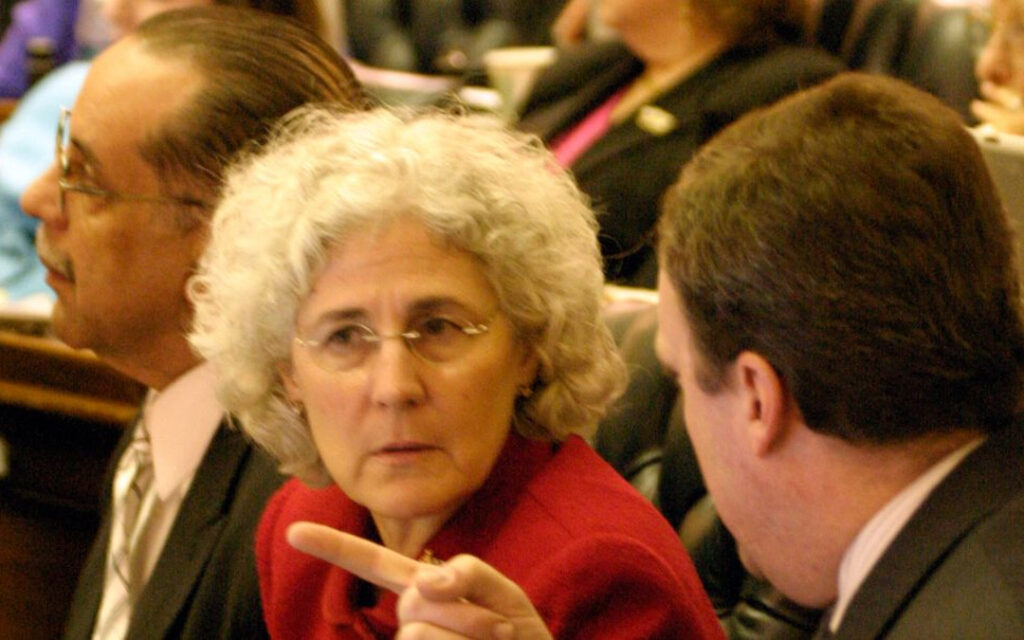
It took only 54 seconds for Del. Shane E. Pendergrass (D-13th) to stand up and call out another member of the Maryland General Assembly for what she felt diminished the meaning of the Holocaust.
Pendergrass, who represents Howard County and lives in Columbia, said she wishes she acted even faster.
“The question was, how did I make myself sit in my seat for the extra 15 seconds before I stood up?” she said.
On Apr. 8, Del. Daniel L. Cox (R-4th) rose on the House floor to oppose a bill that would lower the age at which children can seek mental health treatment without parental consent. House Bill 132 was sponsored by Del. Heather Bagnall (D-33rd) of Anne Arundel County.
Cox, who represents portions of Carroll and Frederick counties, compared the bill to the Nazi behavior revealed during the Nuremberg trials of 1946. Cox said he would mark that particular day, Yom HaShoah, or Holocaust Remembrance Day, by voting against the bill, which he said “interferes with the sacred right of parents and their children.”
Pendergrass rose at that point and said she wanted to speak on a “point of personal privilege,” a right granted by the House rules. Cox objected, but House Speaker Adrienne A. Jones (D-10th) allowed it.
“I am enormously affronted as a Jew when you in any way compare this bill to the Holocaust, especially today,” she said. “Shame on you.”
Talking about her response later, Pendergrass, 71, said, “I am the absolute least likely person to be doing this,” noting that she was raised Jewish but no longer has any connection to religious ritual. “I have very little connection to the practice of the religion.”
But as Pendergrass, a Los Angeles native, listened to Cox, she said she recalled how her late father, Marvin Reitman, was a prisoner of war held by the Germans during World War II. She said he understood Yiddish but did not let the Nazis know he comprehended what they were saying in German. He threw away his army dog tags before being captured to avoid being identified as a Jew.
“His family thought he was dead,” said Pendergrass. (The Library of Congress recorded Marvin Reitman’s story.)
Pendergrass, who serves as chair of the House Health and Government Operations Committee, became emotional while recalling her father’s story. “Forgive me, this is hard for me to say,” said Pendergrass. “You know, if you’re born a Jew, you’re a Jew. It’s not about whether you go to shul.”
She said she was offended by Cox’s remarks not only because she is Jewish but also because her professional experience as an art therapist included caring for children with mental health issues.
“I’m very sensitive to mental health issues,” said Pendergrass, whose primary focus as a legislator has been health care.
The bill Cox objects to would allow minors as young as 12 to seek care for certain health services without parental permission.The bill passed the Democratic-led legislature, 92-44
During his remarks on the floor, Cox said the COVID-19 face mask he wore that day had a photo from the Nuremberg trials printed on it, and compared the bill to the Nazis’ infringement on “the rights of parents.” During the war crimes trials that began in 1945 in Nuremberg, an international tribunal charged Nazi medical doctors for their involvement in human experimentation and mass murder.
“One of the things that was interesting and very sad in the Nuremberg trials was the fact that medical professionals interfered with parental rights. And what was the result of those trials? Well, the European Union passed the European Commission on Human Rights guaranteeing that never again will the state and the health care community interfere with the rights of parents, and the rights of family,” he said. “That’s what this bill does.”
Cox was likely referring to the European Convention on Human Rights, adopted in 1953 by the then Council of Europe.
In a statement, the Jewish Community Relations Council of Greater Washington called Cox’s comparison “unconscionable.”
Cox later in the session said he wanted to “apologize for any improper comparison, that wasn’t my intent at all.”
Cox said he was seeking to protect “sacred parental rights,” and noted that he has visited Auschwitz and is of Jewish ancestry.
“I just want you to know that I’ve been raised to absolutely love and remember the struggle of the Jewish race and the Jewish religion and of our dear friends,” he said. “My great-great-grandmother actually is Jewish from eastern Germany. And when I walked the halls of Auschwitz I want you to know I went, I actually walked into the gas chamber. And so I just, you know, absolutely want you to know how much that impacts me.”
Pendergrass, who was first elected to the General Assembly in 1994, said she has a reputation in the chamber for outspokenness. For instance, she is known for speaking out whenever invited clergy invoke the name of Jesus in blessing House proceedings — she would bang the lid of her desk shut in protest.
As a result of the protests from Pendergrass and others, the General Assembly in the early 2000s ended the practice of inviting clergy to open sessions, making it unique among American legislative bodies. Instead, Maryland lawmakers open sessions with prayers but are forbidden to invoke a specific religion.
“I have a long history of, when people do things that are unacceptable, of standing up and letting them know,” she said.
Pendergrass said she was not exactly surprised that Cox outraged her with his Holocaust allusion. He is considered to be on the far right of the Republican party and organized two buses to attend the Jan. 6 protests at the U.S. Capitol that aimed to overturn the election of President Joe Biden. He shocked fellow delegates when on Twitter he called Vice President Mike Pence, who affirmed that former President Donald Trump had lost the election, a “traitor.”
In January, Gov. Larry Hogan, a Republican, publicly called Cox “a QAnon conspiracy theorist who says crazy things every day.”
As Cox spoke on the House floor, Pendergrass said she was actually stunned that he acknowledged the reality of the Holocaust.
“The first thing I thought as he talked about the Holocaust, and knowing who he is, I looked at him and was quite startled that he was not a Holocaust denier,” she said. “So I was paying attention to what he said.”
Ron Kampeas writes for the JTA global Jewish news source. Jmore staff contributed to this report.

The Jerusalem Orchestra East & West, which arranged the program for young musicians, blends Western orchestral music with Middle Eastern traditions.
A Norfolk native, Frankle worked at Sinai Hospital, Camp Airy and privately for five decades.
Esther Greenberg, Leora Match, Kathlleen St. Villier Hill and Ben Gershowitz will be recognized for the contributions to the community.
For more than five decades, Dr. Rosenstein was known by local families as a trusted and caring physician for their children.