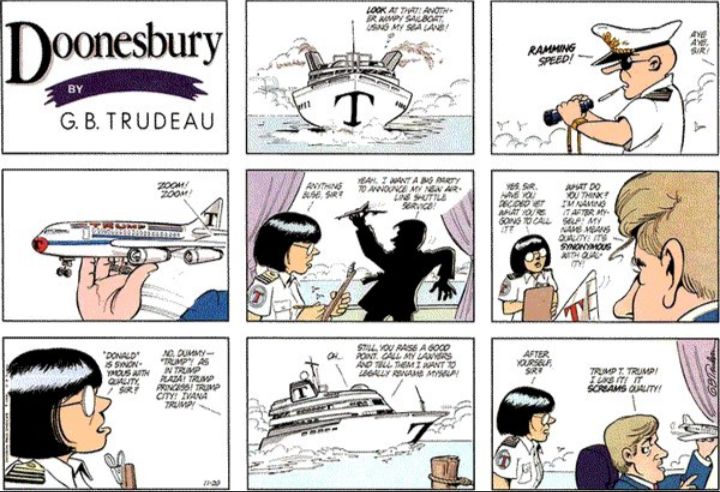
When he was 26, Garry Trudeau became the first funny pages artist to win the Pulitzer Prize for editorial cartooning. He won it in 1975 for “Doonesbury,” the cartoon that brought an adult sensibility to the newspaper page historically aimed mainly at children.
That was a pretty good year for Trudeau.
His strip was running in 450 newspapers with a total of 60 million readers. A national poll ranked him as the 10th most-admired man in the world, behind Russian dissident Alexander Solzhenitsyn and ahead of Walter Cronkite and Ronald Reagan. And he became the youngest person ever to receive an honorary degree from Yale.
Also, he was dating Candice Bergen, all of which was a few years before he met and married television’s Jane Pauley.
For more than half a century now, Trudeau has been one of our most astute political and cultural observers, a remarkable real-time satirist, and a guaranteed smile when he’s not making us grimace over the state of world. He’s a national treasure.
As he moves ever closer to 80, and he’s cut his cartooning back from seven days a week to Sundays only, Trudeau is entitled to an admiring examination of his life and the great characters he’s brought us such as Michael J. Doonesbury, Zonker Harris, Joanie Caucus, Mark Slackmeyer and football star-turned-wounded war hero B.D.
So the timing couldn’t be better for “Trudeau & Doonesbury: A Biography: The Cartoonist Who Turned the News into Art” (Abrams Press), by Joshua Kendall.
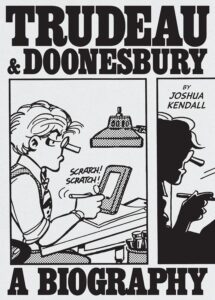
But unfortunately for all of us who have admired Trudeau and his creation, the biography misses its mark. It’s less a history of Trudeau’s life than a catalogue of the righteous causes he’s taken on, an inventory of the plaudits and the hits he’s sustained, and the strength he’s shown in carrying on his work in the face of it all.
It’s not that Kendall hasn’t made attempts to get at Trudeau’s true personality. He has. He’s interviewed dozens of people who have known him over the years — the famous and the infamous and the unknowns — and gotten their takes.
But the insights feel like they’re about an inch deep.
What’s also missing is a sense of the great “Doonesbury” characters. What makes these people tick? They’re comic strip characters, but not really. They’re representatives of cultural types, reflections of a couple of generations of Americans trying to figure things out in a confusing world.
Ironically, Kendall had a piece about his book last week in The Forward, in which he strips down one of the “Doonesbury” characters in precisely such a manner.
The piece is headlined, “Garry Trudeau was a prep school kid, but he identified with the Jewish outsider in ‘Doonesbury.’”
It’s about Mark Slackmeyer, the campus radical who becomes the radio talk show host “Megaphone Mark.”
The piece is really good. As Kendall writes, Slackmeyer is Trudeau’s vehicle to “break the tension between assimilationist anxiety and a self-assured, unapologetic Jewish sense of identity.”
That’s the kind of analysis that’s missing from the book — about the comic strip’s characters, and about Trudeau himself.
It’s nice to know Trudeau’s an honorable guy, generous with fellow cartoonists, hard-working, modest, a dedicated family man. But for a fellow who’s spent his life making up stories, there ought to be some more good ones about him.
For a long time, we’ve known he’s a very private man who’s gone years at a time without granting an interview. He’s not J.D. Salinger, a hermit at heart. Trudeau’s got a rich circle of friends and family, and he works the cartoon narratives hard.
But the same desire for privacy that Trudeau has felt his whole life apparently held firm when Kendall came calling. It feels as if the author is thinking, “How lucky I am to get this gig, writing about this terrific guy. Now, don’t blow it by making him go back into his shell.”
The great newspaper columnist Nicholas Von Hoffman called Trudeau our first “investigative cartoonist.” And so he was, giving us not only laughter but smart insights into American pop culture, Vietnam and Watergate, and politics from the disastrous Nixon years to the catastrophic time of Trump.
The book is pleasant, and it’s loaded with old “Doonesbury” strips. Each one harkens back to a specific time in American life. And each is a reminder that Garry Trudeau and his creation have been a gift to the whole country, even as newspaper audiences shrink so dramatically.
But this “biography” isn’t quite what it’s supposed to be. It’s not exactly the story of Trudeau’s life. And it doesn’t tell us nearly enough about all those wonderful characters he brought to life.
A former Baltimore Sun columnist and WJZ-TV commentator, Michael Olesker is the author of six books, including “Journeys to the Heart of Baltimore” (Johns Hopkins University Press) and “Michael Olesker’s Baltimore: If You Live Here, You’re Home” (Johns Hopkins University)
What does it mean to be fully present with each other and the sacred, asks Maryland-born cultural anthropologist Alanna E. Cooper.
As millions mourn the passing of Stephen Colbert from the airwaves, Michael Olesker looks back on the "institution" of late-night TV.

As he gets ready to leave for California, Rabbi Daniel Cotzin Burg looks back on his time in Baltimore and his 10 years writing for Jmore.