
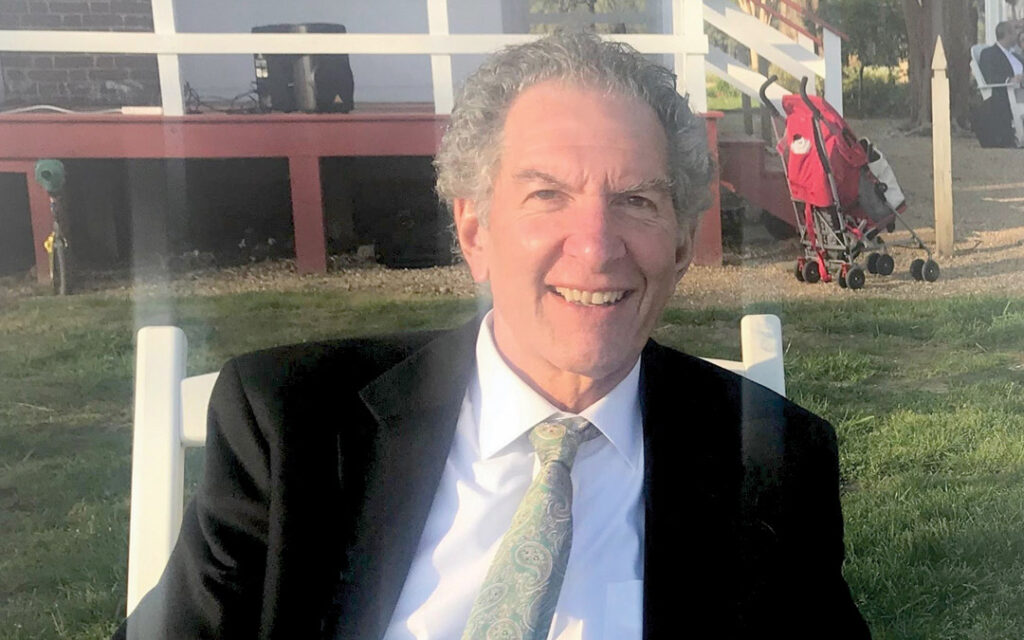
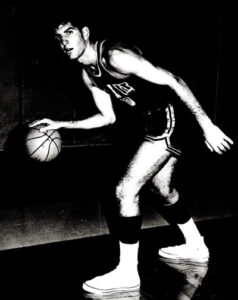
A Southwest Baltimore resident born and raised in Brooklyn, N.Y., Ivan Leshinsky is a former basketball star for Long Island University. He also played for three years in the Israeli Basketball Premier League, all for Hapoel Tel Aviv, from 1968 to 1971. In addition, Leshinsky played for the Israeli national team and competed in the 1969 FIBA European Championships for Men and in the 1970 Asian Games, at which he won a silver medal with Team Israel.
Now 74, he recently self-published “Teaming Up: A Memoir about Sports, Work, Travel, Family, and Neighbors,” which tells Leshinsky’s life story pertaining to basketball and his various occupations, including the 37 years he served as executive director of the Chesapeake Center for Youth Development in Baltimore. The CCYD is a nonprofit that operates programs for disadvantaged youth.
Jmore recently spoke with Leshinsky, co-founder of the Southwest Sports & Fitness Alliance, about “Teaming Up.” He will speak on Thursday, Sept. 9, at 6:30 p.m. at the Federal Hill branch of the Enoch Pratt Free Library, 1251 Light St., as part of the “Writers Live!” program.
Jmore: What was your initial inspiration for writing this memoir?
Leshinsky: My parents were first-generation Americans — their parents immigrated from Russia — and when you’re a teenager and growing up or young, you’re very self-centered. So neither myself or any of my brothers had much interest in finding out where our family came from, what they did for a living, those sort of things.
My parents never shared that information with me. … Three of my grandparents died either before I was born or when I was very young, so I couldn’t even talk to them, and I thought that what I could do is to make sure my one granddaughter had some sense of family history, and that holds true for my nieces and nephews as well, and their children.
That was really the initial motivation. But as I started writing, I’m thinking, ‘You know, there’s a lot more to this story that other people might be interested in.’ And I think that’s true because I’ve probably sold about 30 or 40 books already … and I’m getting some really great feedback from people who have read the book.
A lot of this book is marked by a sense of location. What is the role of place in your story and your family’s history, and how do you think that impacted how you learned all the information you needed to write your story?
Place is incredibly important. So much of my life up until I was in my early 20s revolved around New York City and Brooklyn, where I was born. New York was just such a melting pot of so much stuff going on.
But I had a pretty sheltered life. When I was growing up, it was a pretty safe place. This is back in the ’50s and ’60s. When I was growing up, you really didn’t have to worry that much about crime and violence. And then I lived overseas, and that was a real eye-opener. I lived in Israel for three years. I’d come back [to the United States] in the summer, but I was playing basketball over there for the Israeli team, so I’d come back home in the summer and usually work in a summer camp.
I traveled all over the world playing basketball, and it basically led to a lot of the other travels once I stopped playing basketball. I met my wife while I was playing in France. Once we got married, we would spend every year either going back to France to visit her family and [to take] some side trips, or taking some very exotic vacations. She was a teacher, and once I moved to Baltimore I became the director of the Chesapeake Center for Youth Development, [so] I could pretty much write my own pick in terms of vacations as long as everything else was covered. We’ve had a lot of wonderful trips.
Again, living overseas was different. I got a lot out of seeing different cultures and eating different foods, discovering new cities, all of that. After I stopped playing basketball, I lived in Annapolis for 30 years. I was close enough to D.C. and to Baltimore, and we’d take advantage of everything that those cities had to offer. I’ve been living in Baltimore now for 15 years. I call myself a ‘Baltimore Believer.’ No matter how bad things seem in the city, I’m always thinking that they can get better. There are people here that are trying to make it better. We have a really great community association living down here. That really makes [Southwest Baltimore] very livable.
How did playing basketball impact the rest of your life?
I played organized sports and I had coaches, mentors, teammates. We would trust one another, we became lifelong friends. You work hard, you build up your confidence, [and] I think there’s value in that.
To me, the sports background really prepared me. I was the executive director of the Chesapeake Center for Youth Development for 37 years. That was a job that was important. The organization felt [like] something that was badly needed in Baltimore. You had hundreds upon thousands of kids that were either not attending school regularly or they were getting suspended and expelled, so you needed these alternative programs. … We had this alternative school, and if we could just help these kids get to a more settled age without further legal troubles, we would be doing our job. If they improved their academic skills along the way, that was even icing on the cake.
If you had to pick, what section of this book is closest to your heart?
It has to be the years that I was leading the Chesapeake Center for Youth Development, because it’s a very hard thing to do, especially when you’re running a non-profit organization and especially when your mission and purpose is not something that elicits great support from the general population.
These were kids that are breaking into houses, they’re stealing cars … I’ve always had to do fund-raising, write grant proposals, go after individual donations, seek out very wealthy people that had some discretionary money and try to convince them that they could make an investment in what we were doing, and [that] it would pay off in the long-run for some of these kids. I had plenty of sleepless nights wondering if we were going to make payroll. … Fortunately, there were some very generous people that supported us, [and] they’re continuing to support the work that I’m doing now.
I retired in 2017 and started a new non-profit here in Southwest Baltimore just to get more kids involved in organized sports. If I were an artist, I’d probably be working more with the schools to bring more arts and music programs to the area. Children and youth down in Southwest Baltimore need a lot of everything, so they benefit — like I did — from organized sports. So that’s what we’re about right now.
Gillian Blum is a Jmore editorial staff intern.

The 16-year-old sophomore succumbed to injuries sustained in a car crash last week in Cockeysville.
Schools in Montgomery County have recently experienced a wave of antisemitic incidents.

CCBC Honors scholars are discovering a level of academic rigor and opportunity typically associated with elite four-year institutions.
Filmmaker Justin Schein looks at wealth and inequality through the very real story of his late father.