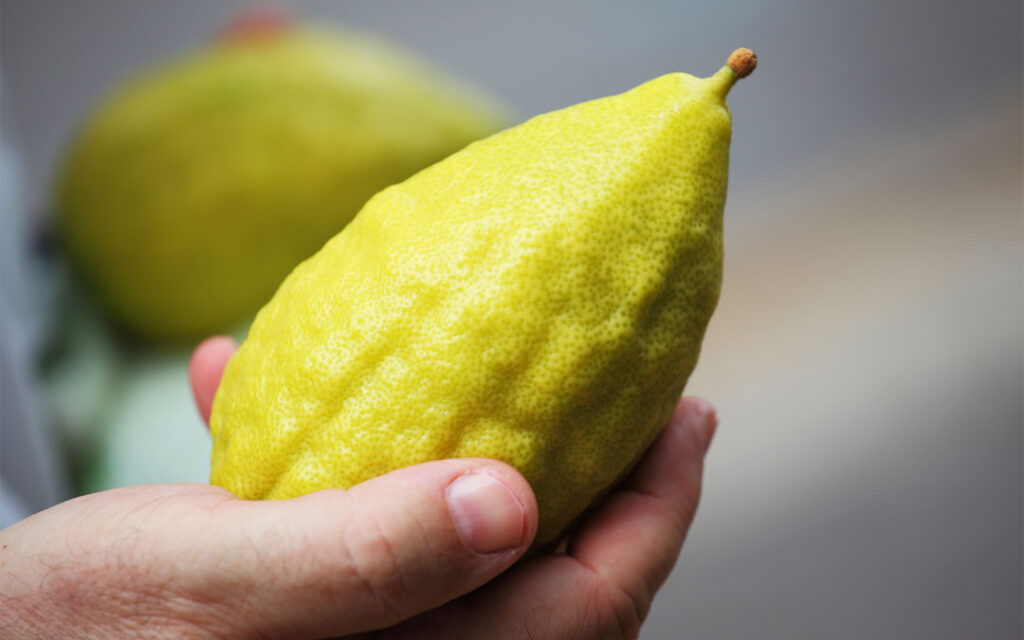
There is a wonderful, true story that is so relevant for us during this High Holiday season, and not only because it deals with an etrog and the holiday of Sukkot.*
There once was a young boy who at age 8 lost his father in an accident. The boy’s mother was forced to take on the financial burden of the family, and as a result money was very tight. As the boy’s first Sukkot as a bar mitzvah drew near, he sought an etrog with which to fulfill the mitzvah of the holiday.
Our Sages instruct us to acquire as beautiful an etrog as possible, an etrog mehudar, clean of all blemishes. This is what the boy wanted, but there was no extra money to facilitate the purchase.
He decided to save up, one shekel at a time, until he finally collected enough money for a beautiful etrog. And he did — just in time for Sukkot! He excitedly rushed to the Machane Yehudah Market in Jerusalem. On the vendors’ tables were kosher and mehudar etrog boxes. But when he arrived home and opened the box, there appeared to be a big mistake: the etrog was kosher, but it was not mehudar!
The boy wanted to make sure his assessment was accurate, so he brought the citron to former chief rabbi of Israel Rav Mordechai Eliyahu (1929-2010), an expert on the matter. When the boy presented the etrog to the revered sage, the rabbi drew it close, inspecting it from all sides. He then looked at the boy and pronounced, “Kosher!”
The young boy immediately responded, “But HaRav, is it mehudar?” Rav Eliyahu again tersely answered, “Kosher!” The young boy was grateful for the rabbi’s time but was deeply saddened. He wanted an etrog mehudar, not just a “kosher” one! He took his etrog, thanked the rabbi and left, sad and dejected.
As he exited the rabbi’s home, he heard someone running his way. It was one of the rabbi’s family members. Rav Eliyahu wanted to see the boy. When the boy stepped into the home, Rav Eliyahu was waiting for him with the most beautiful etrog in hand, worth over 1,000 shekels. Rav Eliyahu gently said, “Let’s trade etrogs. You take my etrog mehudar, and I will take your kosher etrog.” Tears began running down the boy’s cheeks out of shame and excitement. He took the etrog mehudar from the rabbi’s hand and, with a smile from cheek to cheek, parted ways once more with the rav.
The next day was the first day of Sukkot, and the young boy joined Rav Eliyahu at his early minyan. When the rabbi shook his four species, the boy intently watched to see which etrog he would use. “Surely it would be something special!” he thought, like the one the rabbi gave the boy. He looked and couldn’t believe his eyes. The Rav was reciting the blessing over the young boy’s etrog!
The story continues with the young boy, now an older man, reflecting on what happened years back, lavishing praise on Rav Eliyahu for his humility. He gave over his only etrog mehudar to the child, so he would be happy and continue to scrupulously guard the mitzvot. What a kindness!
Another message we learn from the story — and perhaps Rav Eliyahu wanted to teach this to the boy and others as well — is that when a rabbi says something is kosher, it is 100% kosher! Kosher is kosher! At least kosher enough for the chief rabbi of Israel!
However, the most powerful explanation I heard to this story is that Rav Eliyahu never gave up on his desire for an etrog mehudar. He just found it in the young boy’s etrog! The child put his love, devotion and purest of intentions into acquiring the etrog. He waited patiently and saved up money for it in the hopes of serving HaShem in the best of ways. In this way, it was beautiful, despite its external imperfections. It was so special that Rav Eliyahu used it for himself on Sukkot!
There is a pertinent message here for all of us in these days of prayer and teshuvah (return). We must, of course, pray, repent and mend our ways during this auspicious time of year. However, we must always remember what Rav Mordechai Eliyahu knew all too well: that HaShem wants our hearts! Let’s put it all out there this year, with sincerity and purity of intention, and in this merit may we all be remembered for blessing, peace and a “good life”!
* The original etrog story (in Hebrew) can be found here.

Rabbi Dr. Eli Yoggev serves Pikesville’s Beth Tfiloh Congregation.
What does it mean to be fully present with each other and the sacred, asks Maryland-born cultural anthropologist Alanna E. Cooper.
As millions mourn the passing of Stephen Colbert from the airwaves, Michael Olesker looks back on the "institution" of late-night TV.

As he gets ready to leave for California, Rabbi Daniel Cotzin Burg looks back on his time in Baltimore and his 10 years writing for Jmore.