Driving through Northwest Baltimore in Saturday morning’s raw wind and snow, I saw the armies of the faithful trudging their way to synagogue on foot, and marveled at the strength of their belief.
Such miserable weather never keeps them from walking all the way to Shabbat services, whatever the distance, following ancient scriptural decrees. It’s a lesson in devotion for those of us who don’t obey those scriptures so closely, and instead drive cars with the heaters humming away as we head for less sacred venues.
But I wondered what happens once the faithful are inside at prayer. Do the comforts of a warm place and some healing rabbinical words explain not nature’s wrath — but Vladimir Putin’s?
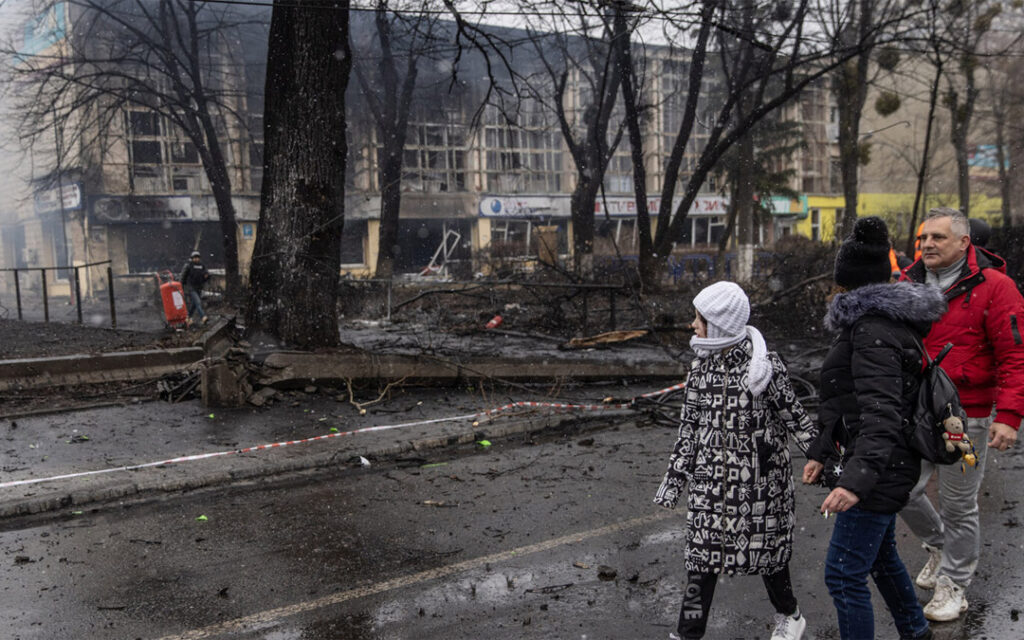
In the midst of the killing of innocents in Ukraine, are there answers to the mysteries of God’s intentions amid catastrophe?
As Isaac Bashevis Singer wrote, with tongue slightly in cheek, in “The Magician of Lublin, “The Jews spoke to a God no one saw. Although plagues, famines, poverty and pogroms were His gifts to them, they deemed Him merciful and compassionate, and proclaimed themselves His chosen people.”
In Ukraine now, all people are the chosen people — chosen, as innocents, to be led to slaughter. Who could watch the ongoing massacre and not question the power, or the intentions, of God at such a time?
Or as Joseph Heller wrote in “Catch 22,” “And don’t tell me God works in mysterious ways,” Yossarian said. “There’s nothing so mysterious about it. He’s not working at all. He’s playing. Or else He’s forgotten all about us.”
Yossarian’s cry comes in the midst of his own hellish war. Here we are, three-quarters of a century and many wars later, and still not one of us knows any answers. When it comes to God, no one has inside information. We choose to think there’s a force in the universe with infinite power, who uses that power to make moral judgements, and we call this power God.
But the evidence is a little sketchy in our current moment of the Dark Ages revisited.
We’re told Vladimir Putin is a man of God. It’s been reported he’s worn a crucifix around his neck for most of his life. His mother was a devout Christian (and his father an atheist). He’s embraced the patronage of the Russian Orthodox Church.
But none of this answers questions about Putin’s genuine belief in God. More likely, he sees himself as a messianic figure.
When he thinks of God, or his mother’s religious devotion, Putin can’t be thinking of Jesus’s words from the New Testament: “Blessed are the peace makers.”
Over the catastrophic weeks of the Ukraine fighting, I’ve had increasingly frustrating discussions about God and faith. One rabbi openly admitted his notions of God are based merely on conjecture. Who can honestly say otherwise?
My own conjecture is that God is a combination of conscience and nature, of poetry and music, and love.
All of these are missing now as the killing continues in Ukraine. So I’m taken back to Saturday’s synagogues, and to Sunday’s churches, as well, and I’m left wondering: How do our religious leaders explain God in the midst of Ukraine?
And I’m left knowing that, whatever their words from the pulpit, they’re based on pure speculation — the same as the rest of us.
Michael Olesker’s newest book, “Boogie: Life on A Merry-Go-Round,” will be published this spring. It’s the life story of Baltimore legend Leonard “Boogie” Weinglass,an original “Diner” guy who grew up to create the Merry-Go-Round clothing chain and donate millions to charity.
What does it mean to be fully present with each other and the sacred, asks Maryland-born cultural anthropologist Alanna E. Cooper.
As millions mourn the passing of Stephen Colbert from the airwaves, Michael Olesker looks back on the "institution" of late-night TV.
As he gets ready to leave for California, Rabbi Daniel Cotzin Burg looks back on his time in Baltimore and his 10 years writing for Jmore.