
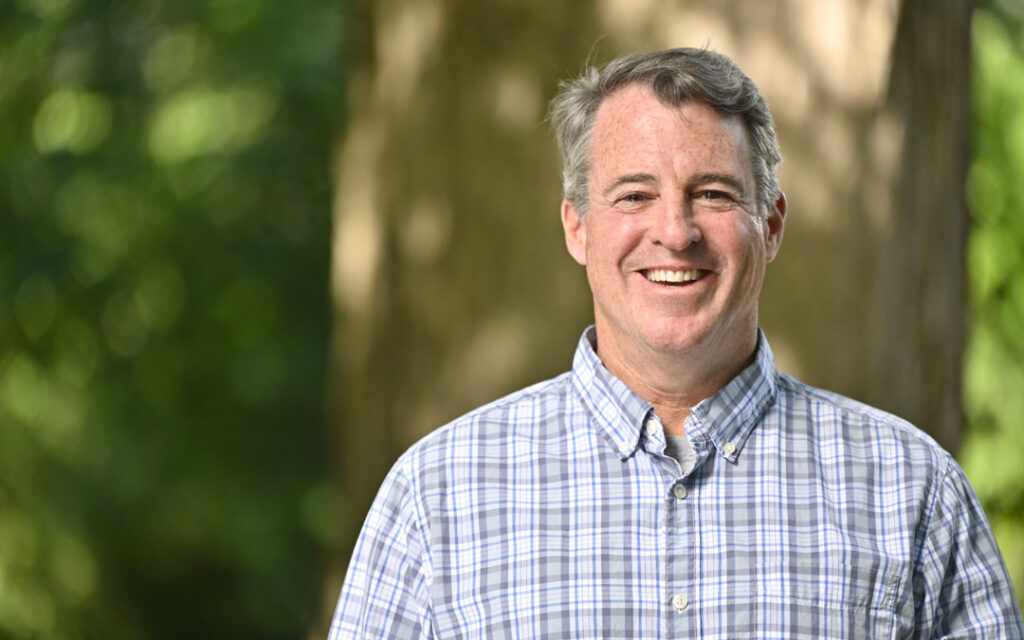
Doug Gansler walks down a busy stretch of Charles Street on an overcast afternoon when he hears someone honking their car horn from a stoplight. He turns and notices a driver waving excitedly at him.
“Do you know him?” someone asks Gansler. “Nope, just a fan, I guess,” he says, smiling and waving back. “That’s great to see, especially so early in this race.”
A longtime resident of Chevy Chase, Maryland, Gansler wants to be the next governor of Maryland. No stranger to state politics, Gansler, 59, served as attorney general of Maryland from 2007 to 2015, and as Montgomery County’s attorney general from 1999 to 2007. In the latter position, he handled several high-profile cases, including the prosecution of “Beltway Snipers” John Muhammad and Lee Boyd Malvo.
During his tenure as Maryland’s attorney general, Gansler focused on such issues as public safety, consumer protection, gun control, environmental cleanup efforts, affordable health care, marriage equality and internet privacy.
A Democrat, Gansler lost the 2014 gubernatorial primary to former Lt. Gov. Anthony Brown, who in an upset was defeated in the general election by Gov. Larry Hogan.
A partner at the law firm of Cadwalader, Wickersham & Taft LLP, Gansler is married to Laura Leedy Gansler, a lawyer and author, and has two sons, Sam and Will.
Gansler is the founder of Charm City Youth Lacrosse, a league program created in 2009 for underserved boys and girls. His late father, Dr. Jacques “Jack” S. Gansler, served as undersecretary of defense for acquisition, technology and logistics in the Clinton administration from 1997 to 2001.
Jmore recently caught up with Gansler to discuss his candidacy. Maryland’s primary elections will be held July 19, and the general election day is Nov. 8.
Jmore: You ran for governor in 2014 and lost. Why put yourself through this again?
Gansler: Well, I believe strongly in public service. I served 23 years in government, including as attorney general of Montgomery County and then as the state’s attorney general. I believe in government and its ability to effect change and to help people.
I ran in the Democratic primary for governor in 2014 and lost, and as a result we’ve had a Republican governor for the past eight years. I was urged to run by a number of people in the establishment of Maryland’s Democratic Party.
There is a strong appetite out there among Democrats to have a candidate that can win both the primary and the general election, and that has become even more so as we are now in the most Republican election of our lifetimes.
A lot of state Democrats are worried about the general election and the candidacy of Kelly Schulz, the former secretary of commerce under Gov. Hogan. Your thoughts about her candidacy?
Kelly Schulz is a very formidable candidate. Governor Hogan is very popular with Democrats and Republicans, and she is running on his legacy. Meanwhile, we have a number of candidates on our side who’ve never run for office before, dogcatcher or otherwise. I think she’s going to be very hard for a lot of the Democratic candidates to beat.
I’m the only pro-business, pro-social justice, practical moderate with progressive values in the race. I am the crime solution person in the race. I’m running against very nice people, but none of them have been involved in criminal justice. They’ve had accomplishments in their fields — as an author, a political operative, a teacher or as the tax collector. What I bring is a spectrum of experience that I would submit is unparalleled, in terms of my record on social issues, environmental issues, on leadership during times of crisis, which I think we are in now.
The most important thing I bring to the table is 23 years in criminal justice. Again, the people I’m running against are wonderful but they learned about criminal justice from ‘Law & Order’ on television. I’ve knelt on sidewalks with mothers grieving for the loss of their child by a bullet, for no good reason. That puts an indelible impression on your heart and your soul and your mind. I understand how to fix that, because I’ve done it before.
There’s always been talk of a deep division between Montgomery County and Baltimore. You’ve lived most of your life in Montgomery County. Do you feel any connection to Baltimore?
I actually don’t think there’s that much of a division now. I felt it more when I was attorney general. People around the state have their jurisdictions and cultural differences, but we all want the same thing – great schools, public safety, opportunities for our children, to be able to put food on the table.
I’ve been coming to Baltimore my whole life. I’ve been an Orioles ticketholder since 1989, and I worked here for many years. I love the city. That’s one of the reasons I decided to run.
There are so many people who truly, deeply care about the city. What’s missing, in my view, is leadership from the state to work with leadership from the city, to get into a room and identify the problems – crime, affordable house, public health, jobs, education — and get the stakeholders together to collaborate.
You have a lot of great things here in Baltimore — the harbor, Johns Hopkins and other great hospitals, I-95 going through, Amtrak. But we have a governor now who doesn’t spend a lot of time worrying about what’s going on in Baltimore city, because they didn’t vote for him. I think we need a governor who can work with the Democratic establishment in Baltimore.
Your overall feelings about Gov. Hogan?
People trust Larry Hogan because he does not come across as a polished politician. What I hear is that he’s done a great job for Republicans. But we live in a time that we want to have a governor who will do a great job for Democrats and Republicans.
I think he has not taken on the gun lobby, polluters, he has not addressed the crime problems in Baltimore and around the state. But he’s done a good job in COVID response and turning the conversation from Maryland being a state where you don’t want to do business to a state where you do want to do business. We still have a long way to go. We still only have three Fortune 500 companies headquartered here. We need more minority- and women-owned businesses here, and we need to provide more help for small businesses.
I think there is a natural advantage for a true Democrat to be governor to work with the Democratic General Assembly. A Republican will have trouble navigating the General Assembly.
What do you think are the top issues facing Maryland right now?
Crime. I think it’s a pretty clear choice. We have a murder problem in Baltimore and around the state, but we also have car-jackings and home invasions, thefts, and no one seems to be addressing it on a state level. If you’re sitting at a light and worried about getting carjacked, I ask for your vote. If you’re not, then vote for someone else.
The environment and climate change — my record is very extensive on that, with solar power, residential, commercial public spaces, clean power sources. Reproductive rights are very important. Also, being Jewish and the Jewish candidate in this race, I’m aware of the rise of antisemitism and hate crimes in general.
Do you think antisemitism is a problem here?
I do. We have a rise in hate crimes, especially with Asian-Americans and Jews. We’ve always had hate crimes with people of color, especially against African-Americans, and against gay people. As attorney general, I worked on many cases fighting hate over the years
Traveling around the state, what are you hearing from voters on the campaign trail?
I’m hearing that they want people with experience, someone who’s led in times of crisis. They don’t want a quarterback with just high school experience, but one with NFL experience. And someone who has experience with criminal justice and can help people live safely. That’s the number one job of government, to keep citizens safe.
And they want someone who can win the general election.
During the 2014 gubernatorial race, you received negative press when you were photographed dropping by a party in Bethany Beach attended by your son where there was underage drinking. After that experience, why would you want to run for office again?
I guess I’m just a glutton for punishment [laughs]. Look, when the riots were happening in Baltimore [in April of 2015, after the death of Freddie Gray in police custody], a lot of my friends texted me and said, ‘Aren’t you glad you aren’t governor now?’ But my reaction was the exact opposite. I wanted to be on the streets of Baltimore, talking to people.
I love my job now and am doing very well with my law firm. But during COVID, I reflected a lot and thought, ‘What am I doing? I want to help people.’ And then I got pressure from people to run.
I love helping people, and I want to provide an example to my sons. I graduated from Yale in 1985 at the height of Wall Street, and all of my friends went into investment banking and made tons of money. I went into public service because I feel we’re on this earth once and you need to give back.
Your feelings about the national political climate today?
Politics has gotten personal and nasty. We had an immensely ill, narcissistic, not bright president in Donald Trump, and this country survived it. We’ll survive this polarization as well. But it is unfortunate. People are turned off by it. It’s terrible, very hard to watch.
Can you work well with Republicans?
I’ve worked with Republicans throughout my career. I believe that you do the right thing for the right reasons and you’ll never get in trouble. It’s when we deviate that we get in trouble.
We have to all work together to address the problems. We can all have different opinions.
How does being Jewish inform your public service?
I’ve been Jewish all my life [laughs]. If you look up Jewish mother and grandmother in the dictionary, you’ll find my mother. I grew up in a very Jewish environment, although not an exclusively Jewish one.
I think faith is important. I think that the Jewish faith, like other faiths, teaches us to care for one another, to believe in community and help the less fortunate, the value of family.
I lived on a kibbutz in the north [of Israel] when I was in the 10th grade and it had a great impression to me, that people can work closely together. I can’t tell you what I had for breakfast this morning, but I remember everything about my time there. It made a big impression.
Who are your personal role models and influences?
My father, for sure. He was the smartest yet most modest person I ever met. The way he dealt with people, he was always friendly to everyone. I think that example permeated the way I like to believe I treat people.
Politically, Sen. Joe Tydings was my mentor. He taught me a lot of lessons, including bucking the political trend if you feel it’s the right thing.
And my kids. They both live out west, and are 25 and 27. They’ve taught me to keep humble, and inspired me by how they help others.
With so much cynicism out there, how do you inspire young people today?
You lead by example, inspire them to care. They’re their sick of labels, and I don’t think you can overestimate the effect of Donald Trump on people of that generation. They watched this guy try to tear apart and degrade our institutions, and it makes them not want to be part of all that. You have to inspire them by good leadership.
Any specifics?
I was called ‘the environmental attorney general.’ I want Maryland to be an East Coast leader on electric vehicles. We need an infrastructure to charge your cars. Maryland can be the leader and the example. These kids all know about electric vehicles and want them, but they feel the grownups don’t want to really do anything about it. And they see that.
Also, our education system is quite xenophobic. It’s on us to teach our children why it’s important to stand up against dictatorships in Europe and elsewhere and to fight for freedom. History does, in fact, repeat itself and we should do a better job of teaching our children about history.
Is there anything that a governor for Maryland can do for Ukraine at this time?
I would try to galvanize the other governors around the country to stand united on behalf of Ukraine. There’s only so much a governor can do, but you can work with nonprofits to make safe passage for refugees to come here for the short- or long-term. A governor can do that. Leadership is important there. You can make it a smooth, seamless transition for refugees.
What would voters be surprised to learn about you personally?
That I’m still playing lacrosse and actually pass the ball more now. I play in an old men’s league.
Why did you start Charm City Lacrosse?
My sons were the impetus. There’s a tournament called Lax Splash in Baltimore County every year. Kids come from all over. I coached and used to see kids from Towson, Lutherville, Perry Hall – but none from Baltimore. I only saw four or five African-American kids in the whole thing.
So I started Charm City Youth Lacrosse league here and we go every Saturday morning to Carroll Park, and we have 500 to 600 kids in the league. One of the things I want to do as governor is bring the Final Four to Baltimore for Memorial Day Weekend. This is our state sport. We’re the epicenter of lacrosse.
What’s the best advice you’ve ever received in life?
Always do good. If you’re always doing good and for other people, you can’t go wrong.

Filmmaker Justin Schein looks at wealth and inequality through the very real story of his late father.

This year’s Community Block Party at the JCC of Greater Baltimore will feature classic cars, giant inflatables, games, a rock-climbing wall and roller skating rink, and strolling entertainers.

Marc Terrill talks with Michael Bresler, CEO and President of Broadheights, an AI consulting group, about the opportunities and challenges of artificial intelligence.

For 35 years, the late Deborah Brodie, aka Bubbie Cookie, amassed a collection of over 200 Jewish ritual objects, which she used to teach her Hebrew school students with special needs.