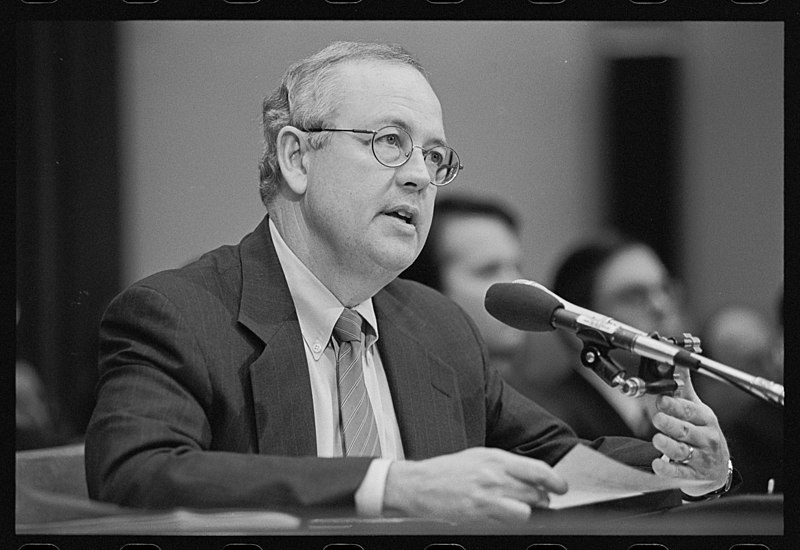
When the creepy Ken Starr went to his grave last week, it reminded everyone of Bill Clinton and Monica Lewinsky inside the White House. But it reminded me of Clinton and my wife one day in West Baltimore.
Starr was the special prosecutor who tried to end Clinton’s presidency by making a federal case out of sexual indiscretion. Starr imagined this was America’s business. He was wrong. It was nobody’s business but Bill and Hillary Clinton’s.
Clinton’s fling with Lewinsky was shameful, but it was no reason to paralyze a presidency. We’ve had bigger creeps in the White House, and the stories somehow slipped away. Just ask all those women who claim Donald Trump groped them. Where were Ken Starr and all the other Republican purists while this was going on?
So Starr died last week, at 76, still trying to justify the constitutional crisis he created out of sexual sweatiness — his own, and Clinton’s. Starr took a bunch of tape recordings from a yenta named Linda Tripp, who dredged up Monica Lewinsky’s late-night confessions, and made these into a pornographic morality play.
Starr imagined himself Inspector Javert. He was more like Peter Sellers’ Inspector Clouseau, a bumbling poseur who should have been laughed off, which is what my wife and I did after our encounter with Clinton.
He was running for a first term as president back then. On a campaign trip one afternoon in West Baltimore, Clinton had then-Mayor Kurt Schmoke showing him around the refurbished Sandtown-Winchester neighborhood.
I was there to write a newspaper column, and my wife Suzy was tagging along to watch a little history being made.
After a while, as a modest crowd drifted away, Clinton spotted Suzy and walked over to her. She was all alone, except for the apparently invisible man who stood next to her: me.
“That’s a lovely pin you’re wearing,” Clinton said, staring at the center of Suzy’s blouse.
“Thank you,” she said.
“Where did you get it?” he asked.
More compliments and questions followed, none memorable. But the whole country was just beginning to read stories about Clinton’s roving eye.
There was one newspaper profile that read, “He tends to approach women and offer conversational ice breakers such as, ‘That’s a lovely pin you’re wearing.’”
When my wife saw that story, she exclaimed, “I feel so used.”
She was laughing when she said it. What Bill Clinton did later was no laughing matter. But the damage should have been private. It was damage to his marriage, not the country.
Ken Starr was a different story. He spent a year, and many millions of dollars, dividing America over a dalliance. He imagined himself Javerts, but he was a cynical, calculating Clouseau.
Michael Olesker’s latest book, “Boogie: Life on A Merry-Go-Round,” was recently published by Apprentice House. It’s the life story of Baltimore legend Leonard “Boogie” Weinglass, an original “Diner” guy who grew up to create the Merry-Go-Round clothing chain and contribute millions to charity.
What does it mean to be fully present with each other and the sacred, asks Maryland-born cultural anthropologist Alanna E. Cooper.
As millions mourn the passing of Stephen Colbert from the airwaves, Michael Olesker looks back on the "institution" of late-night TV.

As he gets ready to leave for California, Rabbi Daniel Cotzin Burg looks back on his time in Baltimore and his 10 years writing for Jmore.