
Growing up in the German village of Griedel, Adolph “Ed” Baer was often the victim of antisemitic bullying by his classmates. He witnessed the torching of his town’s synagogue during Kristallnacht, the 1938 “night of broken glass,” and saw his father Eugene marched away by the Nazis.
By the time Baer immigrated to the United States with his mother Hedwig at the age of nine in late 1939, he had experienced enough to know he never wanted to return to his birthplace.
But Baer’s life took an unexpected turn. After watching the TV series “Roots,” he and his family took a trip to Germany in 1977. Baer, a longtime Hagerstown resident who grew up in Baltimore, and his German-born wife Hannah returned to his village every few years until he passed away at age 90 on Sept. 6, 2020.
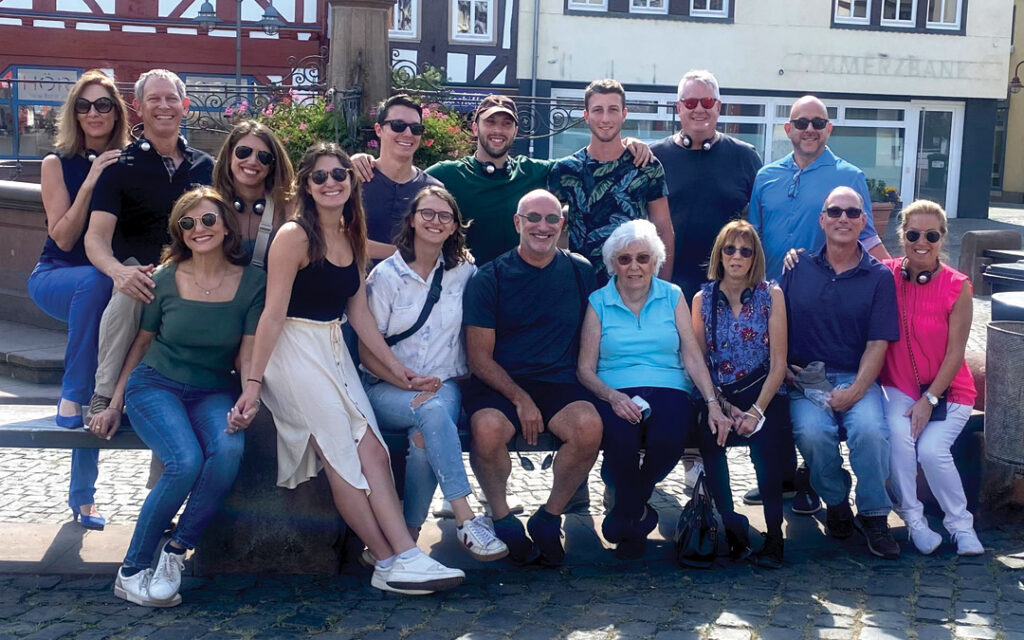
Exactly two years after his death, Baer, a pharmacist, father of three and grandfather of six, was honored by the mayor of the town of Busbach (which includes the village of Griedel) with a street-naming ceremony and related events. Hannah Baer, who was married to him for 59 years and now lives in Towson, and 15 other relatives were in attendance.
Although the pandemic prevented the town from holding the ceremony during Baer’s lifetime, the events were the culmination of his decades-long crusade to commemorate the Jews of his former community.
“They wanted to recognize that even after the Holocaust and all the horrific things the Nazis did to the Jews, we could rekindle these friendships,” said Baer’s daughter, Jmore Senior Sales Account Director Dede Glassband. “On Sunday, we all got there and they did a dinner reception for us. And then on Monday at 9 in the morning, we went right to the mayor’s office. We had roundtable, open discussions about the history of the town. The room that we were in was actually the synagogue for the Jews of Busbach in the late 1800s, before they actually got their own synagogue.”
Glassband, who lives in Owings Mills, described the town’s officials as “the most gracious people. They worked so hard to put this event together. My family was absolutely blown away. The town picked up all our hotel bills. They had dinners planned for us; a lunch planned for us. They had an event where they did a dedication and there were over 100 people that came. They had musicians and a huge Israeli flag.
“The event happened to be on the [50th] anniversary of the Munich Olympics [massacre] and they talked about that — how far they’ve come.”
The mayor also spoke privately to the Baer family.
“He said, ‘You have to understand during [the war era] that not all people in the community were bad, but if they didn’t join the army, they themselves would have been killed. They really had no choice,’” Glassband said. “But then you think, there were some that took it to another level, who were just plain evil.’”
While visiting Griedel, Glassband said she learned a great deal about her father’s childhood from a former classmate named Analisa, now 92.
“She said my father did very well in school,” Glassband said. “He was a very nice young man and always came to school very well dressed. It was interesting to hear her say these things. But [after the Nazis came to power], my father got report cards and he had all Fs. The teachers would write that he was failing because he was a Jew. They didn’t want him there. … Analisa told me, ‘You couldn’t imagine how this has affected me my entire life — the things that I saw living in this town, how the Jews were persecuted. And here I was, an innocent nine-year-old.’”
Glassband said Analisa also told her about when Glassband’s grandmother was physically attacked.
“All the Brownshirts were in the street in Griedel and telling the Jews they weren’t allowed to come out,” Glassband said. “And my grandmother heard all this commotion and peeked her head out the door, and one of the soldiers started throwing stones at her and said, ‘Get in your house, you’re not allowed to be out. Don’t show your face.’ She had a large scar on her forehead that I remember to this day.”
During the street-naming ceremony that took place in a new section of Griedel, Glassband said she took a few moments to absorb the events of the visit.
“My father and I were super, super close, and I miss him so much,” she said. “I’m not a crier. It takes a lot for me to cry. But I just remember at the actual street-naming, kind of like walking away by myself just to have that moment and speak to my father and tell him how happy I know he would be and proud he would be of this very moment, how his family is here … and how everything he worked for has really come to fruition.”

The 16-year-old sophomore succumbed to injuries sustained in a car crash last week in Cockeysville.
Schools in Montgomery County have recently experienced a wave of antisemitic incidents.

CCBC Honors scholars are discovering a level of academic rigor and opportunity typically associated with elite four-year institutions.
Filmmaker Justin Schein looks at wealth and inequality through the very real story of his late father.