

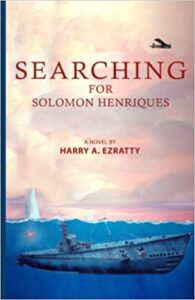
For his latest book, “Searching for Solomon Henriques” (Read Street Publishing), Harry A. Ezratty merged his passions for seafaring stories and Sephardic history.
A New York native who lives in Baltimore’s Mount Vernon neighborhood with his wife, Barbara Tasch Ezratty, he is a maritime lawyer and an independent history scholar. Ezratty is also the author of several books, including “500 Years in the Jewish Caribbean: The Spanish and Portuguese Jews in the West Indies” (Read Street Publishing), “They Led the Way: The Creators of Jewish America” (Omni Arts) and “Baltimore in the Civil War” (History Press).
Ezratty, who practiced law in the Puerto Rican capital of San Juan for 35 years, teaches American Jewish history at Howard Community College.
A novel, “Searching for Solomon Henriques” tells the story of a Sephardic family divided by the Spanish Expulsion and Portuguese Inquisition of the 15th century.
Jmore: What inspired you to write this book?
Ezratty: I teach Jewish history at Baltimore County Community College. I am concerned about how little Jews know about their history. Most of us think American Jewish history begins with the Eastern European migration of the 1880s. I try teaching early history to alert them to the richness of the Jew’s position in America and throughout history.
One day I was having lunch with a friend of mine who is Ashkenazic, with roots in Poland and Russia. She told me she did a family genealogy and was surprised to find out one of her ancestors was a forcibly converted Jew who sailed as physician with Columbus on his first voyage to the New World.
She shouldn’t have been surprised. In 1492, most of the world’s Jews lived in Spain, Portugal, southern Italy and southern France.
Many Ashkenazim and non-Jews can trace ancestry to 1492 and the great expulsion of Jews from Spain. With ‘Searching for Solomon Henriques,’ I wanted to tell the story of a gentile whose family is unaware they can trace their origins to 14th-century Spain and subsequently with the wanderings of Jewish exiles in the Sephardic diaspora.
Which parts of this story are rooted in history and fact?
All of the novel is basically historical fact. Of course, the Ennis family is fictitious. I have visited most of the places I detail in the book, and since I am a direct descendant of Jews expelled from Spain, some of the events occurred within my family.
Who is the protagonist?
Henriques is the descendant of a family that was forcibly converted known as anusim. His ancestors escape from Iberia, return to Judaism and begin to settle throughout Protestant Europe, where they are grudgingly accepted. Solomon comes to America from London in his late teens, fights in the American Revolution and dies a hero.
Who are some other major players in this story?
Of course, the main protagonist is James Ennis, who is completely ignorant of his past and is curious to learn about it. He gets bits and pieces but can’t solve the puzzle, mainly because as an officer in World War II he is busy helping to fight a war.
I purposely set the story before the advent of the internet because, as you are aware, today he could have learned about his background in just one afternoon in front of the computer, as my Ashkenazi friend did.
How would you summarize the essence of ‘Searching for Solomon Henriques’?
There is much in our backgrounds that we are unaware of. We shouldn’t pigeonhole ourselves Ashkenazim nor Sephardim. We should not be surprised about things we learn about ancestors and where they came from. Some people I know are surprised to find ancestors they could never have conceived of.
We are all part of a big family. It’s hard to be an antisemite when somewhere in your ancestry there is a Jew. I really believe Jews should be aware of their history so that they understand their place in the world.
Is there a common thread in all of your books?
I believe in the maxim that a writer should write what he knows. As a maritime lawyer, not only do l know the sea but I love it. All my tales are based on events I was involved in. As to history, my father related the stories of our family from the time we were expelled from Spain.
What challenges did you face while writing ‘Searching for Solomon Henriques’?
Making it interesting for readers other than Jews. That’s why I put exciting chapters in the book which didn’t relate to religion. I tried explaining as simply as possible Jewish rituals such as burial and laws like maternal lineage to gentiles.
What about this novel makes you most proud?
That I have explained a little-known part of our history to Jews and gentiles, and that Jews have a strong part in early American history.
For information, visit readstreetpublishing.com.
Tomer Nusinov is a local freelance writer.

"A Beautiful Noise" chronicles the singer-songwriter's rise to musical icon.
Duke Zimmerman and Lori Gale will talk at Towson University about their new book "People Get Ready" and the role played by Globe Posters in the civil rights movement.

The new exhibition revisits and updates a previous show about ritual hair covering in the observant community.

The Pikesville resident's latest offering "There's a Dragon in the Tree House and He Won't Come out!" was co-written with her grandsons.