
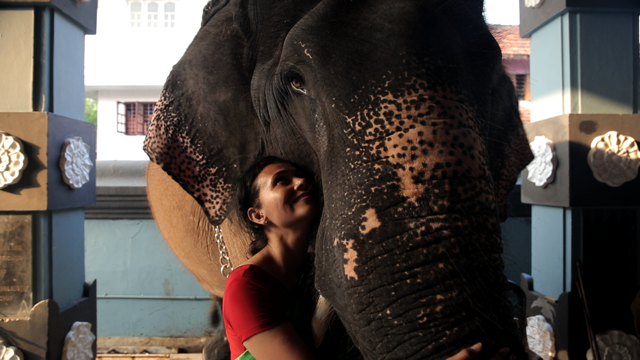
Extravagantly adorned elephants, revered in India as the living embodiment of the Hindu deity Ganesh, inspire awe and incite boisterous revelry at the annual Thrissur Pooram festival. The gathering is celebrated at the Vadakkunnathan Temple in the Indian state of Kerala, the epicenter of the elephant entertainment industry. UNESCO declares this event “the most spectacular festival on the planet.”
But the award-winning documentary “Gods In Shackles,” which was recently screened at the historic Senator Theatre in Govans, reveals the stark and shocking truth behind the festival and the pomp and pageantry of India’s temple elephants.
The screening, which was co-sponsored by Jmore, was a fundraiser to help raise awareness about the animals’ plight.
Using interviews and undercover footage shot on location in Kerala, “Gods In Shackles” illustrates the brutal treatment of Indian temple elephants at the hands of their owners who exploit their charges for profit in the name of culture and religion, exposing the dark side of the southwest Indian coastal state’s glamorous festivals.
The film paints a grim existence for the elephants. They animals do not have sweat glands and rely on movement and wind to stay cool, so it is tortuous for them to stand still, which they do for hours during the Indian festivals.
Elephants are frightened by fire and fireworks, both of which fill the air while mayhem continues for 36 hours non-stop, sometimes causing an elephant to go rogue due to stress and fear.
Fatal accidents happen occasionally, involving people and elephants. The elephants are paraded under the scorching sun and deprived of food and water, to the point that many of them collapse and die from heat exhaustion.
A Sharp Paradox
Experts in the film explain that the elephants, a natural herd animal, live their existence shackled in place for hours in solitude. In perhaps the most gruesome example, the bull elephants, which naturally become aggressive due to their physical state during the four-month mating season, are quarantined 24 hours a day for the duration. They become agitated and anxious and are victims of extreme physical abuse at the hands of their handlers, who suppress them with extra shackles that leave them injured and bloody.
They employ sharp prodding sticks and hooks to keep them in place.
At the end of the period, the film showed drunken men who “beat the animal back into submission,” for 48 to 72 hours non-stop, because the handlers believe during isolation that the elephant has forgotten commands.
Hindu scripture does not implore using elephants for religious reasons, but sheer spectacle and commerce have driven their popularity in pageantry.
“The paradoxes are sharp — they are worshipped and tortured, beaten and revered,” according to the film.
Award-winning journalist, director and executive producer Sangita Iyer, who risked her safety to capture the animals’ abuse on hidden cameras, attended the benefit event. The funds raised will pay for screenings in India to increase public awareness, with hopes that public pressure will be brought against government and temple officials to improve treatment of the animals.
Iyer said she wants to spread the word “of the pandemic of the abuse.”
With less than 40,000 Asian elephants worldwide, 60 percent — about 26,000 — live in India, Iyer said. “So there’s a moral imperative for this nation to protect [them],” she said. “They call them the cultural icon of India, yet they’re being exploited under the name of culture and religion, so that is the paradox.”
Iyer feels a deep affinity to elephants, which started as a child and grew with each visit back to her hometown of Kerala from Toronto, where she is now based. But championing the cause and making the film “was very much of a divinely guided endeavor,” Iyer said, which began after she witnessed a festival in December of 2013.
She saw tethered elephants with “massive ghastly wounds on their hips and bleeding ankles. People are just dancing and singing and completely oblivious to the pain and suffering of this animal … so engrossed in their own fun and joy that they don’t even see the suffering of this poor and amazingly majestic and intelligent animal.”
Iyer had a camera along during her travels, and she began “filming feverishly.” Back in Toronto, she raised the funds to complete the film. She has been “blown away” by audiences’ reactions.
Rampant Commercialism
Jennie Ray, who attended the screening, is the volunteer education chair for Elephants D.C., an advocacy group working to educate young people about inhumane animal treatment and to stop ivory trade and animal trafficking. She said she was unaware of torture in the name of Indian religious ritual.
“It was worth every moment to listen to [Ayer] and see the movie,” she said. Ray said she will acquire DVDs of the film and “change my approach to how to educate” young people about the treatment of elephants and to “connect the curriculum to prove animals are part of the chain of life.”
Julie Dechowitz and her husband Robert Strup, of Pikesville, also attended the screening.
“[Strup] was moved and horrified,” Dechowitz said, and for her “it was a real eye-opener. It was very powerful and upsetting and a story that definitely needs to be told. The Indian people seem to respect elephants as gods, yet treat them another way so it’s hard to reconcile the two. Somewhere along the line, commercialism has taken over.
More people need to know about this. People need to see this movie and support it.”
For information, visit http://www.godsinshackles.com/ .
Melissa Gerr is a Baltimore-based freelance writer.

Schools in Montgomery County have recently experienced a wave of antisemitic incidents.

This year’s Community Block Party at the JCC of Greater Baltimore will feature classic cars, giant inflatables, games, a rock-climbing wall and roller skating rink, and strolling entertainers.

Marc Terrill talks with Michael Bresler, CEO and President of Broadheights, an AI consulting group, about the opportunities and challenges of artificial intelligence.

For 35 years, the late Deborah Brodie, aka Bubbie Cookie, amassed a collection of over 200 Jewish ritual objects, which she used to teach her Hebrew school students with special needs.