
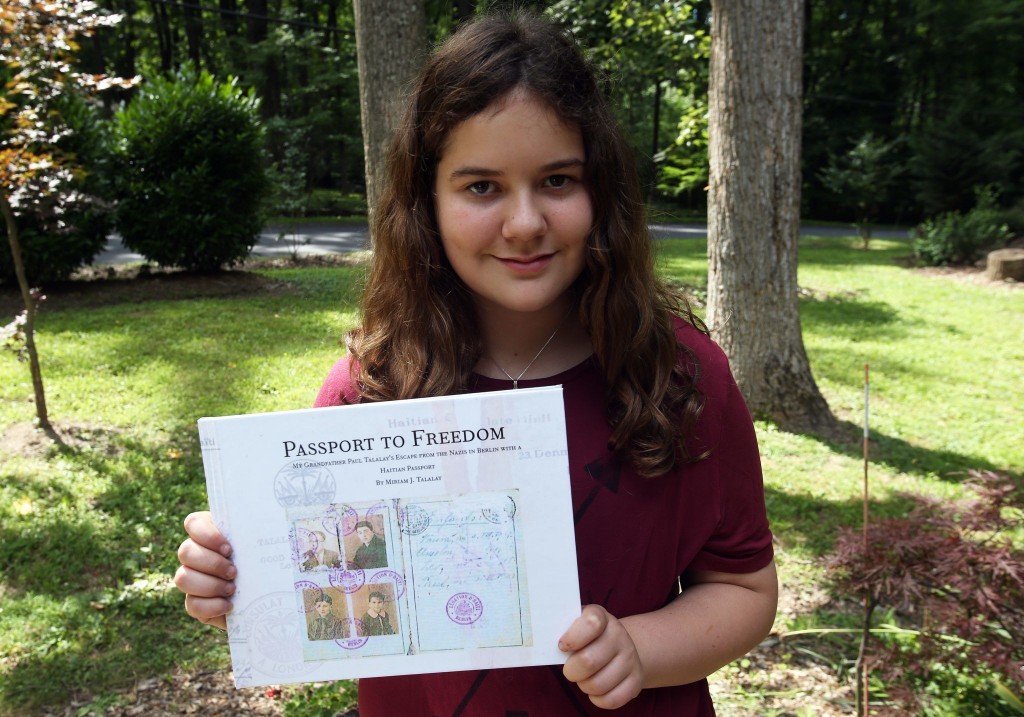
A granddaughter revisits her grandfather’s journey from a young refugee of Nazi Germany to a world-class researcher.
While walking around the Johns Hopkins University School of Medicine, you may come across a sign for the Paul Talalay M.D.-Ph.D. Student Library.
Dr. Talalay, 94, a Berlin native who came to the United States from war-torn Europe in 1940, is a world-renowned researcher in the Department of Pharmacology at Hopkins. He is best known for discovering sulforaphane, a compound in broccoli that increases the body’s ability to fight off cancer.
While his research is well known in medical circles, the journey of how he came to this country and became a prominent doctor is not.
“My father rarely spoke about his childhood when we were growing up. It is as if he didn’t really have one,” says Dr. Talalay’s daughter, Susan, who lives in McLean, Va. “He was beaten at school by teachers for being Jewish and eventually his father kept him home.”
Now, his story of escaping Nazi Germany is coming to light because of the efforts of his 13-year-old granddaughter, Miriam Talalay. For Miriam, a Lutherville resident and Friends School of Baltimore eighth-grade student, what began as a school assignment became so much more.
“This started as an art history project,” she says. “That’s when my parents first told me about our family history and when I first learned about my grandfather’s story. I wanted to know more because it was really amazing to me.”
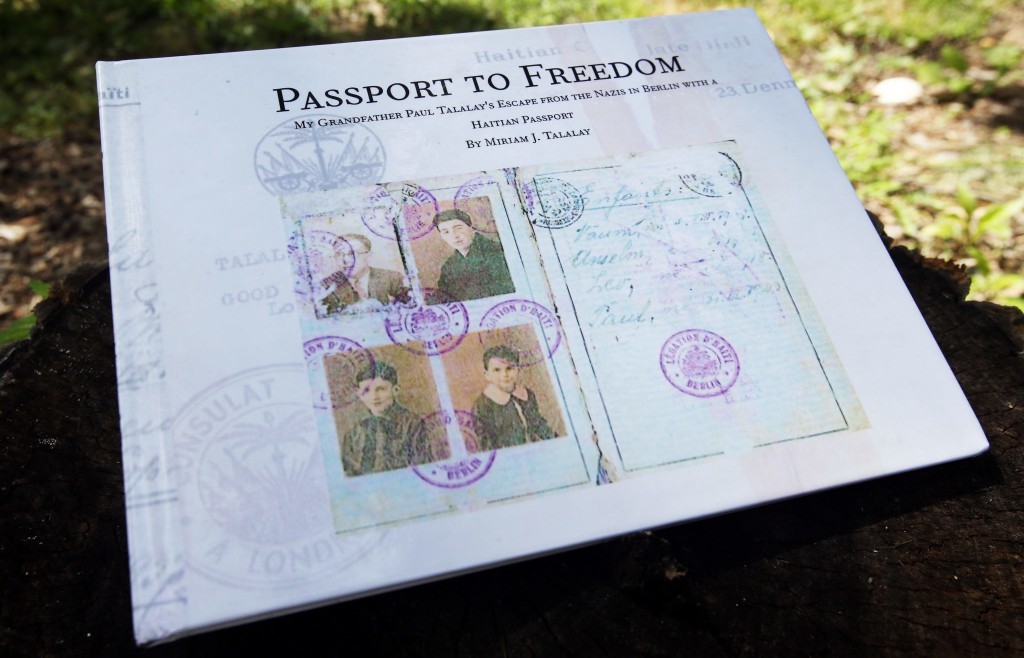
Miriam’s telling of her grandfather’s journey is now “Passport to Freedom,” a book on Shutterfly, an internet-based image publishing service, with a slideshow on the LinkedIn SlideShare hosting service.
“It’s been viewed a couple thousand times because relatives, friends and former students were interested in his story,” says Mary Talalay, Miriam’s mother and Dr. Talalay’s daughter-in-law. “Everyone knew pieces of the story, but no one had put the entire story together.”
A Haitian Connection?
Dr. Talalay, who was unavailable for comment due to recent health issues, was 10 when his family left Berlin in 1933 — just two days before Hitler ordered a boycott of all Jewish businesses. Because the government was no longer granting travel documentation to Jews, Talalay’s family needed to devise a plan to obtain immigration papers.
“The family received Haitian passports and that was the only way they could get out of Berlin,” says Miriam.
To get the Haitian passports — which cost approximately $135,500 — the Talalays pretended to buy land in Haiti.
“I don’t know if we know how the family managed to come up with the money for the passports,” says Mary Talalay. “I think it was the alignment of the stars that all this was able to happen. They look Russian and don’t speak Haitian. There is nothing about them that would make you think they are Haitian, and yet this document worked for them.”
The Talalays used the passports to travel to Belgium and eventually made their way to England, where they lived in Liverpool until coming to the U.S. in June 1940.
“The ship they were on was part of a convoy that would zigzag its way through the water, and one ship in the convoy was torpedoed,” says Mary Talalay. “It’s fascinating that any of the ships made it to the United States because of the U-boats. This convoy, where a few ships were sacrificed to get the rest of the people to safety, is what Paul lived through, and he was just 10 years old.”
A longtime member of Baltimore Hebrew Congregation and a Roland Park resident, Dr. Talalay came to Baltimore in 1963 with his wife, Pamela, and their four children when he was named chairman of the Department of Pharmacology at Hopkins.
“Paul’s gone on to do amazing things,” says Mary Talalay. “I think about how this is one family’s story, but it’s amazing how many stories are out there and how few are shared. I think Paul’s parents were so smart and their timing to get out was impeccable.”
Dr. Talalay’s story continues to amaze and inspire his family.
“Learning about his story makes me grateful,” says Miriam. “I’m thankful because I owe my life to him. I wouldn’t be here if he wasn’t here. I’m very thankful that he survived and he can share his story with me.
“I’m lucky to have someone as important to history in my life,” she says. “I want kids to realize everything isn’t just a blip in history. Who we are today is based on our history.”
Mary Talalay, who belongs to Har Sinai Congregation, says she learned a lot as well, helping Miriam with the interviewing process.
“When we were interviewing Paul, it became clear how profoundly grateful our family had to be toward anonymous people along the way who made decisions in Paul’s favor,” she says. “That’s huge to me. These are people who saved others, and that makes me think of the actions I take every day. Decisions in our lives have an impact on others.”
For information, visit slideshare.net/mtalalay/passport-to-freedom-44608539.
Top photo: For a school project, Miriam Talalay wrote about her grandfather’s journey from Berlin to Baltimore. (Photo by Daniel Kucin Jr.)
Aliza Friedlander is a Baltimore-based freelance writer.
A former resident of Baltimore and central Florida, Ritt was active in the Soviet Jewry movement of the 1970s and 1980s.
For more than four decades, Goldman played a vital role in the supervision of elections in the city.
The 16-year-old sophomore succumbed to injuries sustained in a car crash last week in Cockeysville.
Schools in Montgomery County have recently experienced a wave of antisemitic incidents.