
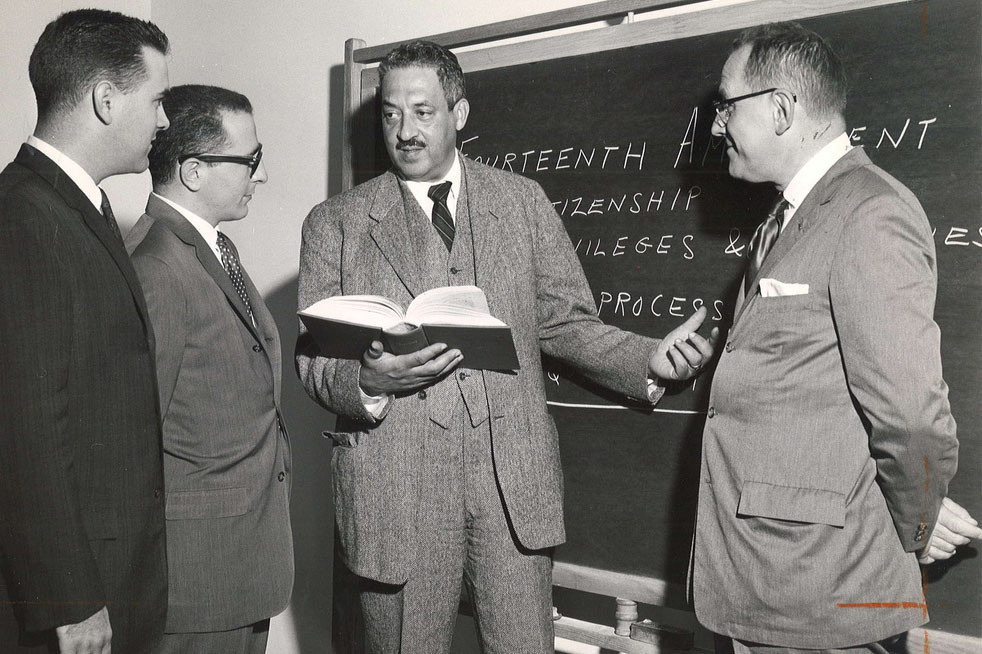
We went to see the new film “Marshall” over the weekend because it had all of the great, inspiring story elements: an early criminal case of Thurgood Marshall’s, the legendary attorney out of impoverished West Baltimore, and the attorney who worked with him, a guy named Sam Friedman, brought to us in the big room at the Senator Theatre so that lots of people could gather to see it.
If only, if only …
They had it tucked away in one of the little side theaters, because the people who run the Senator obviously know their business. There were maybe 15 people in the place. The Senator’s big theater was reserved for a fantasy science fiction flick called “Thor: Ragnarok.”
Movie-goers apparently have more interest in fantasy than in the real-life stuff that turns fantasy into fact.
The story goes back to Marshall’s early days as the NAACP’s attorney, roving the entire country to defend African-Americans accused of crimes solely because of skin color. This one takes place as the world lurches toward World War II and Hitler has begun rounding up the Jews.
Among them are attorney Friedman’s European relatives. There are parallels drawn between Germany’s killing racism, and America’s, but the movie doesn’t preach about them too heavily.
And there are passing references to Marshall’s Baltimore background. This was a young guy – years before he won the Supreme Court decision to integrate America’s so-called “public” schools, and years more before he became a Supreme Court justice himself – who first met segregation here at home.
He attended segregated Douglass High School and segregated Lincoln University. He wanted to attend the University of Maryland Law School. From his parents’ West Baltimore home, he could have walked there every day. But the school wouldn’t let blacks enroll, so Marshall had to commute every day to Howard University in Washington, D.C.
“Marshall” shows the legal legend beginning to take hold – but it’s also a feel-good tale of men from different backgrounds putting aside cultural differences in a treacherous time, teaming up against seemingly insurmountable odds, to win a moral victory.
It’s the kind of story that serves as a reminder of the American ideal – that our differences help us bring out the best in each other when we reach for our common morality.
That’s the kind of story that should be seen on big screens, in big auditoriums, absorbed by big audiences. The movie’s inspiring. But that small crowd over the weekend was a disappointment.
 A former Baltimore Sun columnist and WJZ-TV commentator, Michael Olesker is the author of six books. His most recent, “Front Stoops in the Fifties: Baltimore Legends Come of Age,” has just been re-issued in paperback by the Johns Hopkins University Press.
Top photo: Thurgood Marshall, courtesy Villanova Law Library, Flickr
A new biography captures the intensity and magic of the musical theater giant, writes Michael Olesker.

Melinda Michel pays tribute to the longtime Jewish community leader and volunteer who passed away on June 8 at age 68.

Jmore Editor-in-Chief Alan Feiler remembers Temple Emanuel's longtime spiritual leader, who passed away earlier this week at age 91.

Camp and youth group experiences have the ingredients for true, deep, lifelong transformation, writes Rabbi Jessy Dressin.