

As president of MedChi, the Maryland State Medical Society, and founder and head of the Baltimore-based organization’s Opioid Task Force, Dr. Gary W. Pushkin is passionate about educating physicians about the dangers of overprescribing opioids.
A native Baltimorean and orthopedic surgeon, Dr. Pushkin, of the medical practice Cohen & Pushkin, is a graduate of the University of Maryland and the Universidad Autónoma de Guadalajara in Mexico. He lives in Guilford with his wife, Kathleen Abbott, and they have two adult children.
Dr. Pushkin belongs to the Ner Tamid-Greenspring Valley Synagogue in Northwest Baltimore. He also is a French-trained pastry chef who graduated from the Ritz-Escoffier Ecole de Gastronomie in Paris.
Jmore recently spoke with Dr. Pushkin, who last fall became the 170th president of MedChi, about the organization and the opioid epidemic.
Jmore: Why did you want to lead MedChi?
Dr. Pushkin: Several years ago, my wife told me to stop complaining about what was happening in medicine and get more involved. So I’ve served in a number of positions. I like being in charge, having a more controlling interest in the whole process.
How can MedChi play a role in combatting Maryland’s opioid epidemic?
This crisis has two parts. Mostly what we hear about is the second part — dealing with people who are already addicted and die from one opioid or another. I’m working on the first part of the problem, getting doctors the training they need in prescribing opioids. Doctors right now have a target on their back, and I don’t think it’s completely fair. I never had training in how to prescribe opioids or how many to prescribe or how to stop someone from abusing them. Years ago, physicians were told to give someone enough pain medicine so they wouldn’t call on the weekend.
[Now] we’re developing guidelines for prescribing opioids. For example, people don’t need more than eight or 10 pills after arthroscopic surgery. But orthopedic surgeons used to routinely give patients 40-50 pills. The Prescription Drug Monitoring Program enables us to look up the prescription drugs given to individual patients. If we recognize that a particular doctor appears to be prescribing opioids in an unsafe manner, we can invite that doctor in for a discussion. We can also get information about individual patients from pharmacies.
In addition, we’re learning to ask a variety of questions before an operation. For example, we now ask if there’s anyone else in the family who is using narcotics. If so, we try to learn if [that person has] a history of substance abuse. [We want to avoid the possibility of] the other family members stealing them.
And we’re also talking about multi-modal responses. … We don’t have the science yet to know which responses are right for every patient. So if someone comes to me with chronic pain, maybe the best thing I might do is refer them to a psychologist. Or maybe that patient needs to relax, go to the gym, take a yoga class, do a lot of things that don’t involve opioids.
How can governments help manage the crisis?
Let’s put together legislation with good science that makes sense for patients. But it does no good to refer someone for treatment that is not covered by insurance. So one of the roles of government is to get insurance companies to cover things science shows makes sense medically.
Is there a role for private citizens?
Yes, and I’ve been discussing this with my rabbi. Why are Americans taking 90 percent of the world’s narcotics? My wife’s brother owns a pharmacy in Italy. I asked him, “How many narcotics do you give out each week?” He answered, “Five or six.”
If you have opioids in the house, don’t flush them down the toilet or they’ll get into the water system. Doctors can’t take them back, and pharmacies don’t want to take them back. Now you can now dispose of them 24/7 at any police barracks in the state.
Does smoking marijuana lead to the usage of other drugs?
We don’t know… but the majority of drug users started with marijuana. I think the growing use of marijuana is a mistake until we have scientific validity on which use of marijuana is better for particular cases. Too many physicians and patients want to use marijuana for chronic pain, but we don’t know that it’s good for chronic pain.
Do Jewish values played a role in your medical practice?
They play a role when we [at MedChi] have discussions regarding abortion or end-of-life issues. I don’t impose my values on others, but I have a problem acting to end a person’s life, including assisted suicide. Let’s suppose a doctor wrote a prescription of 100 sleeping pills knowing that you have a suicidal condition. That’s assisted suicide. There are a lot of doctors who are on the other side of this. They say, “I really wish I could do something to put this person out of pain.” I think it’s in God’s hands, but I don’t want [doctors] to be prosecuted.
What common medical practices should be decreased or eliminated?
I don’t like people doing things and selling things to the public that don’t have scientific validity.
Peter Arnold is an Olney, Md.-based freelance writer.

Schools in Montgomery County have recently experienced a wave of antisemitic incidents.

This year’s Community Block Party at the JCC of Greater Baltimore will feature classic cars, giant inflatables, games, a rock-climbing wall and roller skating rink, and strolling entertainers.
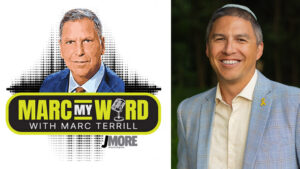
Marc Terrill talks with Michael Bresler, CEO and President of Broadheights, an AI consulting group, about the opportunities and challenges of artificial intelligence.

For 35 years, the late Deborah Brodie, aka Bubbie Cookie, amassed a collection of over 200 Jewish ritual objects, which she used to teach her Hebrew school students with special needs.