
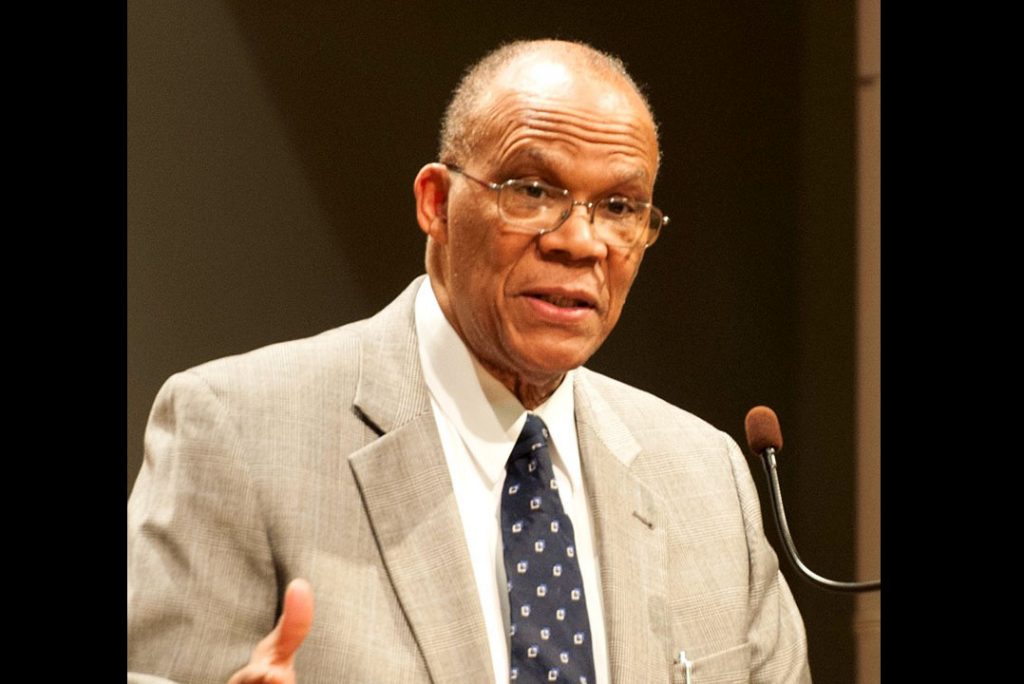
For decades, Larry S. Gibson has played a vital role in the civic and political life of Baltimore City. A law professor, civil rights activist, author and attorney who specializes in race relations and Maryland law, Gibson will speak about his career and community issues on Sunday, March 11, at 1:30 p.m. at the annual “Sages for the Ages” at Reservoir Hill’s Beth Am Synagogue. Joining him will be his longtime colleague and friend of 50 years Ron Shapiro, who will serve as the program’s moderator.
A seasoned political organizer, Gibson served as campaign manager for former Mayor Kurt L. Schmoke in the 1987, 1991 and 1995 mayoral elections. In addition, he is the author of the 2012 biography “Young Thurgood: The Making of a Supreme Court Justice” (Prometheus Books).
Jmore recently spoke with Gibson, 75, who is of counsel at the Shapiro Sher law firm, about the state of the city, the Trump administration, and current relations between Jews and African-Americans.
What’s your view on Baltimore’s current problems?
Few realize that Baltimore has a larger population than Seattle, Atlanta, Milwaukee, Cleveland and many other cities. We have too many people here; it’s too dense. And we need to find a way to get county residents to work in the city to pay more for the city services they consume.
I think our schools are doing a remarkable job with the resources they have. But they are asked to do an increasingly more complicated job with fewer and fewer resources. We have young people with greater needs who are getting dramatically fewer services. So, of course, we get negative results, and we wonder why the crime rates go higher.
Your vision of the city’s future?
Within one mile, Baltimore has what exists in few other cities. We have a football stadium, baseball stadium, theaters, a city center, a major university [University of Maryland, Baltimore, where Gibson teaches] and Johns Hopkins University just outside the one-mile radius. This unusual compactness is a blessing. One can walk directly to these facilities without crossing any superhighways or railroad tracks. Few cities are so blessed. And there is Baltimore’s unique relationship to the water. The miles of shoreline inside the city boundaries promote continuous rebirth. We see this now occurring in Port Covington, Canton, Locust Point and Harbor East.
How would you characterize today’s black-Jewish relationship?
There is an historically close relationship as a result of facing common opponents, common adversity. Many people dislike blacks and Jewish people and discriminate against them. For black and Jews, there has also been a common appreciation of a desire for freedom from oppression across the world, especially in the Western Hemisphere.
In addition to that, blacks and Jews have historically worked closely together. For example, there is a history of civil rights lawsuits fought by black attorneys. If any white attorneys joined them between the 1930s through 1971, in the research I have done, every single one of those white lawyers was Jewish.
But how would you characterize the current relationship?
Let’s take a recent national experience. A higher percentage of Jews voted for [former President] Barack Obama than whites who are non-Jewish, even though Obama lost the overall white vote.
Your feeling about black college students who support the Boycott, Divestment and Sanctions movement against Israel?
In addition to what minority groups have in common, some of their interests are divergent. In the 1970s when blacks were pushing for affirmative action, it reminded some Jews of the quotas colleges had against Jewish advancement. So there are similarities and differences in perceived interests.
But I’m reminded of Charlottesville [Va.]. Young people, many from the middle class, were vituperative in negative attitudes toward blacks and Jews. It was a shocking reminder of racism and anti-Semitism. And many people were shocked that this president could not find the courage to condemn the Ku Klux Klan and the white nationalists without feeling compelled to make false equivalency. They were carrying torches and chanting, “Jews will not replace us!” I couldn’t believe this was happening in 2017.
Why didn’t President Trump fully condemn the white supremacists in Charlottesville?
I have every reason to believe that, to his core, Donald Trump is a racist. Look at what he has said, what he has done, not just recently but throughout his career. The evidence is clear. He believes that darker people are less intelligent and less worthy than lighter colored people.
Do you believe he’s anti-Semitic?
I suspect that his attitude toward Jewish people is complicated, but he has what I would call anti-Semitic elements. … Donald Trump believes black people and Jewish people are different from himself and from other people of Western European descent.
What can we do to combat prejudice?
Continue to resist. It’s not going away. … Do what you can to point it out, to resist it, to get more people in political power that don’t think that way. But start with the face in the mirror. In one’s own life, resist mankind’s tendency to prejudice.
What about gender bigotry?
There is generally less prejudice among women than men. This is an oversimplification, but there are aggressive tendencies that males tend to have that appear to be less strong with females. In much of the history of mankind, males have oppressed women. Women have faced discrimination similar to blacks and Jews. In some parts of the world, oppression of women is almost absolute. So to elect people with the right tendencies, it probably helps to elect more women. Anything that can advance equality is good.
For information about “Sages for the Ages,” visit bethambaltimore.org.
Peter Arnold is an Olney, Md.-based freelance writer.

Schools in Montgomery County have recently experienced a wave of antisemitic incidents.

This year’s Community Block Party at the JCC of Greater Baltimore will feature classic cars, giant inflatables, games, a rock-climbing wall and roller skating rink, and strolling entertainers.
Marc Terrill talks with Michael Bresler, CEO and President of Broadheights, an AI consulting group, about the opportunities and challenges of artificial intelligence.

For 35 years, the late Deborah Brodie, aka Bubbie Cookie, amassed a collection of over 200 Jewish ritual objects, which she used to teach her Hebrew school students with special needs.