
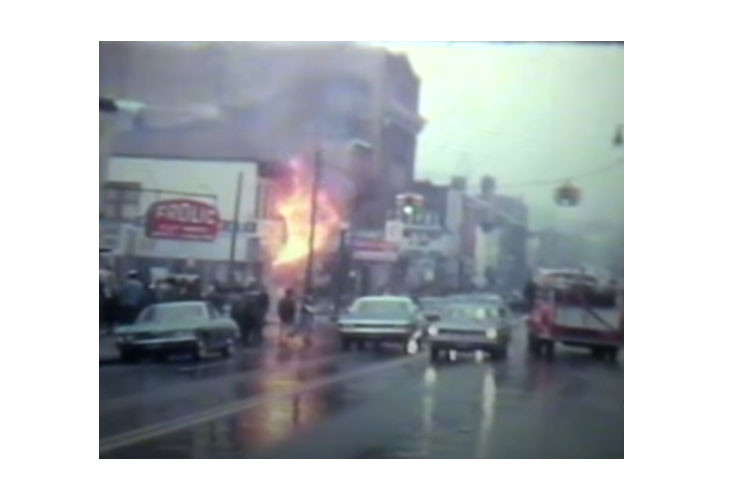
A half-century later, a reporter remembers the fiery chaos and devastation of the April 1968 riots in Baltimore.
On the evening of April 27, 2015, as the martyred Freddie Gray went to his grave, legions of Baltimoreans marked the moment with acts of heartfelt felonious arson. This violated previous local custom, which honored the deceased by lighting small memorial candles. Now, mourners burned a neighborhood pharmacy or a city police car, and on the darkening streets of the city they declared such acts of anarchy to be ceremonies of grieving.
Gray, 25, died mysteriously while in police custody at Shock Trauma in a national season of high-profile police killings of unarmed young black men, and legions who never knew Gray now claimed they sought retaliation for his demise. All across America, those watching television news saw dismaying images of sheer chaos.
But the TV correspondents’ sense of perspective and history apparently went no further back than the last commercial break. “Have you ever seen anything like this?” cried CNN anchor Wolf Blitzer as he sat safely in a Washington studio and watched the destruction of a CVS pharmacy.
He sounded like a man who thought 1968 never happened.
In the Baltimore convulsions of 2015, rioters would damage about 350 businesses. Awful, of course. But in the eight-day Baltimore riots of ‘68 — whose 50th anniversary we mark this month — they destroyed more than a thousand places and snatched anything that could be hauled home: food and clothing, entire shelves of medicine, liquor, TV sets and anything else portable.
Decades after the riots of ‘68, the distinguished African-American Rev. Marion C. Bascom would remember seeing an elderly woman parishioner carrying off a stolen television in the midst of the disturbance. “The Lord blessed me with this TV,” the woman explained gently.
This was payback time for generations of the previously deprived.
Many in the ‘68 riots had too much to carry in their arms so they piled their stolen goods into shopping carts, also conveniently stolen, and hid their faces from news cameras pointed their way while racing down streets covered with broken glass.
They ran past empty little stores looted moments earlier and then set ablaze. Always the First Law of Rioting: loot before you burn. They ran past young mothers carrying their babies in one arm and stolen boxes of Pampers in the other. They ran past old men shaking their fists and shouting Scripture at the fiery upheaval all around them. They ran past watchful little children with large eyes who were wondering, “Is this what grown-ups do?”
They ran past a looter commandeering a liquor store doorway who called out to a crowd on the sidewalk, “The good stuff is gone. Only thing left is some cheap Thunderbird.” Then, in a kind of afterthought: “And don’t be lighting no matches, ’cause I live upstairs.”
It was everyone’s great come-and-get-it day.
So yes, Wolf Blitzer, we had previously seen something like this.
Start of a Migration
The rioters were out of control, and many seemed out of their minds, some with rage and grief over the assassination of Dr. Martin Luther King Jr. I am one of the few left standing who spent four days and nights covering those ‘68 riots for a daily newspaper. I was 22 and too naïve to feel personally threatened by the madness all around me.
In 2015, rioters burned about 60 buildings. Terrible, of course. But in ’68, they set more than 1,200 fires in Baltimore. In the Freddie Gray riots, police arrested about 250 people; in the chaos of ‘68, they arrested about 6,000 people in Baltimore and packed all available cells so tightly that the City Jail warden declared, “Keep ’em coming. I don’t care if they have to stand on their heads.”
And yet 800 additional people had to be housed in the basement of the building we called the Baltimore Civic Center, nominally the home of Earl Monroe and his Baltimore Bullets basketball team.
Soon thereafter, the fabulous “Earl the Pearl” would depart for New York and his Bullets would move to the upscale D.C. suburbs. Both were victims of the riots, as for years people were too frightened to venture into downtown Baltimore after dark for basketball games or anything else.
This was part of the great emptying-out of a city once America’s sixth largest: a basketball team here, an entire downtown shopping district there, and a quarter-million people who migrated to the suburbs like refugees searching for some other, distant, safer America.
Gone from the city, all gone, and never to return across the next half-century.
In 2015, Blitzer couldn’t believe his eyes as the CVS pharmacy on Pennsylvania Avenue was burned. This was the heart of an entire day’s hysterical TV coverage.
But in ’68, virtually every store along a four-block stretch of this same Pennsylvania Avenue was torched, and never mind all the handwritten “Soul Brother” signs desperately posted in windows by white merchants hoping to pass as black, or at least imply sympathy.
In ’68, it took nearly 12,000 soldiers to calm the city. With a nighttime curfew imposed, armed troops gathered at the Fifth Regiment Armory, where their African-American commander instructed them, “If anybody’s walking, you order them to halt. If they don’t stop the first time, you order them a second time. If he don’t stop the second time, shoot him.”
Behind him, the commander heard a couple of civilians gasp at his words. One of them was Marvin Mandel, soon to become Maryland’s governor. Years later, Mandel remembered the commander whipping around and declaring, “Let me tell you something. See all these men in this company? They’ve survived fighting in Vietnam, and I’m not going to let them get killed on the streets of Baltimore.”
That’s what the riots of 1968 were like.
A Culture of Indifference
Everywhere, you saw people with tears running down their faces, dazed and disbelieving, crying, “They killed the king” — meaning the martyred civil rights leader, whom many imagined their savior after lifetimes of enforced, second-class American citizenship.
In ‘68, more than 100 cities were put to the torch. Having survived damnation once, we imagined we might never have to confront it again — until the Freddie Gray riots of three years ago, and the lingering question: What went wrong?
By 2015, the city had embraced a succession of African-American politicians, police commissioners and public school superintendents. Black people previously denied a fair shot at decent jobs and housing finally found their place in the American middle class.
Who needed to riot in the face of such progress?
Forgotten, though, were the tens of thousands left behind in neighborhoods with houses falling apart and a disappearing industrial jobs market, and police patrolling streets with murderous drug trafficking.
These folks were part of the permanent underclass who took to the streets in 2015. They were the children of the children of the ‘68 riots, distant generations bonded by mutual failure and simmering rage.
For them, Freddie Gray’s death was a chance to stage an accusation — of the utter abandonment by all those, white and black, who fled the city and forgot so many of the impoverished left behind.
In 2015, CNN’s Jake Tapper stood on little North Mount Street, directly in front of the city’s Western District police station, and announced, “We’re expecting hundreds, if not thousands, of protesters.”
Why so much anger? Here’s a hint: in 2015, the poverty rate in black West Baltimore topped 30 percent. Across Maryland, the median household income was $73,000. But in this part of Baltimore, it was $29,000.
In post-riot 1970, there were 38 Baltimore neighborhoods listed as high-poverty. By 2010, there were 55 such neighborhoods.
On North Mount Street in 2015, directly in front of the police station, of 23 runty little rowhouses on the block, nine were abandoned, boarded-over, decaying wrecks.
Each issued an implicit message: No one cares about the people who live here.
Today, people live inside such miserable little hovels across swaths of Baltimore, where some rat scuttles across an infant’s crib, and winters are sufficiently warmed by turning on the kitchen oven’s burners all night long. Flakes of lead paint seep into a child’s neurological system precisely the way it happened to a kid named Freddie Gray, whose death took America back to memories of April ‘68.
Across impoverished West Baltimore, an officially estimated one-third of all buildings are still abandoned and crumbling. In a city public school system that is 82 percent African-American, 84.8 percent are low income. Two-thirds of West Baltimore families have only one parent at home.
In the chaos of ‘68, I listened as city police stopped youngsters who were on the street past a riot-imposed curfew. The dialogue, time after time, was identical.
Officer: “Where are you going?”
Child: “My mother’s.”
Officer: “Where are you coming from?”
Child: “My father’s.”
Freddie Gray came from such a splintered family. In half a century since the riots of ‘68, he was part of a distressing majority still with us.
 A former Baltimore Sun columnist and WJZ-TV commentator, Michael Olesker is the author of six books. His most recent, “Front Stoops in the Fifties: Baltimore Legends Come of Age,” has just been re-issued in paperback by the Johns Hopkins University Press. He covered the ’68 riots for The Baltimore News American.
At its annual meeting this year, the Baltimore Jewish Council will honor the late Harford County educator and longtime Holocaust education champion.
The former Colt, who passed away on May 25 at age 93, achieved immortality during a cold December day in 1958, writes Michael Olesker.
A new biography on the creator of "Doonesbury" misses the mark, writes Michael Olesker.
What does it mean to be fully present with each other and the sacred, asks Maryland-born cultural anthropologist Alanna E. Cooper.