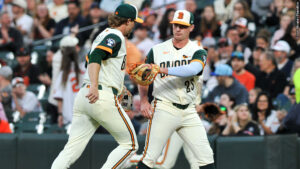
Are we all agreed that the Baltimore Orioles’ 2018 season seems to be over when it’s barely even begun?
This is written the morning after Dylan Bundy – the great young hope, the wunderkind, the alleged ace of the Orioles’ starting pitching staff – becomes the first pitcher in modern baseball history to give up four home runs without recording a single out.
It’s written the morning after the O’s surrendered 10 first-inning runs on their way to a 15-7 loss to the Kansas City Royals before what appeared to be a vast ocean of empty seats at Oriole Park.
It’s written as the Orioles drop to 27 losses in their first 35 games and fall 17 games behind the New York Yankees and Boston Red Sox, each of whom has won 25 of their first 35 games.
The Orioles now have the worst record in all of major league baseball.
Against the Royals Tuesday night, Bundy’s first seven batters went like this: walk, homer, homer, homer, walk, walk, homer. Seven-zip. And the first inning was just getting started — unlike the O’s chances of making a playoff berth, which seem already to have ended.
And that’s just the surface of their troubles.
Their best player, Manny Machado, may be headed elsewhere because Baltimore can’t afford him. Their highest-paid player, Chris Davis, is not headed anywhere. Who else would want him? He’s in the midst of a seven-year deal worth $161 million, and he’s hitting .172, with twice as many strikeouts as base hits.
Last night, when the Orioles were already trailing 13-0, Davis hit his third home run of the season. Yippee. He’s homered so rarely that he now seems out of place and confused as he runs the bases, like some tourist in a strange town. He seems tentative, as if not certain he still remembers where each base is located and needs to refresh his memory as he circles.
The Orioles trailed 15-1 last night but managed half a dozen runs over the last two innings. Caleb Joseph hit a meaningless home run in the ninth. When he got back to the dugout, he was greeted with high-fives by teammates and a particularly enthusiastic cheer from Davis.
Don’t these guys realize how clueless they look at such moments?
The fans – those few remaining in the stands, those few still watching at home – surely realize it.
There was a time when the Orioles drew well over 3 million fans a year. Those days are over. For the last six years, they’ve drawn more than 2 million fans. Those days may be over in 2018.
Through Tuesday night, the O’s were averaging 17,937 fans per game. Over a full season, that’s less than 1.5 million spectators. Of 15 American League teams, the Orioles are 13th in attendance.
You can argue that crowds are down because kids are still in school, or the weather’s been iffy, so maybe attendance will pick up. But the other side is: when the season seems already to be over, what’s the point in showing up for a team that’s already packed it in?
 A former Baltimore Sun columnist and WJZ-TV commentator, Michael Olesker is the author of six books. His most recent, “Front Stoops in the Fifties: Baltimore Legends Come of Age,” published by the Johns Hopkins University Press, is now in paperback.
Also see: Dylan Bundy Delivers Historically Bad Outing, As Orioles’ Skid Continues — PressBox
What does it mean to be fully present with each other and the sacred, asks Maryland-born cultural anthropologist Alanna E. Cooper.
As millions mourn the passing of Stephen Colbert from the airwaves, Michael Olesker looks back on the "institution" of late-night TV.

As he gets ready to leave for California, Rabbi Daniel Cotzin Burg looks back on his time in Baltimore and his 10 years writing for Jmore.