
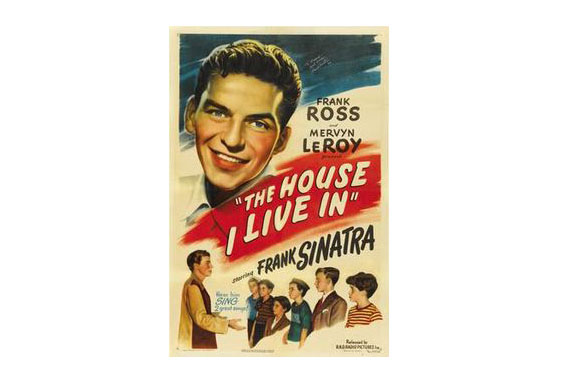
You want to celebrate America’s 242nd birthday with a little more patriotic gesture than a Fourth of July mattress sale? Hike yourself over to YouTube and type in “Frank Sinatra: The House I Live In.”
You never heard of this? Try it, it’ll do your heart good.
The film — which won an honorary Academy Award in 1946 — opens with a bunch of street toughs chasing a defenseless kid. What’s the kid done wrong? Nothing, one of the tough guys says, except, “We don’t like his religion. He’s a dirty …”
“His religion!” Sinatra says. He can’t believe his ears. Here they are, in the midst of a war against Hitler and his murderous bigotry, and these kids obviously need a few words about the true American spirit.
Ol’ Blue Eyes gives it to them. “Look, kids,” he tells them, “religion makes no difference except to a Nazi or somebody that’s stupid. People all over the world worship God in different ways.”
He mentions Pearl Harbor to them, and how the whole country was staggered by the bombing. But a couple of days after that attack, he says, an American air crew sank a Japanese battleship, “and every American felt much better.
“The pilot of that plane was named Colin Kelly, an American and a Presbyterian. And you know who dropped the bomb? Meyer Levin – an American and a Jew. You think they should have called the bombing off because they had different religions? Think of that, fellas. Use your good American brains.”
And then, this being Frank “The Voice” Sinatra, he commenced to sing. The song, written by composer Earl Robinson and Jewish songwriter Abel Meeropol (under the pseudonym Lewis Allan), is called “The House I Live In,” and it opens with, “What is America to me?/A name, a map, a flag I see/A certain word – democracy …”
It’s not about standard-issue “greatness,” as defined by military might or gross national product. It’s about the greatness of “ordinary” America:
“The place I work in, the worker by my side/The little town or city/Where my people lived and died/The howdy and the handshake/The air of feeling free/And the right to speak my mind out/That’s America to me …”
I first saw the movie with my third grade class at the old School No. 20 in East Baltimore. As far as I know, my old friend Harry Lipsitz and I were the only Jewish kids in the school. It felt that way, anyway.
But this movie was telling me something I hadn’t quite figured out until now: I was as fully American as anybody else. No matter how isolated I might have felt living in a housing project where everybody else went to church on Sundays and celebrated such “national” holidays as Christmas and Easter, America belonged to us, too. And we belonged to America as much as anyone did.
The movie made me feel like a citizen. Every July 4, that’s what we celebrate: each person’s little part – little, but never to be diminished – in the American family.
“The House I Live In” made me feel like I belonged. See if you can find it. It’ll make you feel nice. It’ll remind you that you belong, too – whatever your background.
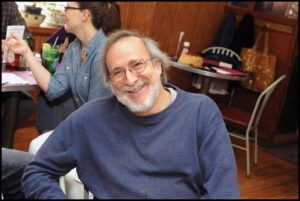 A former Baltimore Sun columnist and WJZ-TV commentator, Michael Olesker is the author of six books. His most recent, “Front Stoops in the Fifties: Baltimore Legends Come of Age,” published by the Johns Hopkins University Press, is now in paperback.

At its annual meeting this year, the Baltimore Jewish Council will honor the late Harford County educator and longtime Holocaust education champion.
The former Colt, who passed away on May 25 at age 93, achieved immortality during a cold December day in 1958, writes Michael Olesker.

A new biography on the creator of "Doonesbury" misses the mark, writes Michael Olesker.
What does it mean to be fully present with each other and the sacred, asks Maryland-born cultural anthropologist Alanna E. Cooper.