
“What’s in the Daily News?”
I’ll tell you what’s in the Daily News …”
Not much.
That’s what’s in the Daily News these days — not much, no matter the affectionate lyrics from “Guys and Dolls,” first belted out to Broadway balconies back when newspapers still mattered, back when New York’s Daily News had more readers than any other newspaper in America, long before it had a parent company which this week reduced its newsroom to dust.
It’s a parent company which happens also to own a Baltimore paper known as The Sun.
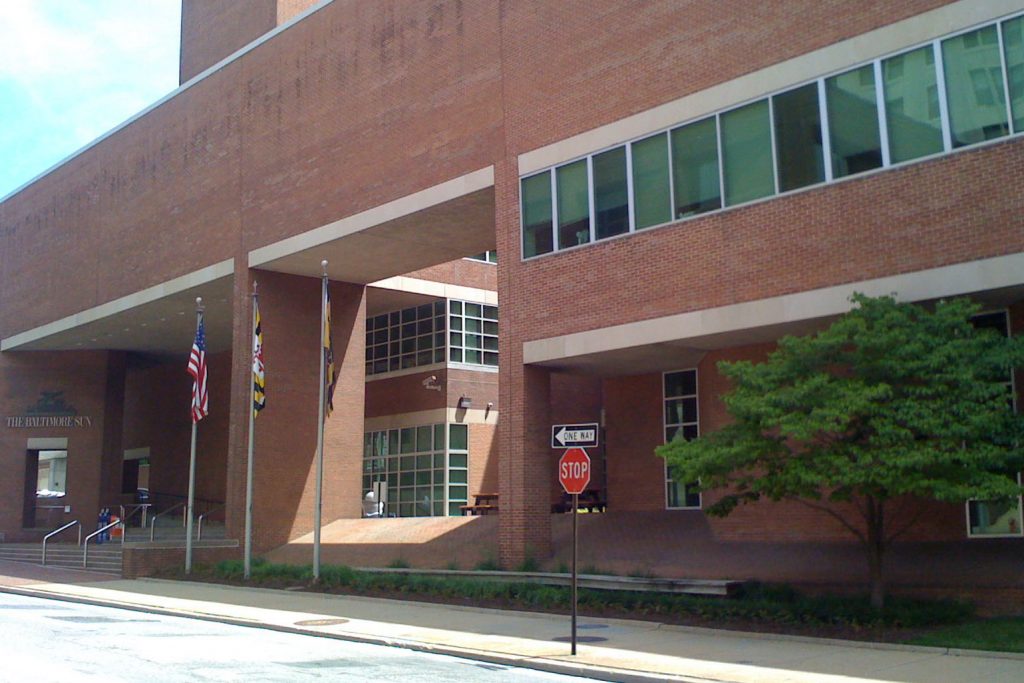
If you just heard, “Uh-oh,” being muttered, it likely emanated from 501 N. Calvert St., where the remaining stalwarts of The Sun remain – at least for a few more weeks – while waiting to see if the grim news out of the Big Apple signals any kind of impending damage to Baltimore.
At The Sun, they’ve already endured more damage than they ever imagined.
When the Chicago Tribune newspaper company – now known as Tronc – bought The Sun, the paper had more than 400 newsroom employees. But as Chicago has taken a bite here and a bite there over the last decade, that same newsroom’s now down to about 100 people.
That’s why they’re getting ready to vacate their old digs on Calvert Street for the distant South Baltimore outpost of Port Covington. The old building’s too big — and too costly — for an operation that’s only a shadow of its former self.
It’s a sad story, and it’s happening all over America, as witness this week’s pulverizing of the Daily News.
That paper was an American icon. It was once home to the great columnists Jimmy Breslin and Dick Young. It was the paper whose front page declared, “Ford to New York: Drop Dead” and turned around a presidential election. It was scruffy and frenetic and impolite, like the city itself. It was The Daily Planet brought to life.
The Daily News still bills itself as New York’s “Home Town Paper.” But this week’s action out of Chicago sneers at such a notion. They cut half the remaining jobs in the newsroom. To cover a metro area of 8.5 million people, the paper now has fewer than a hundred newsroom people. Its sports staff was cut from 35 to nine.
Here’s how it translates to daily coverage: for years, the paper’s reporters focused on local news, on cops and courts and schools. Let the New York Times cover the great capitals of the world, the Daily News told you what’s what in the city’s bustling neighborhoods.
How do you do that when the bulk of your reporting staff has been tossed out the door, and the newsroom’s become a ghost town?
Answer: You don’t.
Chicago’s excuse is that the paper’s readers have already drifted away and left no forwarding addresses. Once the most-read paper in the country, with an estimated 2.5 million post-war circulation, it’s down to about 200,000. Advertising, too, has plummeted.
That’s why they made the cuts in New York, and it’s why there’s a shiver across the newsroom down on Baltimore’s Calvert Street.
 A former Baltimore Sun columnist and WJZ-TV commentator, Michael Olesker is the author of six books. His most recent, “Front Stoops in the Fifties: Baltimore Legends Come of Age,” published by the Johns Hopkins University Press, is now in paperback.

At its annual meeting this year, the Baltimore Jewish Council will honor the late Harford County educator and longtime Holocaust education champion.
The former Colt, who passed away on May 25 at age 93, achieved immortality during a cold December day in 1958, writes Michael Olesker.

A new biography on the creator of "Doonesbury" misses the mark, writes Michael Olesker.

What does it mean to be fully present with each other and the sacred, asks Maryland-born cultural anthropologist Alanna E. Cooper.