

Before we get too depressed over the Ravens’ loss on Sunday, Oct. 7, to the Cleveland Browns, can I add a little touch to our lingering depression over the Orioles?
It’s beginning to look a lot like 1955.
That’s the year the Orioles brought in Paul Richards as their manager (and general manager), and some of us got to watch the beginnings of that catch-phrase known as “The Oriole Way.”
The meaning’s been lost through the years, but it’s really about playing fundamental baseball, learning the essentials like hitting the cut-off man, and building the big club from a firm minor league structure and then feeding it year after year.
The problem is: these things take some time. Those Richards-led O’s didn’t start to blossom until 1960, and then didn’t hit it big until 1966, when Richards was already gone.
In the meantime, you know who’s the Most Valuable Player on the team? The voice behind the microphone.
Night after night, the play-by-play announcers and their color men up in the press box are our connection to the home team, their voices cutting through the summer air to offer hope, to point out the little improvements here, to minimize the setbacks there, and to build emotional connections between the team and the extended home town.
That’s one of the reasons so many of us still have such fond memories of Chuck Thompson. He got us through the rough years, not only describing the action on the field but telling us stories about the players, humanizing them, and sometimes connecting today’s action with baseball lore of yesteryear. He was a next-door neighbor chatting about the game over the backyard fence.
Baseball’s not just a sport – it’s an entertainment. And in a time when the Orioles are drawing fewer people to the ballpark than they have in the last 40 years, most of us are getting our “entertainment” (if you call 115 losses entertaining) from TV or radio coverage.
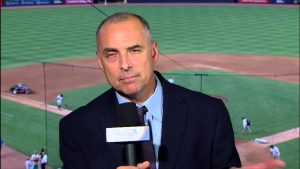
And I see now that Mike Bordick has thrown his name onto the list of those who’d like to be the next manager of the Orioles. Bordick used to play shortstop for the O’s, where he almost never made an error.
But since 2012, he’s been a color man on Orioles’ broadcasts, where he’s never even figured out the game. Up there, the game is entertainment as well as information. It’s about telling a funny story to relieve the boredom when the club’s down 8 to 2 in the 7th inning.
Bordick’s a guy who spent more than a decade in big league dugouts, and in nearly a decade in the broadcast booth, he’s yet to tell an anecdote. He delivers the endless cliché. He reads statistics that are written on the screen, as though speaking to an audience of illiterates. He’s never told us something about the players that most of us didn’t already know.
I’m told Bordick’s a nice fellow. So it saddens me to write something negative about him. But if he gets the job as Orioles manager, that might be a good thing. Down in the dugout, he understands how the game is played.
 A former Baltimore Sun columnist and WJZ-TV commentator, Michael Olesker is the author of six books. His most recent, “Front Stoops in the Fifties: Baltimore Legends Come of Age,” published by the Johns Hopkins University Press, is now in paperback.

At its annual meeting this year, the Baltimore Jewish Council will honor the late Harford County educator and longtime Holocaust education champion.
The former Colt, who passed away on May 25 at age 93, achieved immortality during a cold December day in 1958, writes Michael Olesker.
A new biography on the creator of "Doonesbury" misses the mark, writes Michael Olesker.
What does it mean to be fully present with each other and the sacred, asks Maryland-born cultural anthropologist Alanna E. Cooper.