
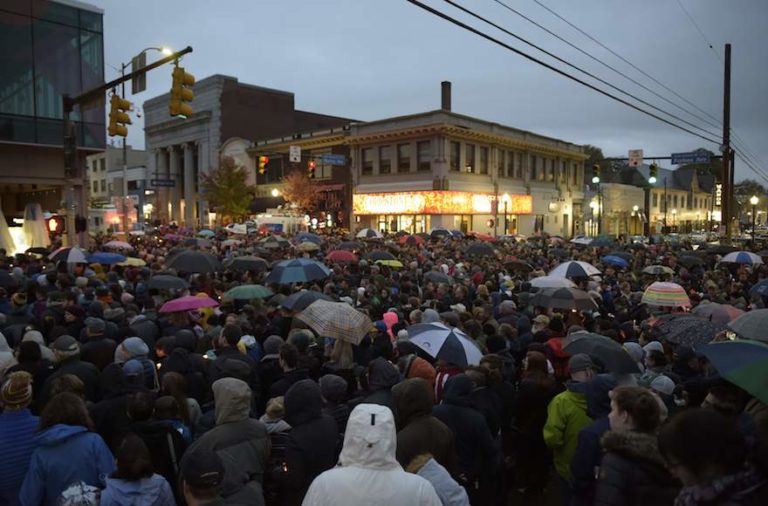
God Himself must wish to turn away from the awful events taking place in America these days.
The Shabbat shootings in Pittsburgh were so heartbreaking that they almost – almost – make us forget the pipe bomb mailings of a few days earlier, which might have resulted in mass political assassinations.
Eleven dead in Pittsburgh, several more alive only by medical science and police bravery, but something else dies in our souls – the sense of safety, the heartfelt wish that no one would come after us simply because of our spiritual beliefs.
The Pittsburgh shootings take us back to Charlottesville, Va., when neo-Nazis marched through the streets chanting, “Jews will not replace us.” The words not only stung, but surprised. We’d imagined we weren’t replacing anyone – we were part of the American whole, cherished extended family of all other Americans.
Pittsburgh tells us otherwise.
The pipe bombs do, too. They send a message not only to Jews, but to all who dream of an America where we do not divide ourselves by whom we hate. We wish to bind ourselves to each other by the things we have in common, the things we love, and the American ideal that we all belong.
But we live in an America now where that wish is challenged routinely – not only by the Pittsburgh anti-Semite, not only by pipe-bomb political hater, but by anyone in public life who seeks to divide us.
Do we need to name names?
Do we need a reminder that when President Donald Trump called the Pittsburgh assailant “evil,” he was using the precise term he’s used for Hillary Clinton, the precise term he’s used for Democrats in general who have challenged some of his most poisonous rhetoric?
Words matter.
Even as he decries the Pittsburgh shooter, who shouted that Jews must die, this president looks at the desperate people – many of them women and children – attempting to flee danger and poverty in Guatemala with their unimaginable thousand-mile walk to the American border, and Trump demonizes them as “dangerous.”
Even as the entire country notes that each one of last week’s pipe bombs was aimed at those who have been verbally attacked by Trump, this clueless president blames “the media” – including CNN, which was itself attacked.
Never mind that he calls his opponents evil, and never mind that he makes jokes about reporters getting body-slammed, or calls reporters enemies of the people. In his mind, it’s just coincidence that his opponents are the very ones who receive pipe bombs in the mail.
This president acknowledges no responsibility of his own for setting a tone in this country – one in which our president willfully chooses not to heal our wounds, but to turn them into political advantage.
And so we live in a time of pipe-bombs sent to political leaders, and Shabbat shootings at a Pittsburgh synagogue.
It’s enough to make God Himself cover his eyes.
 A former Baltimore Sun columnist and WJZ-TV commentator, Michael Olesker is the author of six books. His most recent book, “Front Stoops in the Fifties: Baltimore Legends Come of Age,” published by the Johns Hopkins University Press, is now in paperback.

At its annual meeting this year, the Baltimore Jewish Council will honor the late Harford County educator and longtime Holocaust education champion.

The former Colt, who passed away on May 25 at age 93, achieved immortality during a cold December day in 1958, writes Michael Olesker.

A new biography on the creator of "Doonesbury" misses the mark, writes Michael Olesker.
What does it mean to be fully present with each other and the sacred, asks Maryland-born cultural anthropologist Alanna E. Cooper.