
Americans go to the midterm voting booths with some remarkable new numbers just below their radar. Across the country, there’s been a phenomenal growth in the number of political candidates who are female, people of color, gay, lesbian and transgender.
According to a New York Times analysis, more than a quarter of all candidates running this year are female, including 84 women of color. That’s a 42 percent increase from just two years ago. And there are at least 215 candidates of color and a record 26 openly LGBTQ candidates. That’s more than five times the number in 2010.
This, as The Times points out, in a nation where white men make up one-third of the population – but 69 percent of all governors and members of congress are white men.
This year, among Democratic candidates, white males are actually a minority. They make up just 41 percent of candidates for Congress and governor. Among Republicans, three in four candidates are white men.
The overall numbers reflect a social transition in this country that’s partly a response to President Donald Trump’s awful remarks about women, and polls indicate a huge female antipathy toward him.
But the changeover, involving both race and gender, certainly pre-dates the president. Three decades ago, the election of Kurt Schmoke as the city of Baltimore’s first African-American mayor was considered a remarkable moment in history.
That the last three Baltimore mayors have been African-American women is no longer considered headline news.
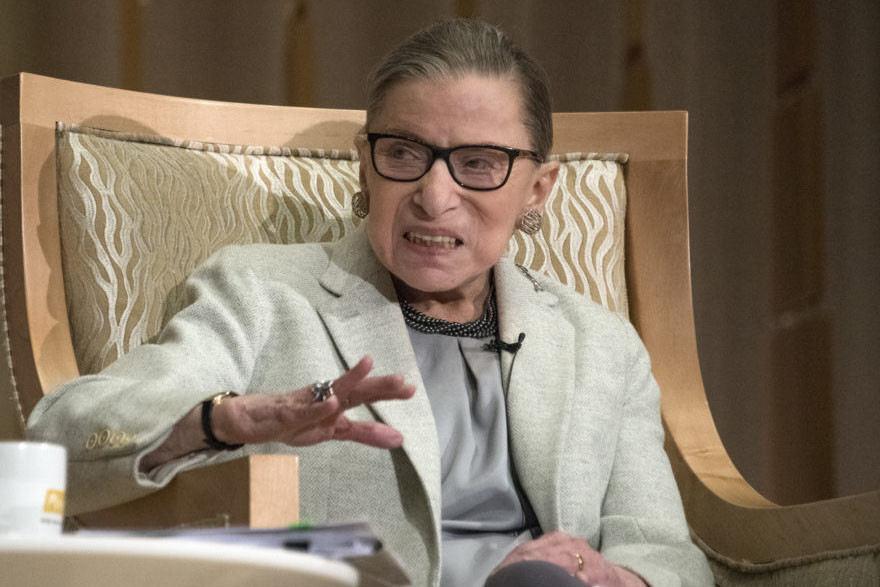
Now consider a new biography, “Ruth Bader Ginsburg: A Life,” which tells us even more about the changing public role of women.
In her Harvard Law School class of 1959, Ginsburg was one of only nine women among 552 students. Though she was tied for first in her class at Columbia Law School (where she transferred to be with her husband in New York), she couldn’t find a job after graduation. Women were supposed to stay at home. When she turned to teaching, in 1963, there were only 18 female tenured law professors in the entire country.
That was a time when professional women didn’t become doctors, they became nurses. They didn’t become lawyers, they became secretaries. It wasn’t the law that dictated such choices; it was the culture.
At the dawning of Ginsburg’s professional life, virtually every member of the U.S. Congress was male. It was 1961 before Baltimore had its first female Supreme Bench judge. It was 1963 before Baltimore County had its first female assistant state’s attorney.
As Americans go to the polls, the world of politics and the law have changed dramatically.
Precisely how dramatically, we’ll discover when the votes are counted.
 A former Baltimore Sun columnist and WJZ-TV commentator, Michael Olesker is the author of six books. His most recent book, “Front Stoops in the Fifties: Baltimore Legends Come of Age,” published by the Johns Hopkins University Press, is now in paperback.
At its annual meeting this year, the Baltimore Jewish Council will honor the late Harford County educator and longtime Holocaust education champion.
The former Colt, who passed away on May 25 at age 93, achieved immortality during a cold December day in 1958, writes Michael Olesker.

A new biography on the creator of "Doonesbury" misses the mark, writes Michael Olesker.
What does it mean to be fully present with each other and the sacred, asks Maryland-born cultural anthropologist Alanna E. Cooper.