
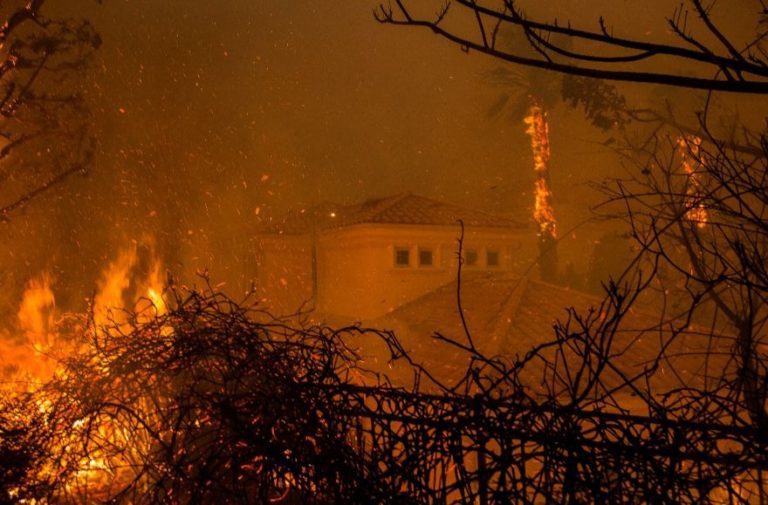
The hellish fires in California have combined with modern technology to take us where humanity has never been before this: to play-by-play descriptions of the apparent final moments of human life, unedited, for all to share in the experience.
The fires have now, officially, taken 50 lives. Unofficially, counting those who are described as “missing” somewhere in the devastation, the number is likely to multiply.
Among the victims, also, are more than 8,000 destroyed homes and hundreds of thousands of acres of once-lush land now charred and ashen.
But we’re watching, from the safety of our living rooms 3,000 miles from California, something beyond the wrath of nature – a glimpse into the human spirit as death seems to have arrived.
The cable news stations are bringing us videos taken from the interior of cars as people try to escape the flames surrounding them and closing in. The videos were taken by people who imagine – for good reason – that they might not escape, and that these could be the very last moments of their lives.
And they capture these moments on their cell phones.
With fire all around them, we hear them talking to each other, trying to ease their worst fears, trying to comfort their frightened children. We hear them singing to ward off the terror. We hear them praying, as though God might find them in the midst of such blinding catastrophe and send down a miracle.
They’re doing virtual play-by-play of what are conceivably the final moments of their lives. Then, when they finally find themselves safely delivered from the dangers, we share a piece of their relief and exultation.
The terror can stay with them forever, preserved on video – but it’s OK, they got through it alive.
And now the play-by-play coverage goes one step further. The survivors are interviewed on cable news stations, where the videos are shown and the questions come at them like post-game analysis:
“What did it feel like when you were going through this?”
“What were you thinking when this was happening?”
“Describe your sense of relief when you realized you’d survived.”
I do not denigrate any of this, nor precisely applaud it. I appreciate the insights into people’s genuine emotions, though it feels a little too close to invasion of their privacy.
But it’s clear that technology is taking us places in the human spirit where we’ve never been before, where people are expressing themselves, in real time, so vividly and so honestly and without any apparent self-consciousness, at what they fear are the last moments of their lives.
 A former Baltimore Sun columnist and WJZ-TV commentator, Michael Olesker is the author of six books. His most recent book, “Front Stoops in the Fifties: Baltimore Legends Come of Age,” published by the Johns Hopkins University Press, is now in paperback.
At its annual meeting this year, the Baltimore Jewish Council will honor the late Harford County educator and longtime Holocaust education champion.

The former Colt, who passed away on May 25 at age 93, achieved immortality during a cold December day in 1958, writes Michael Olesker.

A new biography on the creator of "Doonesbury" misses the mark, writes Michael Olesker.

What does it mean to be fully present with each other and the sacred, asks Maryland-born cultural anthropologist Alanna E. Cooper.