
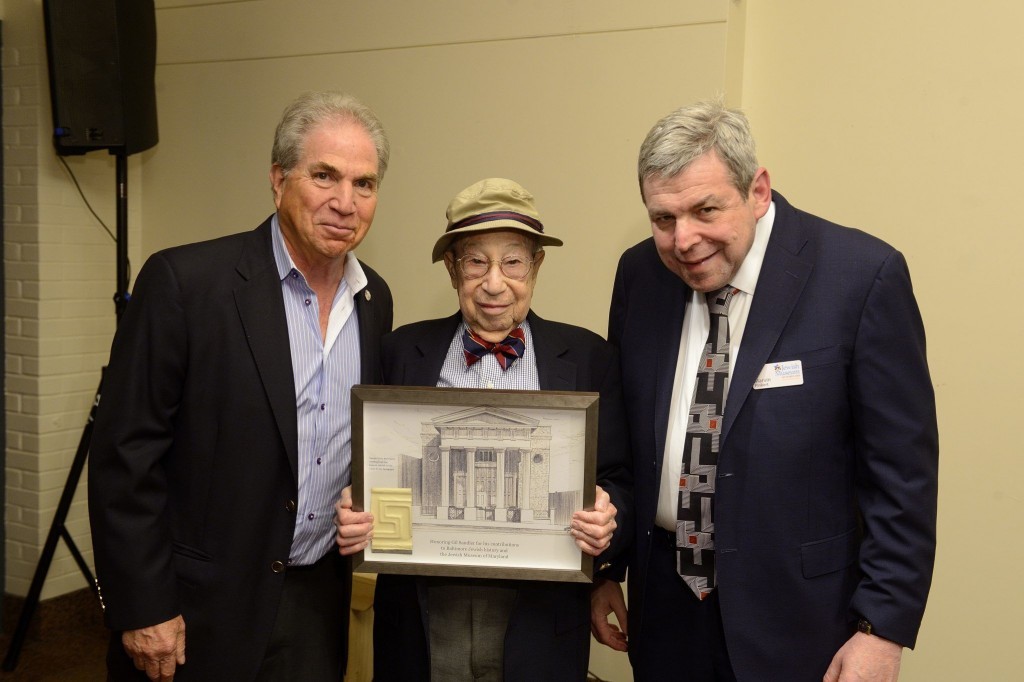
Gilbert Sandler goes, and all he takes with him are a century’s memories: of Jack Pollack and Irv Kovens, of Carlin’s Park and Nate’s and Leon’s, of public baths on Lombard Street and handball games at the old YMHA on Monument Street, of late nights at the Hilltop Dinner and late afternoons at Old Hilltop when the thoroughbreds headed down the stretch.
He was our municipal tour guide across the generations, whether it was his “Baltimore Glimpses” column in The Sun, or his many columns for other publications, or his broadcasts on WYPR, or his books on Baltimore.
He was 95 when he left us on Dec. 19, and his memory bank went back even further. So did his love of his hometown. He knew its flaws, felt its pain and held onto the love anyway.
He gave us history, and he gave us perspective. In the modern era of social media, of websites and tweeting and instant communication, so many of us hurtle breathlessly along the informational highway. We reduce thought to fragment, analysis to shorthand quip.
Gil’s implicit message was: Let’s slow things down for a bit. Take a glance into our rear-view mirrors, where there’s still a lot worth remembering.
He’s remembered here as a chronicler of Jewish Baltimore – which was, of course, the title of one of his books, “Jewish Baltimore” – but his reach went much further.
He connected this political club with that political aftershock, connected the death of one downtown theater (the Hippodrome) with the birth of another (the Mechanic), and then the Mechanic’s death with the rebirth of another (the Hippodrome).
And he connected, too, the Jewish community with those around it.
He remembered which streetcar line got you to Bay Shore Park. He remembered Park Circle with its amusement park instead of its industrial park. He knew the box scores from old Oriole Park and the academic scores out of City College’s A-course.
He knew all of these things not only because of a great memory and a great reservoir of energy for research when his memory came up short – but a great love of Baltimore’s characters, and its neighborhoods (including Little Italy, whose joys he chronicled in another book, “The Old Neighborhood.”)
He connected generations, and neighborhoods, and institutions. He brought long-gone ghosts back to life. Each memory of his set off memories of our own.
With that crushed fedora pulled across his forehead, and his eyes twinkling behind his glasses, his voice is still out there, full of delight.
Can you hear it? He’s saying, “Hey, did I ever tell you about …?”
 A former Baltimore Sun columnist and WJZ-TV commentator, Michael Olesker is the author of six books. His most recent, “Front Stoops in the Fifties: Baltimore Legends Come of Age,” has just been re-issued in paperback by the Johns Hopkins University Press.
At its annual meeting this year, the Baltimore Jewish Council will honor the late Harford County educator and longtime Holocaust education champion.
The former Colt, who passed away on May 25 at age 93, achieved immortality during a cold December day in 1958, writes Michael Olesker.

A new biography on the creator of "Doonesbury" misses the mark, writes Michael Olesker.
What does it mean to be fully present with each other and the sacred, asks Maryland-born cultural anthropologist Alanna E. Cooper.