
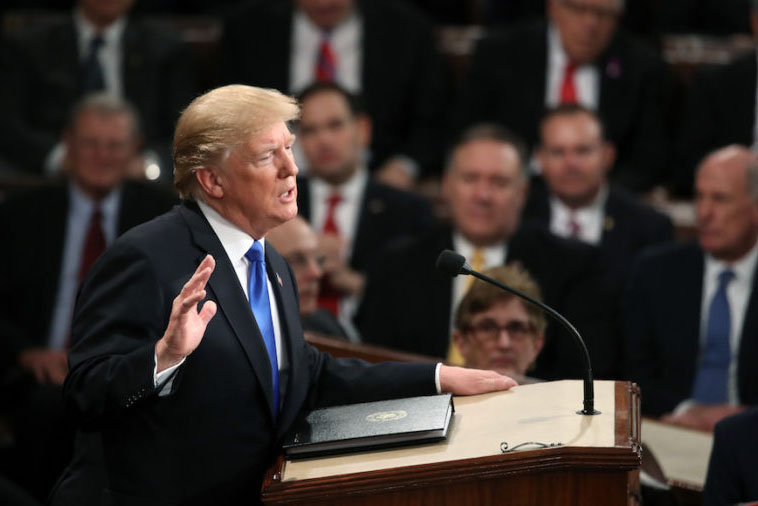
Running time for President Trump’s State of the Union address on Feb. 5 was just under an hour-and-a-half. Walking-out time, or falling-asleep time, was much less.
The speech seemed less of an inspirational oration around the national campfire than a series of applause lines, plodding in delivery but nice if you’re a Republican, hypocritical if you’re a Democrat and cheap shots if you’re an immigrant or remember one.
This president won’t let go of that wall on the southern border, will he? He defended it in his address by decrying a murder committed by an immigrant who sneaked into America illegally.
Never mind that we’re a nation of immigrants who have made this country great. Blah, blah, you’ve heard that argument. So the president reaches for one guy and makes him the poster child for every sinister, dark-skinned foreigner out there in the shadows looking to slither in here.
Just to make it clear: nobody’s in favor of illegal immigration, and nobody (despite what the president claimed) wants “open borders.” And everybody thinks it’s awful when murder’s committed under any circumstance.
But according to the government’s own figures, there are somewhere between 15,000 and 20,000 homicides across the United States year after year. And all but about 12 percent of them are committed by American citizens.
Why didn’t Trump talk about all of those thousands of homicides – and how in the world do you talk about such a thing and not breathe a syllable about gun control?
Somehow, this president managed it.
He also managed, in his very first minute, to bring up not only immigration but the need for infrastructure repair and the high cost of drugs. Somehow, he cited “historic breakthroughs.”
Uh, just for the record, he also brought up the high cost of drugs in last year’s State of the Union speech. And what’s happened since? According to an Associated Press study of brand-name drugs, we’ve had 96 price hikes for every price cut over the past year.
And just for the record, Trump also brought up the need for infrastructure repairs a year ago, when he said the cost would be about $1.5 trillion. Nobody disagrees about the need for better roads and bridges.
But we’re a year later, and Washington still can’t agree on who’s going to pay for it.
Trump rightfully pointed out the healthy numbers on job growth – but failed to mention flat wages, or the enormous gap between the rich and the rest of us.
And, oh yeah, the president failed to mention the government shutdown, when we learned the staggering number of Americans – 78 percent, according to the government – who live paycheck-to-paycheck on a weekly basis. And that’s what passes for a healthy economy?
All of this, remarkably, with Trump addressing us “not as two parties but as one nation.” That’s his gesture of healing. This, on the same day he called Democratic Senate leader Chuck Schumer “a nasty SOB.”
Nice healing gesture, Mr. President.
 A former Baltimore Sun columnist and WJZ-TV commentator, Michael Olesker is the author of six books. His most recent, “Front Stoops in the Fifties: Baltimore Legends Come of Age,” was reissued in paperback by the Johns Hopkins University Press.

At its annual meeting this year, the Baltimore Jewish Council will honor the late Harford County educator and longtime Holocaust education champion.

The former Colt, who passed away on May 25 at age 93, achieved immortality during a cold December day in 1958, writes Michael Olesker.

A new biography on the creator of "Doonesbury" misses the mark, writes Michael Olesker.
What does it mean to be fully present with each other and the sacred, asks Maryland-born cultural anthropologist Alanna E. Cooper.