
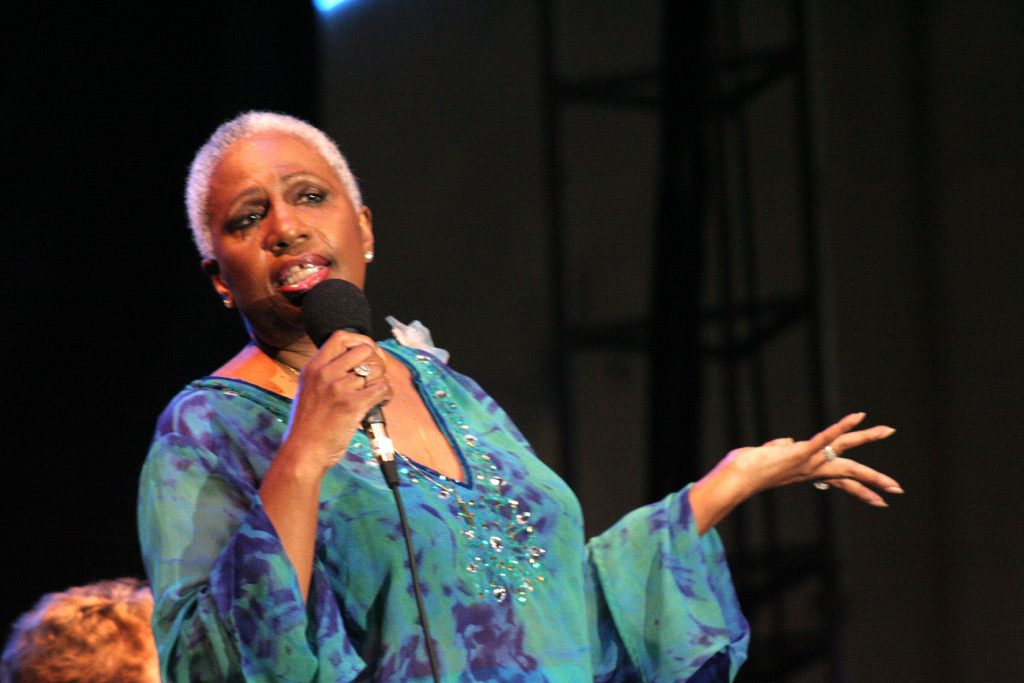
I’ll leave it up to the music critics to evaluate Ethel Ennis’s magic with a song. They adored her. I loved her singing, too – who wouldn’t? But I loved her take on life even more.
Ennis slipped away from us over the weekend, at 86, and the local daily got it right with its front-page headline: “Baltimore’s ‘First Lady of Jazz’ – Singer passed up a national career to stay true to her Baltimore roots.”
But when I think of Ennis, I recall a conversation from 40 years ago and an outlook on life that surely melted into her music.
I’d been assigned a piece of fluff freelance feature for Baltimore magazine back then, which they headlined, “Fantasies: What Happens When You’re Living the Life Most People Only Dream About?”
All the big Bawlmer celebs of that era pitched in with their late-night “secret” musings: William Donald Schaefer, Jerry Turner, the symphony’s Sergiu Commissiona, the city council’s Wally Orlinsky and Clarence “Du” Burns, the Colts’ Glen Doughty. None, frankly, were the stuff of great imagination.
(For the record, Schaefer wanted to catch “the biggest flounder ever caught.” Turner wanted to play big league baseball. Commissiona wanted to sing.)
Ennis and I talked one afternoon in late summer, and at first she said she’d lived all of her fantasies. And why not? She’d sung with Duke Ellington, Louis Armstrong, Benny Goodman, Cab Calloway, Miles Davis and John Coltrane. Frank Sinatra called her “my kind of singer.” Audiences loved her.
So she tossed out a laugh line.
“You caught me in the middle of hay fever season,” she said, “and right now my fantasy is to get rid of my sneezing and itchy eyes.”
As a fellow hay fever sufferer, we bonded right there. But then she took the conversation to a different level.
She was a product of West Baltimore working-class striving, and American racial pressures, living in a city that was still, nearly a decade after the 1968 riots, trying to find a sense of peace with itself.
“My fantasy,” she said, her voice softening now, “is really to be able to give love to those people who hate, shelter to those who need it and comfort where it’s needed. I guess I see myself as some kind of goddess, who could straighten everything out.”
Then she stopped herself, not wanting to sound too grandiose.
“Yes,” she laughed, reaching for a tissue, “straighten out everything. Including hay fever.”
 A former Baltimore Sun columnist and WJZ-TV commentator, Michael Olesker is the author of six books. His most recent, “Front Stoops in the Fifties: Baltimore Legends Come of Age,” was reissued in paperback by the Johns Hopkins University Press.
At its annual meeting this year, the Baltimore Jewish Council will honor the late Harford County educator and longtime Holocaust education champion.
The former Colt, who passed away on May 25 at age 93, achieved immortality during a cold December day in 1958, writes Michael Olesker.

A new biography on the creator of "Doonesbury" misses the mark, writes Michael Olesker.
What does it mean to be fully present with each other and the sacred, asks Maryland-born cultural anthropologist Alanna E. Cooper.