
In the Great Emptinessbetween the end of football season and the beginning of baseball, it’s nice toremember how people survived before we had cable TV and cell phones to helpdistract us through the endless winter months.
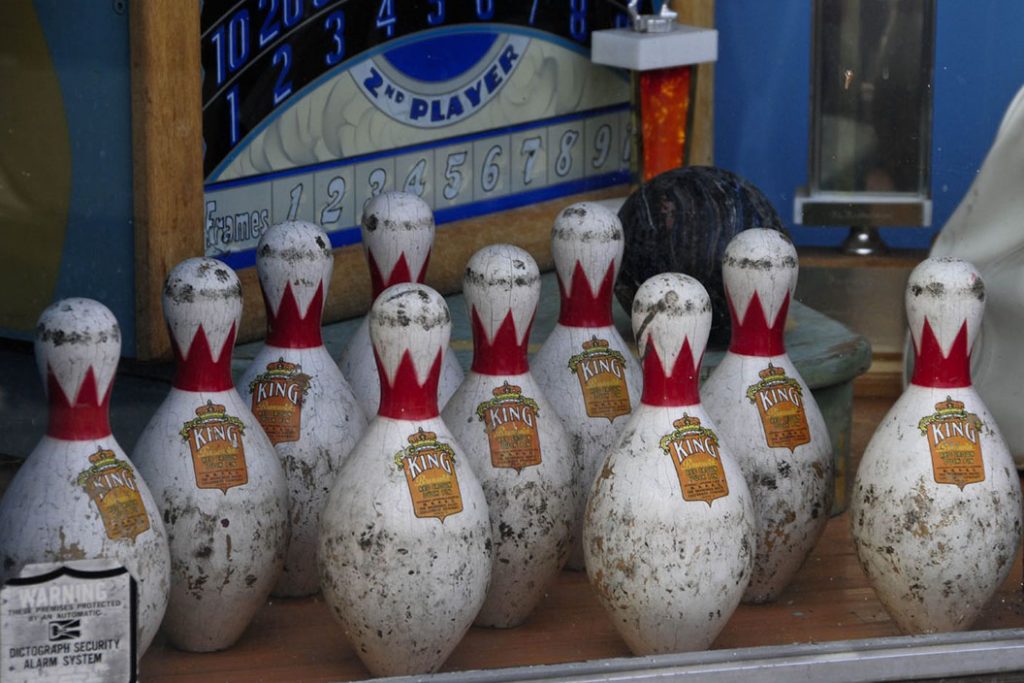
It hit me as I drove along Liberty Heights Avenue the otherday. There it was, that bastion of thunderous noise, that madhouseestablishment where the height of superior athletic achievement was making the impossible7-10 split – the location that used to be Toots Barger’s duckpin bowling alley.
Remember Toots? In post-war Baltimore, she was the queen ofducks when bowling was as big around here as meetin’ ya at Ameche’s or makingout at Carlin’s Drive-In during the slow scenes of “Gidget Gets A Hickey.”
Duckpin bowling’s still around, but it was everywhere in those days, a secular Bawlamer religion celebrated not only onthe hundred lanes on Howard Street but joints on neighborhood corners, beneathstrip malls, in church basements, above shops and movie theaters, and on televisionevery time you turned on the set.
Remember “Pinbusters?” Remember “Duckpins and Dollars”?Remember, every winter when WMAR-TV carried the final round of the Evening Sun duckpin tournament?
Toots was always among the finalists, along with some otherswho became household names of that era, strictly from their Sunpapers TV exposure: Dave Volk and VicLancelotta and Jimmy Dietsch, Mary Kuebler and Patsy Stroessner, Ruth Kratz andAlva Brown, Ethel Dize and Audrey (Sis) Atkinson, and big Min Weisenborn, who’dtoss the ball into the air like a Russian shot-putter, catch it and then heave itso furiously that even the pins seemed to cringe.
I can picture it still.
Toots’s place was one of the three or four great bowlingestablishments in Northwest Baltimore. There were the Hilltop Lanes, around thecorner from the Hilltop Shopping Center; the Forest Park Lanes, where you couldspend an entire Sunday afternoon impatiently waiting for them to call your namebecause the place was so jammed; and Northwest Bowling Lanes, which came alonga few years later.
Even now, when I drive toward Highlandtown on the city’seast side, to pass the ancient Patterson Lanes feels like passing some kind ofathletic religious shrine.
There wasn’t another town in America that made such a big deal out of duckpins. Most cities used the big ten-pin balls, where the scores were so much higher but the game lacked the idiosyncratic spill of the duckpins. It was just one more distinguishing feature of our local character, like beehive hairdos or slurping “urshters” or believing Charley Eckman spoke the King’s English.
For me, Toots’s old place was the heart of it. It was just below Gwynn Oak Junction, with its old Ambassador Theater, Read’s Drug Store and the Ben Franklin 5 & 10 store.
As memory serves, Toots’s place only had about a dozenlanes. For a lot of years, it still had pin boys, with their duck’s asshaircuts and cigarettes dangling from their lower lips. They’d work two lanesat a time and holler at cheapskates who failed to toss a 10-cent tip down thealley at game’s end.
Toots’s place was also good for playing hooky from anoccasional Sunday school class. But I’ll leave that part out. The statute oflimitations might not have expired yet.
Until the arrival of baseball, I’ll just nurture old dreams of making the elusive 7-10 split.
Also see: Is Bowling Still Cool?

A former Baltimore Sun columnist and WJZ-TV commentator, Michael Olesker is the author of six books. His most recent, “Front Stoops in the Fifties: Baltimore Legends Come of Age,” was reissued in paperback by the Johns Hopkins University Press.
At its annual meeting this year, the Baltimore Jewish Council will honor the late Harford County educator and longtime Holocaust education champion.
The former Colt, who passed away on May 25 at age 93, achieved immortality during a cold December day in 1958, writes Michael Olesker.
A new biography on the creator of "Doonesbury" misses the mark, writes Michael Olesker.
What does it mean to be fully present with each other and the sacred, asks Maryland-born cultural anthropologist Alanna E. Cooper.