
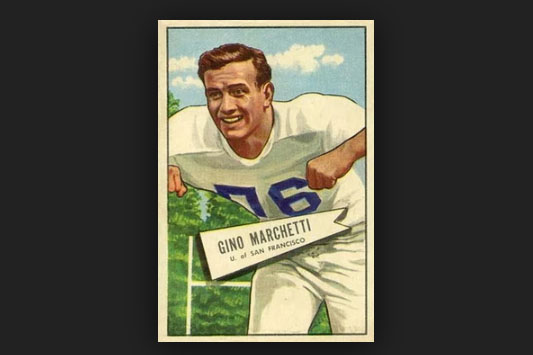
The last time I saw Gino Marchetti, he was shuffling slowly into Artie Donovan’s funeral nearly six years ago. I thought of Donovan’s great story about the big Baltimore Colts rookie who found it impossible to block Marchetti during a team practice session.
First, Gino knocked the rookie on his rump. Then, he ranaround him. Then, on a third play, he leaped over him. The befuddled youngsterturned to Donovan.
“What do I do now?” he asked.
“Applaud, kid,” Artie told him. “Just applaud.”
It’s what we all did, didn’t we? We applauded that whole eraof Baltimore Colts. Like so many teammates from his time, Gino wasn’t just afootball player. He was part of an adored generation that gave a self-consciouscity a sense of community and a brief championship aura.
And, not to be diminished, some of us can still recall the taste of those 15-cent hamburgers back when Gino’s burger joints seemed to cover the landscape.
But now, at 92, Marchetti joins the roster of former Colts who have died. He and John Unitas were the heart and soul of the 1958 Sudden Death champions who electrified the entire country and made professional football the new national sport.
But it was the Hall of Famer Marchetti, even more thanUnitas, who was the club’s veteran leader. That poor rookie wasn’t the only onewho found it impossible to block Gino.
One evening a dozen years ago, I was lucky enough to spend afew hours in a South Baltimore bar with Marchetti and Lenny Moore. Two Hall ofFamers and me, trying to disguise how awed I felt. I’d been invited alongbecause I’d just written a book on the ’58 club, “The Colts’ Baltimore: A Cityand Its Love Affair in the 1950s.”
I remembered Donovan’s story about that big, overmatchedrookie.
“Over the years,” I asked Gino, “who was your all-timetoughest opponent?”
“Oh, that’d be my first wife,” he said without a moment’shesitation.
He was going for the laugh and brushing aside that othergreat opponent in his life. Gino was 18 when he fought in World War II’s Battleof the Bulge.
If you pressed him, he’d mention the freezing cold and lyingin the dark with a few dozen guys, and the Germans out there across a narrowstrip of geography. Somebody would soak a sock in gasoline and put it in abottle and then light it up just so the guys could see. But Gino mostly kepthis war stories to himself.
He made arguably the most important tackle in Colts’ history, in the ’58 Sudden Death game. Time running out, the New York Giants needed four yards or they’d have to punt. Frank Gifford swept right. He got three yards and two feet. But then he met Gino and Donovan, followed by “Big Daddy” Lipscomb.
They stopped Gifford there – but Lipscomb landed on Gino’sright ankle and broke it. They carried him to the sidelines and tried haulingGino to the locker room. But Gino wouldn’t go.
“Put me down here,” he said.
He wanted his teammates to see he was still there and wasn’tdeserting them. Up in the Yankee Stadium stands, thousands of Baltimore fans chanted,“Gino, Gino, Gino.” He was thegladiator who refused to fall on his shield.
When they finally dragged him off to the locker room, Ginolay there in silence, not knowing that Steve Myhra kicked a tying field goalwith seven seconds left, and Alan (The Horse) Ameche scored in overtime for a23-17 championship win.
When the ballclub finally raced in, and Ameche handed him the ball, Marchetti said, “I’d have broken the other ankle if I knew it’d mean this much.”
What’s left as Gino the Giant goes to his grave?
Applaud, kids. Just applaud.

A former Baltimore Sun columnist and WJZ-TV commentator, Michael Olesker is the author of six books, including “The Colts’ Baltimore: A City and Its Love Affair in the 1950s” (Johns Hopkins University Press). His most recent, “Front Stoops in the Fifties: Baltimore Legends Come of Age,” published by the Johns Hopkins University Press, is now in paperback.

As he gets ready to leave for California, Rabbi Daniel Cotzin Burg looks back on his time in Baltimore and his 10 years writing for Jmore.
Michael Olesker pays tribute to WJZ’s retiring Marty Bass, a longtime fixture on local TV screens.
The Orioles' weak defense plays a major role in the nightly carnage, writes Michael Olesker.