
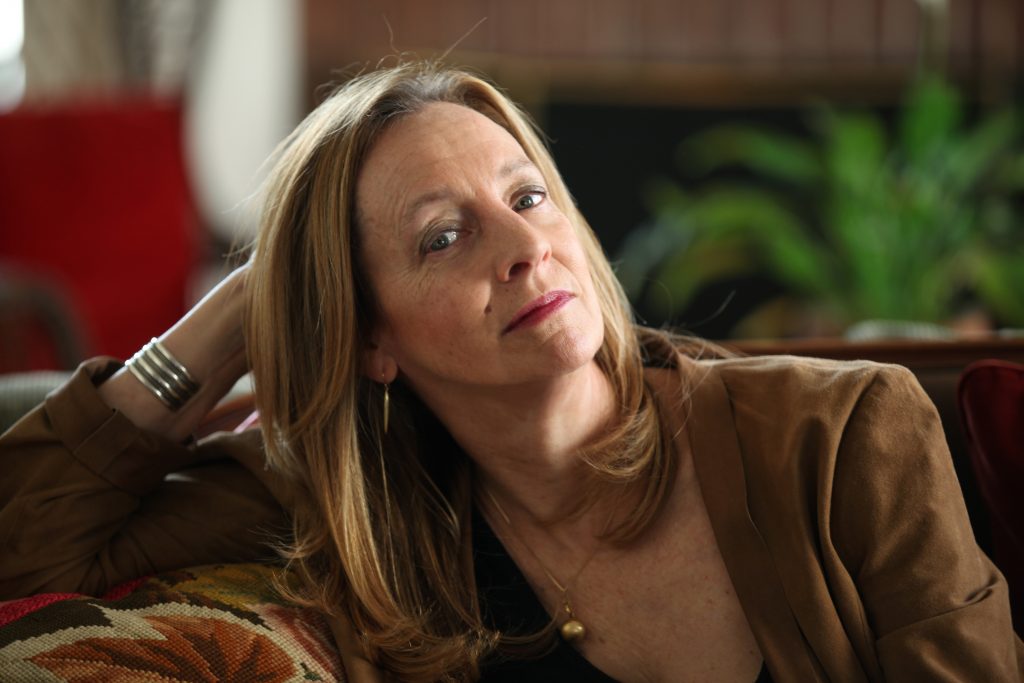
What’s it like to live in the shadow of arguably the most celebrated composer/conductor of the 20th century?
In her new book “Famous Father Girl: A Memoir of Growing Up Bernstein” (HarperCollins), Jamie Bernstein offers an intimate and intriguing portrait of her late father and the unique challenges that come with being the eldest daughter of Leonard Bernstein.

On May 21, Sinai Hospital and the Sinai Mitzvah Foundation will present “Famous Father Girl: An Evening with Jamie Bernstein” at the Gordon Center for Performing Arts in Owings Mills. The evening will include music and storytelling by Bernstein and special guest Darin Atwater, a Baltimore-based composer and founder of the Soulful Symphony orchestra.
Jmore recently spoke with Bernstein, 67, about her memoir, her career as a writer, filmmaker, concert narrator and broadcaster, and the experience of “growing up Bernstein.”
[Editor’s Note: After this interview was conducted, Jamie Bernstein announced she needed to cancel her appearance at the Gordon Center.]
Jmore: Tell us about your own musical journey.
Bernstein: I wasmusical but when it came to making music with my own body, I was very neurotic.I heard music performed all the time at the optimal level, so I would feel sodiscouraged. I hated piano lessons, and I hated practicing. But I loved music,and what became my way into music was through an old guitar I found in thecloset.
At [a Connecticut-based] JCC, we learned the song ‘Easy Rider.’ SoI played for my father and he said, ‘Oh, that’s a blues. It’s three chords.’ Hewas like a teacher faucet or a teacher firehose. He never turned off.
I felt like [the guitar] gave me the Rosetta Stone. I could playall the music I heard on the radio and I could make the music my own.
How didyour father feel about pop music?
My father loved pop music and we shared a love of the Beatles.Every time a new album came out, I would run to the record store to buy it. I’dslam it on the turntable and we’d listen to it. “Norwegian Wood” would come onand he’d say, ‘Hear that? That’s a sitar.’
Eventually, my father used pop music to illustrate [musicalpoints] at his [televised] Young People’s Concerts. At one concert, he used aBeatles song to explain sonata form — the A-B-A structure. My father observedthat this was a great way to get the kids interested. He would sing with histerrible voice and the kids loved it. It was also a great message for parentsthat it was OK to love all kinds of music. He wasn’t making a value judgmentabout one kind of music being better than another.
How didyou wind up having a career in classical music?
After college, I tried to pursue a career as a singer-songwriterso I went to L.A. and finally made a record. The record company listened to itand announced they didn’t like it. I’d just gotten married at the time so Isaid, ‘To hell with it. I’ll just focus on the marriage and start a family.’
So first, I had my daughter, Frankie, and then my son, Evan.Weirdly, on my son’s first birthday, my father died [in 1990]. At that moment,my brother and sister and I realized we had a new occupation. We needed to takecare of my father’s legacy.
Later on in the same decade, an interesting inquiry came from myfather’s music licensor. Would we be interested in developing an educationalconcert just like the [Young People’s Concerts] he used to do, featuringBernstein’s music? For some reason, myhand went up. I volunteered. But of course, I needed help. So I went to MichaelBarrett, my father’s assistant conductor. I said, ‘You be the musical expertand I’ll write and narrate.’
We called it ‘Bernstein Beat’ and it was all about rhythm. Thekids loved it and it was quickly in demand by orchestras all over the U.S.Pretty soon, I was on the road talking about music. This turned out to be theanswer to my conundrum. I was even living a musician’s life — touring, hangingout with musicians. I just wasn’t making music with my own body. It was likecutting off the ailing limb to allow the rest of the organism to thrive.
Was yourdad a hands-on parent?
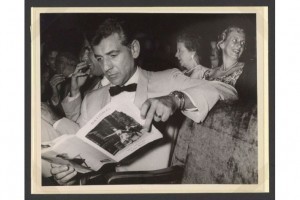
Yes. He wasn’t involved in the nuts and bolts of raising us. Buthe loved having us around and playing with us. We never felt unwelcome. Heinvited us on tour with him. I remember going on the road with the New YorkPhilharmonic.
Can youdescribe a family meal at the Bernstein household?
Noisy! Everybodytalked at the same time. There was lots of laughter, singing — we were happy.We loved being together in one big blob making a racket, preferably in thesummer with lobster and steak and corn on the cob.
What wasyour mother, actress FeliciaMontealegre, like?
My mother was an amazing woman. She had to be to live with myfather. She was very beautiful, witty and had a real sense of style. Everyonealways wanted to come to our house. Our friends adored her.
It was calamitous that she died so young [in 1978]. She was only56. She had breast cancer that metathesized to her lungs. Those were reallyhard years. I was 25 when she died. My sister, Nina, was just 16.
DidJudaism play a role in your family?
My father’s parents both emigrated from the Ukraine. His father,Sam, came to the U.S. when he was 17 without a penny and his mother came whenshe was 8. Sam started a hair supply business. In every spare moment he had,Sam was in synagogue.
Synagogue was the first place where my father heard music. But hemarried my mother, who was raised Catholic in Chile, and in our household it wasmix-and-match. We lit Chanukah candles anddecorated a Christmas tree. We still have rip-roaring seders. My brother had a barmitzvah, but my sister and I didn’t.
You can reallyexplore my father’s spirituality through his music. He’s talked about a crisisof faith and he uses music pieces like “Mass” to express spirituality andmetaphorically to shake his fist at the heavens — ‘If you’re up there, why arewe in this situation?’
What would your father say about today’spolitical climate?
Oh my God! He was a lifelong activist and humanitarian. He was always doing whatever he could. Starting in the 1940s, the FBI was keeping track of Leonard Bernstein. He worked for civil rights, against the Vietnam War, for AIDS awareness.
In the 1980s,through the Freedom of Information Act, he read his FBI file and found out itwas 800 pages long! He knew his phones were probably bugged. He didn’t care.Neither did my mother. If they were around today, they’d be slapping theirforeheads in despair.
What is your documentary “Crescendo: The Power of Music” about?
I becamefascinated by this global movement [started in Venezuela], El Sistema YouthOrchestra for Social Change. The program goes into inner cities and teacheskids to play music every day after school. Not only did it give them a safeplace to be, they are literally harmonizing with others, creating beauty.
So I was talking to my friend Elizabeth Kling about it and she said, ‘Let’s make a film about it!’ So we decided to follow a few kids — two from Philadelphia and one from Harlem (New York) to see how the program affected them. …
Baltimore was oneof the first cities in the U.S. to try it. [Baltimore Symphony Orchestra musicdirector] Marin Alsop gets props for that!
For informationabout “Famous Father Girl: An Evening with Jamie Bernstein,” emailkmeltzer@lifebridgehealth.org.
Jewish Community Services' upcoming "Future-Ready Workplace" event will feature a keynote address from workplace expert and bestselling author Liz Fosslien.
The BCO, founded in 1984, will perform the works of Frank Zappa, Beethoven, Mason Bates and Karena Ingram.
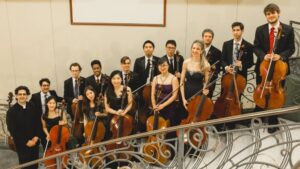
Led by local Israel-American cellist Amit Peled, the Mount Vernon Virtuosi aims to inspire people beyond musical enjoyment.

Container vegetable gardening is a terrific option for people with limited space and/or time. Rebecca Brown and Norman Cohen share some tips.