
Tell Baltimoreans that you’re travelingto Pittsburgh, home of the rival Steelers, for anything more than a footballgame and you’ll either hear “Why?!”or “Oh, I love Pittsburgh!”
I fall into the second of those camps,having first discovered the Steel City almost 20 years ago while visiting afriend there. I’ve made several trips back, and every time I find more to like.
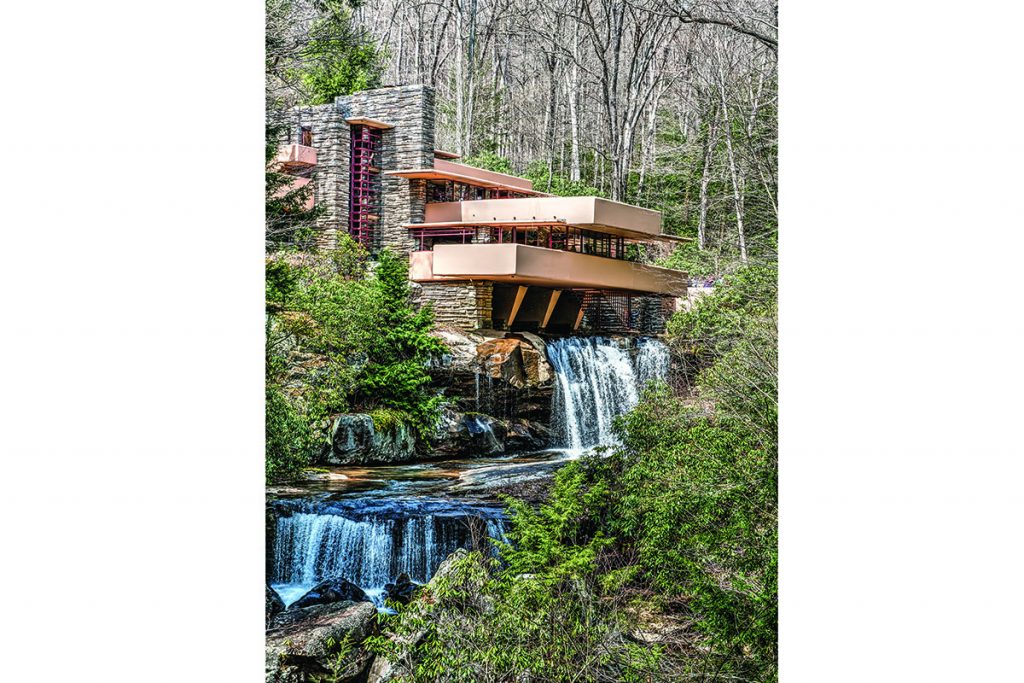
As an architecture buff, I recently visited the Frank Lloyd Wright-designed homes of Fallingwater and Kentuck Knob. Located in Pennsylvania’s Laurel Highlands, these homes draw millions of visitors annually from around the world. Fallingwater was built as a weekend home for the proprietors of Kaufmann’s, the family-owned, upscale Pittsburgh department store. Designed in 1935, Fallingwater’s construction began a year later and the house is considered “one of the 12 landmarks that will change the way you see the world,” according to Travel+Leisure magazine.
As the name suggests, Fallingwater isset over a waterfall, which was the focal point of the family’s weekendactivities from 1937 until 1963 when Edgar Kaufmann Jr., son of the originalowner, donated the house, its contents and grounds to the Western Pennsylvania Conservancy.
Fallingwater was used as a retreat,designed and furnished in such a manner to draw the family and its guestsoutdoors rather than have them cocoon inside the home. Down the road is anotherWright-designed house that was intended — and used — as a full-time familyhome. Kentuck Knob was the residence of Bernardine and I.N. Hagan, friends ofthe Kaufmanns who fell in love with Fallingwater. They contacted Wright andasked if he would design a house for them as well. Then 86 and working on the GuggenheimMuseum in New York, Wright told the Hagans that he could “shake it out of hissleeve at will.”
Wright actually never set foot on the80-acre mountainside site except for a brief visit during the construction.Kentuck Knob was one of the final homes completed by the great architect andrepresentative of his Usonian style — typically small, one-story houses that,like Fallingwater, maintain a strong visual connection between the interior andexterior spaces.
With my mission to finally see these landmark homes realized, it was on to Pittsburgh itself. Our first stop was the Strip District, a one-half square mile northeast of downtown Pittsburgh. “The Strip” is a neighborhood of reclaimed warehouses and industrial spaces that now house shops, restaurants, nightspots and a weekend flea market. One of my favorite shops in the district is Penzeys Spices. If you need a spice (or didn’t even know you needed a spice), this is the place for you. On the other end of the taste bud spectrum is Mon Aimee Chocolat, a veritable worldwide tour of chocolates in one hopelessly adorable shop.

Not far from The Strip is theneighborhood of Lawrenceville, home to numerous antiques shops and home designboutiques. While browsing, a local told us not to miss the Allegheny Cemetery,one of the city’s largest, oldest and most picturesque final resting places.More than 125,000 dead are interred on the grounds of the 300-acre rural gardencemetery, among them composer Stephen Foster, actress Lillian Russell Moore,Civil War General Alexander Hays, Thomas Mellon and 22 Pittsburgh mayors.
From the cemetery, we stopped in at theSociety for Contemporary Craft, an exhibition space and gallery, and theMattress Factory, an installation space featuring artists from around theworld. Then, it was off to Point State Park. If you get the chance, drop by theThree Rivers Arts Festival at Point State Park, which will be held this yearfrom June 7 to 16.
While the festival is an annualgathering, the park — which preserves the historic heritage of the area duringthe French and Indian War (1754-1763) — is worth a visit on its own for its36.4 acres with paved riverfront promenades, beautiful views, 150-foot fountainand large grassy area (which is an ideal spot for relaxing in the middle of thecity).
After a quick dinner on the run, it wasoff to the Duquesne Incline for a quintessentially Pittsburghian activity.Along the wooded slopes of Mount Washington are restored cable cars that havetransported commuters since 1877. Ascend the incline for a panoramic view ofthe city — when dusk turns into nightfall is the ideal time as the city skylinelights up — and take a few minutes before going back down to look at thepictorial history of Pittsburgh. There aren’t many inclines like this left in thecountry, so don’t miss this opportunity.
For our final treat of the visit, we enjoyed a “nightcap” at the MilkShake Factory, founded in 1914 and still family-run. With more than 50 flavors of ice cream and shakes to choose from, you can be there a while. Samples are encouraged, and after a few (well, quite a few), the winner of the evening was a scoop of red velvet ice cream.
Of course, there’s a lot more to do in Pittsburgh — from the Andy Warhol Museum to the Carnegie Science Center to the Phipps Conservatory and Botanical Gardens, as well as neighborhood walking tours, boat rides and, of course, any of this sports-mad city’s professional teams — and all only approximately four hours away from Baltimore.
For information, go to visitpittsburgh.com.

The BCO, founded in 1984, will perform the works of Frank Zappa, Beethoven, Mason Bates and Karena Ingram.

Led by local Israel-American cellist Amit Peled, the Mount Vernon Virtuosi aims to inspire people beyond musical enjoyment.

Container vegetable gardening is a terrific option for people with limited space and/or time. Rebecca Brown and Norman Cohen share some tips.

Filmmaker Justin Schein looks at wealth and inequality through the very real story of his late father.