
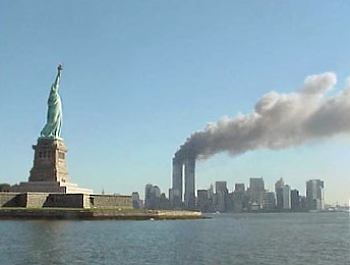
Eighteen years ago today, Sept. 11, 2001, in the shadow of mass murder witnessed by all on television, the mayor and the police commissioner announced a press conference at Baltimore City Police headquarters.
The mayor was Martin O’Malley. He’d just gotten on the NewJersey Turnpike, heading to New York to meet his brother, when he took a phone callfrom a police detective telling him, “You might want to turn on the radio. Theythink a plane crashed into a big building in Manhattan.”
“How bad?” O’Malley asked.
“They don’t know,” the detective said, “but there’s a bighole and a lot of smoke. Lord knows how they’re gonna get the fire out up thathigh.”
A car radio helped sketch in more details. O’Malley turned the car around and headed home, beginning to understand that the whole world was changing. When he got to police headquarters here, he found Commissioner Edward Norris, a New York native and a 20-year veteran of the New York Police Department, at his desk and staring at a TV, repeating mournfully, “I can’t believe they brought down the twin towers.”
I was in the old Sun newsroom on Calvert Street when they announced the press conference at police headquarters. I drove down Guilford Avenue to Baltimore Street into complete gridlock.
People were leaving their jobs, getting out of downtown as fast as possible. The twin towers were down in New York, and now the radio was reporting bomb threats in Baltimore. Who knew what to believe?
I found a parking spot on Guilford Avenue and ran down to police headquarters, where an officer at the front door wore riot gear and carried a sub-machine gun. His name was William Harris, from the SWAT team.
Inside, on an intercom, a voice declared, “All personnel – police and civilians – must display identification in the building.” How about that? Suddenly, police veterans who’d known each other for years had to formally identify themselves.
A few dozen reporters and photographers gathered in a crowdedconference room. O’Malley and Norris were about to make some kind of statements,but what kind? A sense of urgency filled the room. Then a TV reporter, fromWMAR, went up to O’Malley and asked, in a whispery voice, if the mayor mighthold off the proceedings.
“Because my camera crew isn’t here yet,” she explained.
At such a moment of national anxiety, it felt like a radio reporter approaching President Franklin Delano Roosevelt after Pearl Harbor to say, “I know you’re about to make that little ‘date which will live in infamy’ speech of yours, but could you hold off for a while for my broadcast crew to get here?”
Norris opened the press conference moments later. Peopleshould stay calm, he said. This is Baltimore, and not New York. What aboutreports of bomb threats? Norris shrugged. Bomb threats were routine business onthe best of days, he said, but there was no indication of organized Baltimoretargets.
“The SWAT teams and the Uzis at the front entrance,” another reporter said. “Are they an overreaction?”
“I don’t know,” Norris said. “What do you think?”
Nobody knew what to think, not even the police.
O’Malley offered words of calm. His voice had a studied reasonableness to it, an implicit message that said: This is Baltimore, not New York. It’s Baltimore, not the Pentagon.
And in a few minutes, because there was nothing more anybody could say, the press conference was over. I walked back to my car, past a traffic cop named Renee Holmes, standing in the middle of the street. But there was no traffic. Every car was gone, and no people walking about, and downtown felt utterly empty. My car was the only one parked on what had been a packed block. And my meter had run out.
“You don’t have to worry about that,” the traffic cop said.
There were bigger concerns now, much bigger.

A former Baltimore Sun columnist and WJZ-TV commentator, Michael Olesker is the author of six books, most recently “Front Stoops in the Fifties: Baltimore Legends Come of Age” (Johns Hopkins University Press).
At its annual meeting this year, the Baltimore Jewish Council will honor the late Harford County educator and longtime Holocaust education champion.
The former Colt, who passed away on May 25 at age 93, achieved immortality during a cold December day in 1958, writes Michael Olesker.
A new biography on the creator of "Doonesbury" misses the mark, writes Michael Olesker.
What does it mean to be fully present with each other and the sacred, asks Maryland-born cultural anthropologist Alanna E. Cooper.