
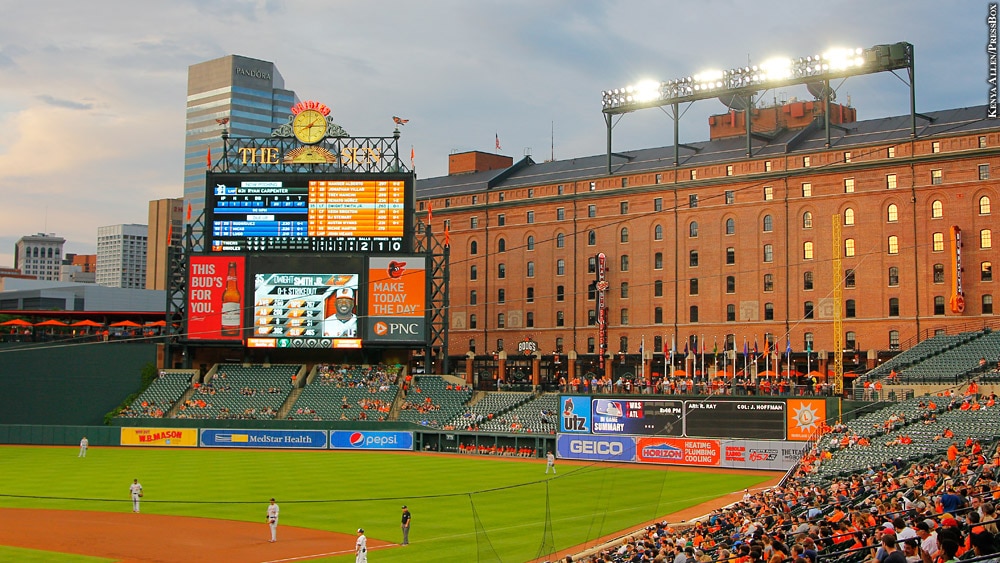
As the Orioles of Baltimore enter the final weekend of the 2019 season, they’ve already lost 107 ballgames, the second-worst record in all of Major League Baseball.
But that’s not the worst number of the year.
Their pitchers have given up more than 300 home runs, which is a Major League record by far.
But it’s not the worst number of the year.
The team’s collective earned run average is 5.65, which isworst among all 30 major league teams.
But it’s not the worst number of the year.
No, that distinction belongs to 1.3 million, which is theOrioles’ home attendance for 2019.
That’s the worst number of the year.
And it’s not even an accurate one. Night after night, as theOrioles’ attendance is announced as some embarrassingly low figure somewheresouth of 10,000, it’s actually lower than that.
The announced figure is the number of tickets sold, which includes lots of folks who buy tickets in advance but don’t actually show up. There have been nights when it looked as if the real attendance was somewhere in the previously inconceivable hundreds.
And that’s not only the worst number of the year, it’s producedthe most anxiety.
This week, John Angelos said something comforting and lovely in the face of that anxiety. He’s the son of principal owner Peter Angelos, and he’s the ballclub’s new voice of authority.
Speaking to a crowd of local business leaders on Thursday, Sept. 26, Angelos said the Orioles would stay in Baltimore “as long as Fort McHenry is standing watch over the Inner Harbor.”
That’s the sound of music to fans who have grown anxiousabout the team’s future. The anxiety’s based, in considerable measure, on homeattendance. Everybody remembers what happened to the Bob Irsay Colts.
Partly, too, it’s based on the team’s lease at Camden Yards,which expires after the 2021 season, and the ongoing dispute with theWashington Nationals over TV revenue, and the declining health of Peter Angelos.
So it’s very nice to hear John Angelos’ words – up to a point. And that point is ownership of the club. As Angelos points out, he’s a Baltimore lifer, and so are other investors.
As long as they own the Orioles, the club’s not going anywhere. But it’s also a fact that there has been talk – a lot of it within the Angelos family – about whether or not to sell the team. And Angelos has not addressed that subject — at least not in public.
If the family sold the team, would there be a Baltimore group to step forward to assure the Orioles stay here? Because if some out-of-town group stepped in and looked at that 1.3 million attendance figure, then all bets are off.
So John Angelos hit the precise note Orioles’ fans want to hear when he said they’ll be here as long as Fort McHenry. But if the ballclub were to be sold, then it’s no longer his call – or his family’s.
What we need to hear is the future of ownership. Theballclub’s record will get better. Bigger attendance should follow. But who’sgoing to own the team? There’s the question still awaiting a precise, assuring,long-term answer.

A former Baltimore Sun columnist and WJZ-TV commentator, Michael Olesker is the author of six books, most recently “Front Stoops in the Fifties: Baltimore Legends Come of Age” (Johns Hopkins University Press).

At its annual meeting this year, the Baltimore Jewish Council will honor the late Harford County educator and longtime Holocaust education champion.
The former Colt, who passed away on May 25 at age 93, achieved immortality during a cold December day in 1958, writes Michael Olesker.
A new biography on the creator of "Doonesbury" misses the mark, writes Michael Olesker.
What does it mean to be fully present with each other and the sacred, asks Maryland-born cultural anthropologist Alanna E. Cooper.