
By Rona S. Hirsch
For lifelong movie lovers like me, one of the benefits of being locked away during this pandemic has been the gift of time to watch and rewatch classic films.
And by classic, I don’t mean the 1980s. I treasure movies dating back to the 1930s and ‘40s.
So while organizing a long-forgotten container in the back of my closet, I was thrilled to come across the audiotape of my interview with screen legend Kirk Douglas that took place two dozen years ago.
It was a bittersweet coincidence that I discovered the tape during the month of his first yahrzeit. One of the few surviving stars of Hollywood’s “Golden Age,” Kirk died last year on Feb. 5 at age 103.
As I replayed the tape — which I had not heard since 1997 — I savored every word of our very candid conversation in his New York hotel suite on an early Sunday morning shortly before Rosh Hashanah.
Every now and then, journalists like myself who do not exclusively cover arts and entertainment are given the opportunity to interview celebrities — from local TV personalities and beloved comedians to novelists, poets, musicians, filmmakers and actors.
I admit I have always been unabashedly starstruck, although I was accustomed to being around the up-and-coming during my youth. My mother, then an aspiring playwright, studied theater under legendary acting coach Stella Adler. Our Bronx apartment was often filled with young actors and would-be directors. My mother’s parties were social events that Adler herself once attended. Elegant and sophisticated, Stella — as everyone called her — chatted with me in our dining room when I was just 17.
Over the past three decades, I’ve interviewed scores of celebrities, including Academy Award winners Jon Voight and Matthew McConaughey, both of whom were extremely warm and gracious.
But no celebrity interview would be as meaningful to me as my meeting with Kirk Douglas.
Instant Connection
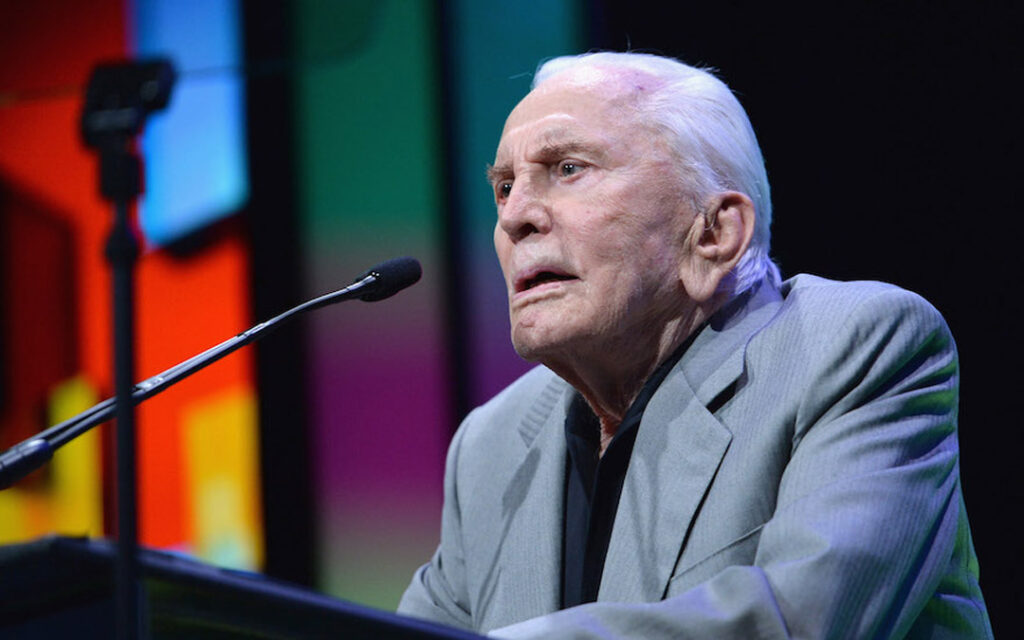
Throughout his long career, Kirk appeared in more than 80 films, including the epic “Spartacus.” A three-time Academy Award nominee, he was honored by the Kennedy Center for the Performing Arts in 1991 and the Academy of Motion Pictures in 1996.
In 2016, director Steven Spielberg spoke at Kirk’s 100th birthday celebration.
“I’ve worked with the best of them,” Spielberg said to Kirk. “But you’re the only movie star I’ve ever met.”
I can relate.
At the time of my interview, I was a reporter for a local publication and was sent the galleys of “Climbing The Mountain: My Search for Meaning.”
In the book, Kirk detailed his spiritual journey following a helicopter crash in 1991 that left two people dead and nearly killed him. He sustained back injuries that compressed his spine. Five years later, he suffered a speech-impairing stroke.
I managed to get on his packed schedule at the outset of his press junket promoting the book, the day before he appeared on “The Tonight Show” with Jay Leno.
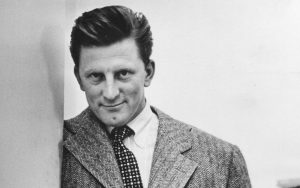
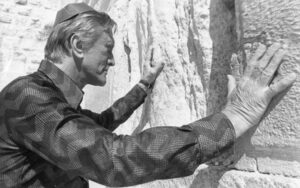
In anticipation, I was on a high for days, fascinated by his backstory. Kirk was born Issur Danielovitch on Dec. 9, 1916, in Amsterdam, New York. Raised in an impoverished Orthodox home with his six sisters, Kirk adored his pious mother, attended cheder, delivered his bar mitzvah speech in Yiddish and led Friday night services at his synagogue. His community wanted to send him to yeshiva to continue his studies, but acting beckoned.
After his accident, Kirk embarked on a spiritual journey and rediscovered the Torah, studying with an Orthodox rabbi he brought in every six weeks from Israel for nearly a year, and then with a Los Angeles outreach rabbi as he prepared for a second bar mitzvah for his 83rd birthday.
After arriving at the posh Sherry-Netherland on Fifth Avenue, I stood at the hotel desk and could not believe the words that came out of my mouth: “I am here to see Kirk Douglas.”
Directed to his room, I swallowed hard as I knocked. The door opened and there he stood. At age 80, Kirk’s handsome looks had faded but his signature cleft chin, piercing blue eyes and unmistakable grit in his voice were intact.
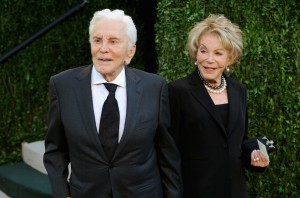
For more than an hour, I peppered him with questions about his youth, the book and his spiritual quest while his second wife, Anne, slept in the adjacent bedroom.
The interview went beyond what I expected. We instantly connected. I told him I was Orthodox, and he was impressed I had been a Judaic studies teacher for many years before studying journalism.
To my surprise, Kirk was contemplative and insightful, even philosophical. And we laughed often at his stories.
I felt a bond with him that no other reporter could have possibly experienced as we discussed his intense Torah study, fluency in Yiddish, mezuzot in his Beverly Hills home, Jewish unity, his joy in singing Shlomo Carlebach melodies at a Friday night minyan and how he led Shabbat services for Jewish sailors aboard a U.S. Navy cruiser while filming “In Harm’s Way” with John Wayne and Henry Fonda.
We spoke about the failings of Jewish education in the early 20th century and Kirk’s regrets over not exposing his four sons to Judaism, including Academy Award-winning actor Michael Douglas.
A prolific author, Kirk had written a dozen books. I asked him what motivated him to write “Climbing The Mountain.”
“All I want to do is to be able to express my thoughts in the hopes that through my book, Jews will be more proud of their heritage and start to look at it a little bit,” he said. “… I just want them to be Jews, to say, ‘I am a Jew.’ ”
He planned to continue his regular Torah studies that had been interrupted to promote his book.
“I want to know how much I can know because I find it very, very exciting, and I want to make up for lost time,” he said.
I asked how his spiritual journey had affected his everyday life.
“Belief in God makes you a better person,” he said. “Most of us are too wrapped up with our lives. I was making three movies a year; I didn’t think enough about other people. My goal now is just to function in a better way.”
Lana, Lancaster and Loving Mezuzot
I was equally curious about his commitment to lighting Shabbat candles for the past two years. “It’s very important to me,” he said. “It reminds me of my mother.”
To my surprise, he even lit candles when he traveled. I asked to see them and he retrieved a pair of sterling silver candlesticks purchased in Israel from his bedroom.
I also asked if a mezuzah hangs on his front door.
“Of course,” he said. “I have had that on and off for some time. But now I make sure I have a mezuzah on the entrance and to my room.”
Throughout his life, Kirk said, he attended High Holiday services if he wasn’t filming a movie.
“But I always fasted on Yom Kippur, whether I was working with Burt Lancaster or making love to Lana Turner on a movie set,” he said.
I limited our discussion of his movies to the two filmed in Israel. I told him that one of my favorites is “Cast A Giant Shadow” about U.S. Army Reserve Col. David “Mickey” Marcus, who was recruited by Israel to command units in 1948.
I asked Kirk if he saw himself in Marcus. “Well, a little bit because Mickey Marcus found his Judaism in Israel [as did I],” he said.
He expressed concern about the divisiveness in the Jewish community and took issue with Orthodoxy’s rejection of patrilineal descent in determining whether a child is a Jew.
“I have many complaints with the ultra-Orthodox,” he said. “Michael has helped many Jewish causes. He actually said to a rabbi, ‘Yeah, but you won’t consider me a Jew.’ That is because his mother [actress Diana Dill] wasn’t a Jew. ‘You want my help, but you won’t say that I am a Jew.’ He’s right.”
Because the interview was before Rosh Hashanah, I asked Kirk if he had made any resolutions for the coming year.
“Of course I have, but I’m not going to tell you,” he said. “I’m only making a resolution to God and to myself.”
Kirk then stood behind me, tapped my notebook and asked, “So do you have enough now to write your book about me?”
I laughed and told him, “Almost.”
He, too, laughed. “Writers never have enough,” he said.
Maccabean Mishap
About to leave, I made the mistake of honoring my editor’s request of asking Kirk if he would ever consider taking a small role in the editor’s planned (but never realized) animated movie of the Chanukah story and the heroic revolt of the Maccabees.
Highly insulted, Kirk questioned how many movies my editor had produced.
“I am surprised at you!” he said, as if we were dear old friends and I should have known better than to suggest he appear in an amateur’s production.
I apologized repeatedly and profusely, but remained hopeful that my article would erase all memories of that absolutely awful moment. However, due to a production mishap, the finished article about my time with Kirk contained many errors.
I was crushed. I cried and cried.
My favorite managing editor ordered me home to rest and keep off any upcoming assignments for a while. Fellow staffers thought I was simply cracking up. And for a few moments, I was. I put so much effort into getting Kirk’s story right — Leno only questioned him about Michael.
But I took comfort when one Baltimore synagogue distributed copies of my Kirk story to its congregation as an inspiration for repentance, highlighting a passage from “Climbing The Mountain”:
“A part of me is saying, ‘Wait a minute, you are becoming too Jewish. Stop!’ And then another part of me kicks in, saying, ‘Don’t be afraid. Keep going, keep going.’ ”
Looking back, I take great pride in capturing the portrait of a Hollywood legend who could have long ago shed all hints of his heritage. But Kirk always hung on and, like many Jews, eventually returned to his religion and its rich traditions to find meaning and fill an aching void.
For the celebrated Kirk Douglas, not even an Academy Award could do that.
Rona S. Hirsch is a freelance writer living in Baltimore.
- Check out Kirk Douglas and Burt Lancaster in their humorous musical duo at the 1958 and 1959 Oscars.
- See Kirk Douglas perform with musical friends on the Jack Benny Program in 1955.

The Jerusalem Orchestra East & West, which arranged the program for young musicians, blends Western orchestral music with Middle Eastern traditions.

Pikesville resident and entrepreneur Luna Rosendorff discusses what she's seeing these days in the world of contemporary interior design.
Jewish Community Services' upcoming "Future-Ready Workplace" event will feature a keynote address from workplace expert and bestselling author Liz Fosslien.
The BCO, founded in 1984, will perform the works of Frank Zappa, Beethoven, Mason Bates and Karena Ingram.