
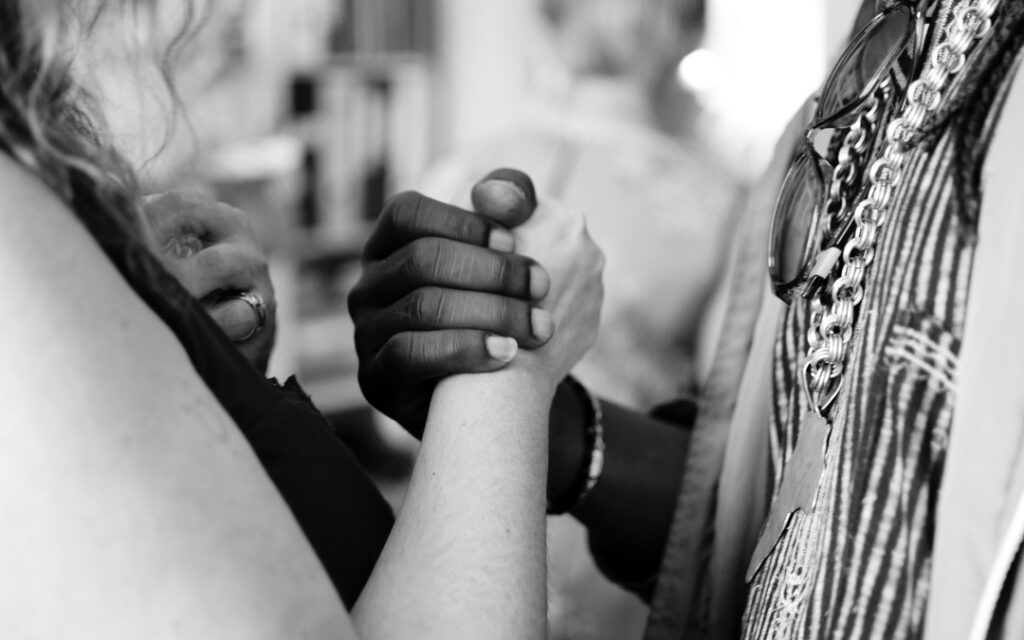
As I wrote this column, Minnesota was waiting for the results of the Derek Chauvin trial after his lynching of George Floyd, even as that state and the country were once again reeling from the murder of another unarmed Black man.
And in Virginia, a uniformed Black and Latino man was shown the business end of a deadly weapon and pepper-sprayed after officers failed to notice his lawfully displayed temporary tags.
Vaccine access remains challenging for communities of color who, frequently experiencing victim-blaming, are labeled “hesitant” when hesitancy among white evangelicals outpaces any other demographic.
Justice in America is elusive as always. I’ve written for this column on relational justice which I define as the linchpin of social justice.
My contention is that without relational work, addressing policy as a lasting solution to injustice is illusory. From slavery to reconstruction to Jim Crow to redlining to mass incarceration and police brutality, human beings have a way of ignoring, undermining and sabotaging progress as we nurture the inexhaustible human proclivity to scapegoat, marginalize and harm the other.
Systemic solutions must be fought for and achieved. But hateful policies will always prevail when there are hateful people calling the shots.
Recently, I heard Terry Gross (Fresh Air) interview Palestinian cookbook author Reem Kassis. Kassis told this story: When she published her first book, she sent a copy to her fellow Philadelphian, Michael Solomonov, noted chef of Zahav, the James Beard Award-winning restaurant. Along with the book, she shared her story of eating at his restaurant years earlier and having both positive feelings about the food — which reminded her of her mother’s cooking — and somewhat negative feelings about why the best Palestinian cuisine she had tasted in America was being served in an Israeli restaurant.
Solomonov was touched by her story and invited her to meet for coffee. The two became friends. Kassis had assumed that as the “face of Israeli cuisine,” Solomonov must be anti-Palestinian or at least deny the origin of the food he serves.
It turns out this wasn’t the case at all. “Once you get to know someone on an individual level,” she said, “you realize how many misconceptions you probably hold of that person.”
Simply getting to know someone (or multiple someones) of a different race or nationality doesn’t bring about justice. There’s always the danger of tokenism, thinking a person is exceptional, viewing that person as, in the words of local activist Dayvon Love, a “special negro” instead of a “helpless negro.” Both, of course, are deeply problematic.
Michael Solomonov or Barack Obama are exceptional people, to be sure. But if they are exceptional as a Jew or an African American, we’ve missed the point. Just how many people from another identity group does one have to know to avoid tokenism?
That’s not really the issue. In their lives, most men and boys know multiple women and girls quite well, yet sexism is hardly vanquished. The difference between inclusion and diversity is “how” we know, not “whom.”
But here’s what I think is clear: There are far too many folks in Baltimore, Maryland and the United States who have neither the opportunity nor the inclination to do the work of relational justice. What’s the outcome? In her book “The Sum of Us,” Heather McGhee points out that when white communities around the country were forced to integrate their public swimming pools, many of them drained their pools rather than comply.
When the enfranchised and disenfranchised don’t know one another, when those with power don’t have relationships with those who have been stripped of power, they will often hurt themselves rather than help someone else. That, of course, erodes our essential and shared humanity, hurts everyone to some degree and helps no one.
The Talmud (Ta’anit 23a) underscores both the importance and high stakes of relationship building when it teaches “either relationship or death.”
That humans are social beings is no surprise. That those relationships can be the instrument of our collective salvation is a fundamentally Jewish teaching. Why relational justice? Because relationships and the empathy they foster are an essential ingredient in the recipe for achieving sustainable pro-social change.

Rabbi Daniel Cotzin Burg is spiritual leader of Beth Am Synagogue in Reservoir Hill, where he lives with his wife, Rabbi Miriam Cotzin Burg, and their children, Eliyah and Shamir. This column and others also can be found on The Urban Rabbi. Each month in Jmore, Rabbi Burg explores a different facet of The New Jewish Neighborhood, a place where Jewish community is reclaimed and Jewish values reimagined in Baltimore.

Fairness and failure walk a fine line in the pursuit of justice, writes Rabbi Daniel Cotzin Burg.

Rabbi Daniel Cotzin Burg of Reservoir Hill's Beth Am Synagogue has been thinking a lot about how Jews with white skin ought to feel about their whiteness.

When we find the world is burning, we don’t have the right to simply give up, writes Beth Am's Rabbi Daniel Cotzin Burg.
Should those who live in cities make a Faustian bargain to fight the tide against urban life, asks Rabbi Daniel Cotzin Burg.