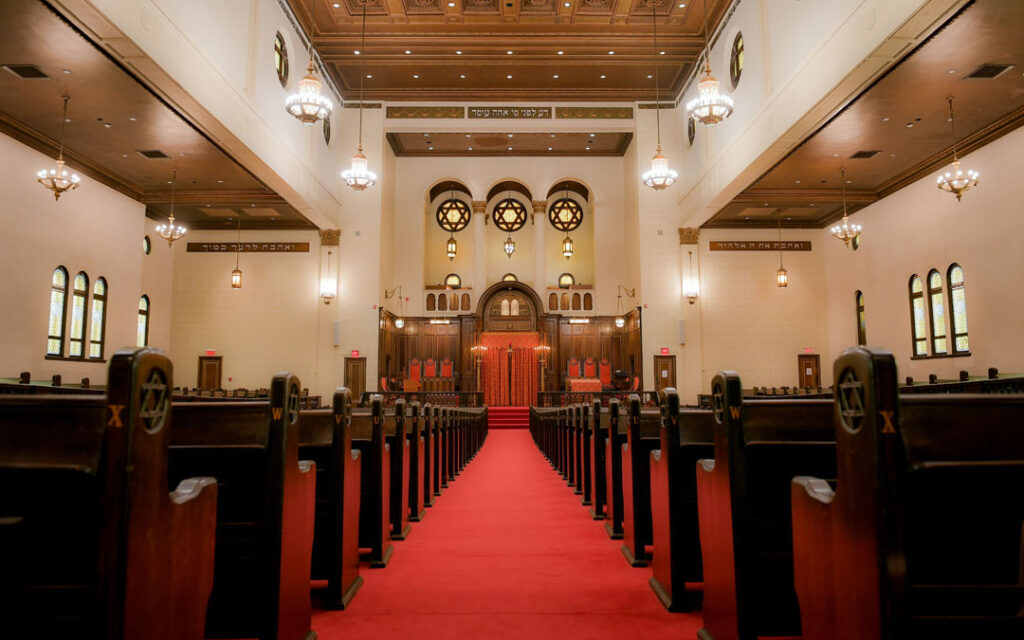
This is the first installment of a three-part series on the pandemic’s impact on Jewish congregational life.
Innovation is more than simply a buzzword right now. Post-pandemic, it’s the way forward for commerce, education, technology, community-building and every other aspect of our lives.
Especially our spiritual and religious lives.
Still, most American Jews would rarely put the words synagogue and innovation in the same sentence.
The COVID-19 pandemic forced synagogues across the country and world to do a hard pivot. Those that were not previously streaming services – a prime example of innovation – had to learn the hard way how to do it after their synagogues shut down.
What lessons will the leadership of America’s Reform and Conservative congregations take away from the global pandemic? As synagogues begin to reopen and hold in-person services and gatherings, how will they consider integrating streaming technologies into the post-pandemic environment?
These are hard questions for synagogues to consider as well as about growing membership, articulating values and taking a hard look at the effectiveness and resiliency of a congregation’s business model.
Even in the best of times, synagogues are complex, nonprofit religious institutions that can be challenging to successfully run, let alone grow.
How do I know? I grew up in a large Conservative synagogue in Tucson, Arizona, as the son of a rabbi (who is now retired).
In its heyday in the 1980s, Congregation Anshei Israel had more than 1,000 member families. That’s a big synagogue. I saw firsthand what worked and what did not, and had an inside view into the eco-system of a modern American shul.
After I moved to Baltimore for college, got married, had children and was well into my career, I enjoyed the honor of serving on the board of Har Sinai Congregation, which then billed itself as the “oldest continuously Reform congregation in America” prior to its merger with Temple Oheb Shalom (now Har Sinai-Oheb Shalom).
If our synagogues are to survive and thrive in the future, we need a new model. COVID-19 may well be the force that brings about change – and innovation – to the traditional synagogue model.
Yes, innovative ideas come with tough questions: How can an online model co-exist for a synagogue that will attract paying members from around the country? Will a diverse demographic and geographic group of Jews be content with ‘shul-by-Zoom’ and streaming?
For answers, I went to the data.
Baltimore at Its Best
Baltimore is blessed with many dynamic and wonderful synagogues from every branch of Judaism. Some of the country’s most dynamic Conservative and Reform congregations came of age here in Charm City.
We’ve had many clergy in our community who inspire us to become better human beings and more compassionate Jews. Rabbis Joel H. Zaiman, Seymour L. Essrog and Mark G. Loeb, all of blessed memory, defined what it meant to be a leading Conservative rabbi in America. Meanwhile, Rabbis Floyd L. Herman and Gustav Buchdahl (both now retired) are two beloved Reform spiritual leaders who made lifelong friendships with congregants and epitomize the menschlichkeit that everyone would want in a rabbi.
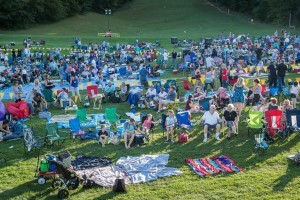
Perhaps the most innovative synagogue program in recent local history is the annual “Rosh Hashanah Under the Stars,” hosted by Baltimore Hebrew Congregation for the entire community at Oregon Ridge Park in Cockeysville. It’s an inspiring event: hundreds upon hundreds of Jews enjoying dinner erev Rosh Hashanah, spread out on blankets and beach chairs in an open meadow, all taking part in the evening service on Jumbotron-sized monitors.
Now in its 14th year, the 2020 event was virtual and cleverly retitled, “Rosh Hashanah Under Your Stars.” This smart, innovative program included its own website for at-home participation.
What the Numbers Say
Every decade, The Associated: Jewish Federation of Baltimore partners with the Cohen Center for Modern Jewish Studies at Brandeis University to conduct a comprehensive community study. The findings relating to affiliation with a particular branch of Judaism — and most importantly, synagogue membership — are illuminating.
According to the 2020 study, “the Baltimore Jewish community consists of approximately 46,700 households that are home to 115,400 individuals, including 95,400 Jews (74,900 adults and 20,500 children) and 20,000 non-Jews (18,000 adults and 2,000 children).”
Of these:
• 21% identify as Orthodox;
• 19% identify as Conservative;
• 18% identify as Reform;
• 3% identify as other denomination;
• and 39% have no particular denomination.
The surprising piece of data? That one-third of community members (approximately 15,000 adults) belong to a synagogue.
Were you expecting it to be higher?
“40% of Jewish adults live in synagogue-member households, similar to the rest of the country,” the study reveals. Interestingly, only 27% are dues-paying members of “brick-and-mortar” synagogues.
The study states that these traditional synagogues that have buildings, conventional dues structures and professional clergy “usually appeal to a relatively narrow range of the denominational spectrum.” Other congregational types are defined as “independent minyans or havurahs, High Holiday congregations, and Chabad.”
• 53% are members of Orthodox congregations;
• 31% are members of Conservative congregations;
• 18% are members of Reform congregations;
• and 1% are members of synagogues of other denominations.
If you focus on those unaffiliated with a local congregation, the numbers are staggering: 60% of Jewish households in Baltimore simply DO NOT BELONG to a synagogue.
Why? The answers are complex. Perhaps they are too expensive or families no longer see value in being involved as their children grow up.
Or is the overall experience simply lacking (and lacking in innovation) to keep up with the needs of the modern family?
Downward Trend
It’s hardly news that across the spectrum, religious membership in the United States is trending downward. In March 2021, Gallup released the results of a 2020 poll that showed “the proportion of Americans who consider themselves members of a church, synagogue, or mosque had dropped below 50 percent to 47 percent.” Interestingly, Gallup “also found that the number of people who said religion was very important to them has fallen to 48%, a new low point in the polling since 2000.”
This trend has great significance for synagogue affiliation in Baltimore. In the second part of this series, I’ll explore a pair of local synagogues that streamed services prior to COVID-19 and share a personal experience of why I needed to find a West coast synagogue that streamed its services prior to the pandemic.
What does it mean to be fully present with each other and the sacred, asks Maryland-born cultural anthropologist Alanna E. Cooper.
As millions mourn the passing of Stephen Colbert from the airwaves, Michael Olesker looks back on the "institution" of late-night TV.
As he gets ready to leave for California, Rabbi Daniel Cotzin Burg looks back on his time in Baltimore and his 10 years writing for Jmore.